Corrugator Muscle Botox: Your 2026 Guide to Frown Line
Those vertical lines between your brows usually don't show up all at once. These lines become apparent in ordinary moments. In the car mirror. On a video call. While washing their face at night. At first, the lines only appear when they concentrate or squint. Then one day, the “11s” seem to stay put even when the face is at rest.
That change is often tied to one small but powerful facial muscle: the corrugator. When it contracts again and again, it pulls the brows inward and down, folding the skin in the same place over time. If the muscle is strong, the lines can start to make you look tense, stern, or tired even when you feel perfectly relaxed.
Corrugator muscle Botox is designed for exactly this problem. It doesn't erase personality or wipe out expression. Done well, it softens the overactive pull that creates frown lines while still letting your face look like you. The skill is in knowing where the muscle sits, how strongly it moves, and how to treat it without affecting nearby muscles that help support the eyelid and brow.
The Story Behind Your Frown Lines
A common concern in clinic sounds like this: “I'm not upset, but I look upset.” That's the frustration behind glabellar lines. Patients aren't usually asking for a dramatic change. They want their face to stop sending the wrong message.
The main driver is the corrugator supercilii, one of the muscles involved in frowning. When it contracts, it pulls the brows inward. Over time, that repeated movement creates the vertical lines between the eyebrows that people call the “11s.” Some people also recruit the nearby procerus muscle, which adds a downward pull at the root of the nose and central brow.
Botox has been central to treating this area for a long time. Botulinum toxin type A reached a major cosmetic milestone in 1992, when the first systematic study showed efficacy for glabellar rhytides, and by 2019 it accounted for 47.2% of the 16.3 million minimally invasive cosmetic procedures performed in the U.S. according to this upper-face botulinum toxin review.
That long track record matters. It tells patients this isn't a trend treatment. It's one of the most established procedures in aesthetics.
Why these lines often bother people so much
The glabella is a small area, but it changes expression quickly. A slight inward pull can read as stress, irritation, or fatigue. That's why this treatment often has an emotional effect as much as a cosmetic one. People don't necessarily want to look different. They want to look more like themselves when they're rested and at ease.
Softening frown lines isn't about chasing a frozen forehead. It's about removing an expression you didn't intend to wear all day.
What experienced treatment looks like
A practiced injector doesn't look only at the line. They watch the muscle in motion. They ask you to frown, relax, raise the brows, and squint. They pay attention to whether the brows sit low, whether one side pulls harder, and whether the forehead is already compensating.
That level of assessment is where natural results start. At BotoxBarb, that anatomy-first mindset is what separates routine treatment from thoughtful treatment. The product matters, but placement matters more.
Meet the Corrugator Your Frown Muscle
The corrugator is small, but it has a big job. It's one of the muscles that helps create a frown by drawing the eyebrows inward and slightly downward. If you think of the brows as curtains, the corrugators are like two little cords pulling them toward the center.
That simple action is why the area between the brows folds so consistently. The skin creases in the same spot, over and over, until the line starts to linger.

Where the corrugator sits
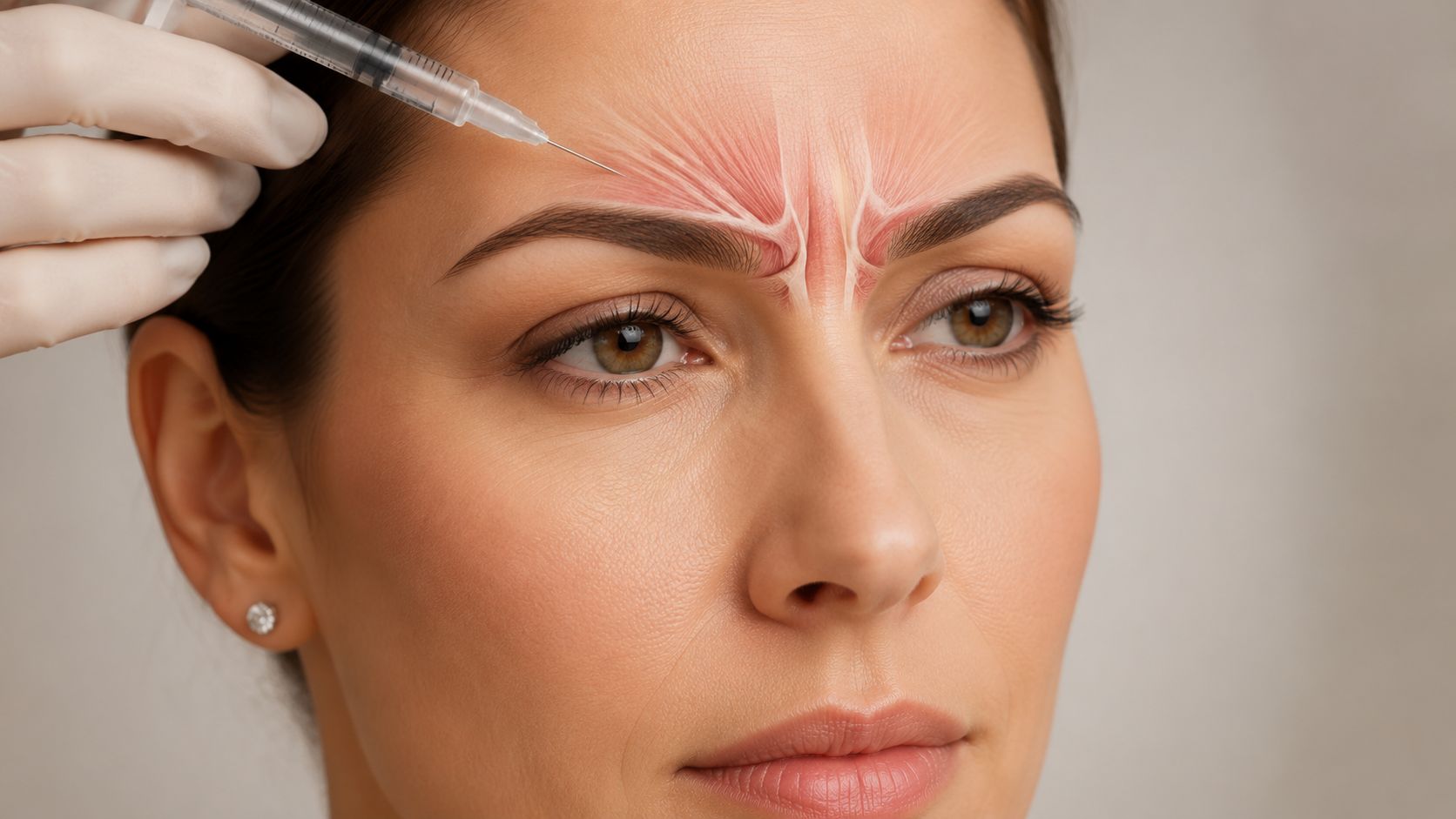
The muscle lives in the glabellar region, between the brows and above the bridge of the nose. It works closely with nearby muscles, especially the procerus and frontalis. That relationship is why treatment can't be approached casually. The injector has to know not only where the corrugator contracts, but also what nearby muscles should be left alone.
If you'd like a broader visual of the upper-face map, this Botox injection sites face diagram helps show how the frown area fits into the rest of the face.
The detail that matters most
The corrugator isn't one uniform strip. That's the part many patient guides leave out. It has a deeper medial segment and a more superficial lateral tail. That means an expert injector often changes depth depending on the exact part of the muscle being treated.
A key reason for seeking an expert injector is the corrugator muscle's complex anatomy. It has a deeper medial segment and a more superficial lateral tail, requiring different injection depths to be effective while avoiding unwanted spread to nearby muscles that control the eyelid and brow, as described in this anatomy review of the corrugator region.
At this stage, real technique comes in.
| Corrugator area | Typical anatomical character | Why it matters |
|---|---|---|
| Medial segment | Deeper, thicker portion | Often treated deeper to reach the active muscle bulk |
| Lateral tail | More superficial extension | Often treated more superficially to limit spread |
| Nearby muscles | Frontalis and eyelid-elevating muscles are close | Poor placement can affect brow position or eyelid function |
A five-point diagram is a starting map, not a substitute for anatomical judgment.
Why this changes your result
If treatment is placed too low, too deep in the wrong spot, or too far laterally, toxin can drift into muscles you don't want relaxed. That's when people worry about a heavy brow or lid droop. On the other hand, if treatment is too timid or misses the main pull of the muscle, the frown lines don't soften the way they should.
So when patients ask why injector choice matters so much in the glabella, this is the answer. The corrugator is small, layered, and close to important neighboring muscles. Good treatment is less about “getting Botox” and more about getting the right depth, right dose, and right location.
How Botox Works to Relax the Corrugator
Botox works like a message blocker. Nerves normally send a signal telling a muscle to contract. When Botox is placed into a targeted muscle, that signal is reduced. The muscle can't squeeze with the same force, so the overlying skin doesn't crease as hard.
For the corrugator, that matters because this muscle is responsible for that repeated inward pulling motion between the brows. When the contraction softens, the skin gets a break. Dynamic lines look less etched, and the area often appears calmer and smoother.
Think of it like lowering the volume
A lot of people worry that Botox means no expression. That isn't the goal with well-planned corrugator muscle Botox. A better analogy is turning the volume down on one overactive speaker, not shutting off the whole sound system.
You should still look engaged, thoughtful, and expressive. The aim is to reduce that repetitive hard pull that creates a stern or pinched look.
What it can and can't do
Botox treats the muscle movement that drives the lines. If the line is mostly dynamic, meaning it appears strongly when you frown, this treatment can make a dramatic difference. If the line has become more fixed in the skin over time, Botox still helps by stopping the repeated folding that keeps carving it in, but the skin itself may need time and good skincare support to look smoother.
That's why patients often do best when they think of Botox as part of a plan, not a magic eraser. First you quiet the motion. Then you support the skin.
Why precision matters here
The corrugator sits in a crowded neighborhood. The challenge isn't just relaxing the right muscle. It's relaxing that muscle without borrowing too much effect from the muscles that help maintain brow and eyelid position.
A precise treatment feels subtle in the best way. Friends may say you look more rested or less stressed. They usually won't say you look “done.”
Your Botox Treatment What to Expect
Most corrugator treatments are quick. The part that shouldn't be rushed is the evaluation beforehand. Good results start with watching the face move, not with reaching for the syringe.
At the appointment, the first step is a conversation. What bothers you most? Do the lines show only when you frown, or are they visible at rest? Have you had Botox before, and if so, did your brows feel natural afterward? Those answers help shape the plan.

The consultation and facial assessment
An anatomy-based visit includes more than checking the wrinkle itself. The injector looks at:
- Muscle strength: Some people have a very strong inward pull and need a different plan than someone with mild movement.
- Resting brow position: A naturally low brow needs a more careful approach than a high brow.
- Asymmetry: One corrugator often pulls harder than the other.
- Forehead compensation: Some patients lift with the frontalis to offset heavy brow depressors.
Before your appointment, it helps to review practical steps in this guide on preparing for Botox.
The standard pattern and the real-world adjustment
For glabellar treatment, there is a labeled baseline. The FDA-labeled BOTOX Cosmetic pattern uses 4 Units/0.1 mL at each of 5 sites, with 2 sites in each corrugator and 1 in the procerus, for a total of 20 Units, according to the BOTOX Cosmetic injection guide.
That's a framework. It is not the whole art of treatment.
The same guide emphasizes safety boundaries. Lateral corrugator injections should stay at least 1 cm above the bony supraorbital ridge, and injections should avoid being closer than 1 cm above the central eyebrow to reduce unwanted spread into nearby muscles.
Where expertise changes the outcome
A skilled injector often treats the medial corrugator with greater depth and the lateral tail more superficially. That adjustment reflects the way the muscle is built. It's also one of the main ways experienced injectors reduce the risk of brow heaviness.
An expert technical guide notes that the lateral tail can be approached about 5 to 8 mm from the insertion point, and using a smaller volume or lower dose laterally can help preserve brow position by limiting diffusion, as outlined in this corrugator and frontalis technique guide.
Practical rule: The same five dots on a diagram can produce very different results depending on depth, angle, and how close the injector gets to the brow-depressing and brow-supporting muscles.
What the injections feel like
The injections themselves are usually brief. Most patients describe them as quick pinches or tiny stings. The needle is fine, and the treatment area is small.
You may see mild redness, small bumps at the injection sites, or a little swelling right after. That usually settles quickly. Some patients bruise, especially if the area is vascular or if they tend to bruise easily in general.
What not to expect
A good corrugator treatment should not make you look blank. It also shouldn't drop the brows when performed thoughtfully. If a patient says, “I still want to look like me,” that's exactly the right goal.
The best appointments are the ones where the injector treats the anatomy in front of them, not the anatomy from memory.
Benefits Risks and Finding Your Suitability
Corrugator muscle Botox can do more than soften a wrinkle. When the overactive frown pattern relaxes, the whole center of the face can look less tense. Patients often say they look more approachable, less tired, or less like they're concentrating all the time.
That said, this is still a medical treatment. A balanced conversation matters more than a sales pitch.
Benefits people actually notice
The cosmetic benefit is straightforward. The “11” lines soften because the muscle creating them isn't contracting as strongly. But the practical benefit is often social and personal. Your resting expression can look more neutral and rested instead of stern.
For people who are starting to see the lines stick around after movement, treatment can also reduce the repeated folding that deepens them over time.
Why dosing isn't one-size-fits-all
This area proves very quickly why cookie-cutter dosing doesn't work. A clinical study of 58 participants found the mean botulinum toxin type A dose used in the corrugator muscle was 7.2 IU overall, with 7.1 IU in women and 7.4 IU in men, while patients with stronger muscle patterns needed higher corrugator doses up to 8.5 IU in this study on muscle strength patterns and botulinum toxin dosing.
That doesn't mean everyone should be treated to those exact numbers. It means the injector should assess the actual strength of the muscle instead of assuming every face needs the same amount.
Common trade-offs and possible risks
There's no honest way to discuss injectables without mentioning trade-offs. The common short-term issues are usually minor:
- Small bruises: The glabella has blood vessels, so bruising can happen.
- Temporary tenderness: The area may feel a little sore the same day.
- Mild headache: Some patients notice a short-lived headache after treatment.
Less common but more frustrating issues usually come down to placement and diffusion:
- Heavy brow feeling: This can happen if nearby muscle balance isn't respected.
- Brow asymmetry: One side may settle differently if the pull wasn't equal to begin with.
- Eyelid or brow ptosis: This is the side effect patients worry about most, and technique is central to reducing that risk.
The biggest mistake in glabellar treatment is treating the wrinkle and ignoring the brow mechanics around it.
Who is usually a good candidate
This treatment often suits adults who have moderate to noticeable frown movement, especially if the area makes them look upset or fatigued. It can also suit patients who want prevention of deeper etched-in lines while movement is still the main issue.
It may not be appropriate for everyone. People who are pregnant, breastfeeding, have certain neuromuscular conditions, or have a history that raises safety concerns need individualized medical guidance before proceeding. A proper consultation should cover all of that before a treatment plan is made.
Aftercare and Enhancing Your Results at Home
Once treatment is done, your job is simple. Don't interfere with the placement. The first day is about letting the product stay where it was intentionally put.
That usually means being mindful rather than nervous. You can go on with the day, but skip the things that add unnecessary pressure, heat, or friction to the area.
A simple aftercare plan
For the first day, most patients do well with the following:
- Stay upright for a while: Don't immediately lie flat or press your face into a treatment table or pillow.
- Avoid rubbing the area: Massaging the glabella right after injections isn't helpful.
- Hold off on hard workouts: Vigorous exercise can wait until the initial settling period has passed.
- Skip excess heat: Saunas, steam rooms, and very hot environments can wait.
- Use gentle skincare: Cleanse and moisturize without aggressive scrubbing.
If you want a more detailed checklist, this Botox aftercare instructions guide is a useful reference.
Supporting the skin at home
Botox treats motion. Your skincare routine supports the skin sitting over that motion. That's where complementary devices can make sense, especially if your goal is not just smoother expression lines but brighter, healthier-looking skin overall.

One option in that category is the BARB N.P. Facial Mask. It's a wireless LED facial mask designed for home use, with a comfortable fit that sits more easily on the face than rigid, awkward devices. It also includes 3 lighting settings for different treatments, which makes it practical for people who want one device that can support different skin goals instead of adding multiple tools to the bathroom counter.
What works well at home and what doesn't
A few home habits complement injectable treatment well:
| Helpful approach | Why it makes sense |
|---|---|
| Consistent sun protection | UV exposure makes lines and texture harder to improve |
| Barrier-supportive skincare | Calm, hydrated skin tends to look smoother and brighter |
| LED support | Can fit into a routine focused on overall skin quality |
| Picking at the area | Not helpful, and can irritate the skin |
| Aggressive rubbing right after treatment | Can interfere with the treated area |
The best home routine doesn't need to be elaborate. It needs to be consistent.
Book Your Personalized Consultation at BotoxBarb
Corrugator muscle Botox sounds simple when reduced to “a few injections between the brows.” In practice, it's one of the clearest examples of why injector judgment matters. The corrugator has a deep medial portion, a superficial lateral tail, and important neighboring muscles that influence the brow and eyelid. Treating that area well takes more than knowing the name of the muscle.
It takes pattern recognition. It takes restraint. It takes understanding when to follow the standard map and when to customize depth and placement for the face in front of you.
That's why a consultation matters. A thoughtful visit looks at how your brows move, where your frown starts, whether your forehead compensates, and what kind of result will still look natural on your features. Some patients need a classic glabellar plan. Others need a more careful adjustment to avoid a heavy look. Those are not small differences.

If you've been noticing that your frown lines linger longer than they used to, or that your resting face looks more tense than you feel, this is a good time to get an expert assessment. You don't need to guess whether you're a candidate or whether your brow anatomy needs a more specific approach. That's what the consultation is for.
The goal isn't to erase your face. It's to soften an overactive pattern in a way that still looks balanced, rested, and like you.
If you're ready to explore treatment options, book a personalized consultation through BotoxBarb. You can also review available aesthetic services and at-home skincare tools in one place before deciding what fits your goals.