Article: Dermal Fillers Cost by Syringe and Area

Dermal Fillers Cost by Syringe and Area
Dermal fillers cost an average physician fee of $715 for hyaluronic-acid fillers, $901 for non-hyaluronic-acid fillers, and $743 for lip augmentation. RealSelf's 2024 patient-reported average of $1,623 is a full treatment figure, not a per-syringe price.
The useful question isn't just what a syringe costs. It's what you'll spend to reach a realistic result, maintain it, and receive appropriate care afterward. A low advertised fee can be appealing, but it doesn't tell you how much product your face needs or what happens if you need another appointment.
What Dermal Fillers Cost Nationwide
The American Society of Plastic Surgeons reports U.S. average physician fees of $715 for hyaluronic-acid dermal fillers, $901 for non-hyaluronic-acid fillers, and $743 for lip augmentation with dermal fillers. These are procedure-fee benchmarks, not standardized retail packages or published per-syringe prices.
That distinction matters when you compare an advertisement with a consultation estimate. The injector's qualifications, geographic market, selected product, treatment area, and required volume can all change the final bill. Additional services may be included, charged separately, or unnecessary for your plan.
U.S. dermal filler fee benchmarks
| Benchmark | Amount | What it measures | What it leaves out |
|---|---|---|---|
| Hyaluronic-acid dermal fillers | $715 | ASPS average physician fee | A specified syringe count, facility-fee allowance, or touch-up policy |
| Non-hyaluronic-acid fillers | $901 | ASPS average physician fee | Product longevity and an individualized session plan |
| Lip augmentation with dermal fillers | $743 | ASPS average physician fee | A defined allowance for extra syringes or other facial areas |
| Patient-reported filler treatment | $1,623 | RealSelf 2024 average from recent reviews | A guaranteed price for any one clinic |
The patient-reported figure reflects a different kind of information from the physician-fee averages. Don't assume that the difference represents a specific surcharge, an extra syringe, or a predictable clinic markup. These measures aren't interchangeable.
Separate the unit price from the finished result
Cost per syringe tells you what a clinic charges for a particular amount of a particular product. It doesn't establish whether that amount will achieve your goal.
Cost per treatment area describes a plan for a region, such as the lips or cheeks. Ask whether the estimate includes all the product proposed for that region or merely the starting amount.
Cost to reach a specific result is the most useful budgeting measure. It includes the proposed areas, product volume, and any planned staged treatment rather than assuming the first appointment completes everything.
Practical rule: Compare the complete treatment plan before comparing the syringe price.
A limited single-area visit may fall near a national procedure-fee benchmark. A facial-balancing plan that addresses several regions may require substantially more product and cost considerably more. Neither total is meaningful without knowing what the injector plans to accomplish.
These are U.S. reference figures, not BotoxBarb menu prices. They also aren't a reliable basis for comparing domestic treatment with treatment abroad, where regulation, taxes, product costs, medical fees, and purchasing power differ.
Use the table to orient your budget, not to negotiate a predetermined dose. Two quotes for the same brand can differ because the clinicians are proposing different amounts, different areas, or different levels of included care.
How Filler Type Changes the Bill Later
A syringe fee is like the price of a tank of fuel. Longevity is how far that tank takes you before another purchase becomes relevant. Paying less initially doesn't automatically mean spending less over the period you want to maintain your result.
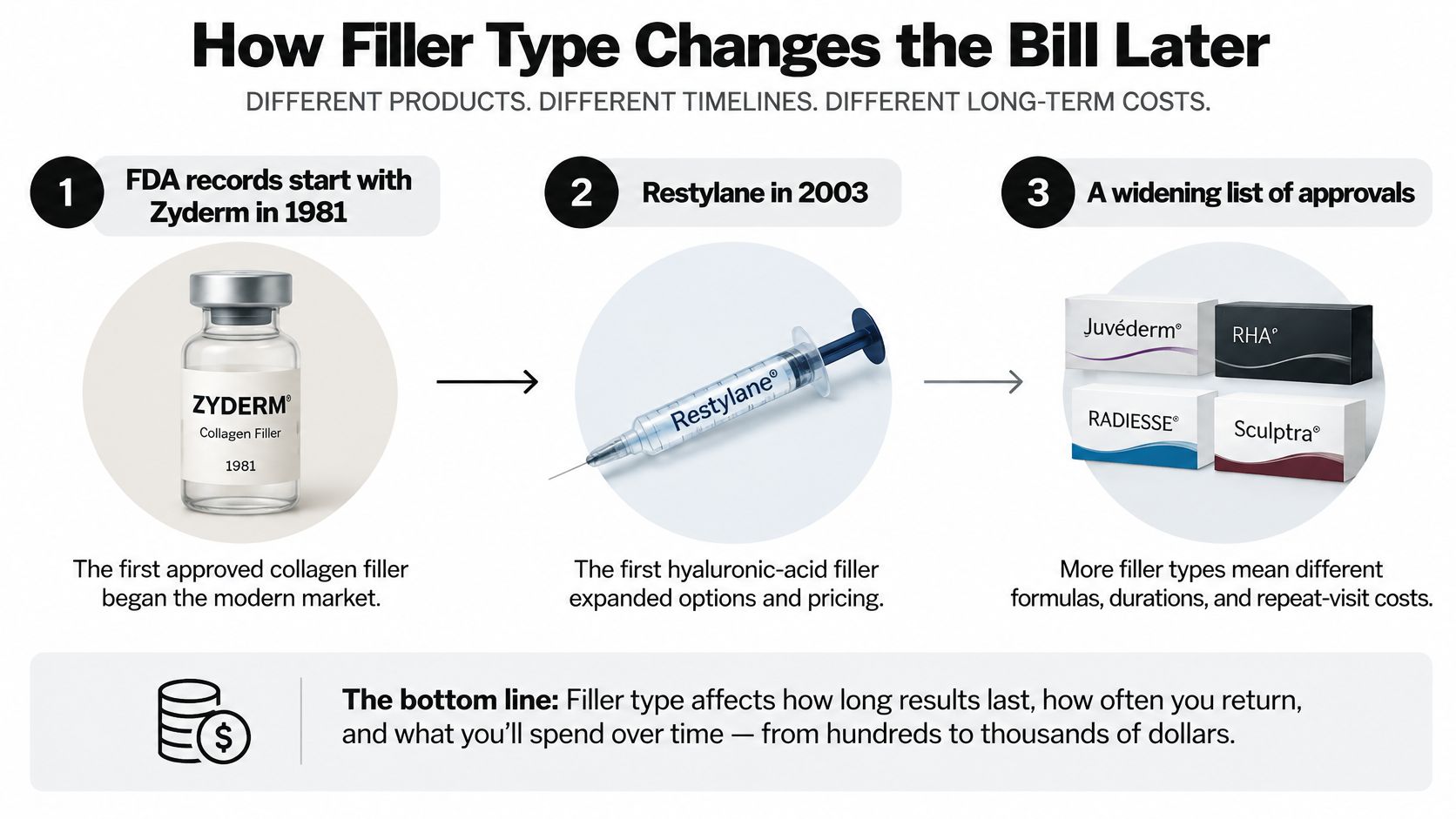
The FDA's dermal filler overview identifies Zyderm in 1981 as the first approved dermal filler and Restylane in 2003 as the first approved hyaluronic-acid filler; it also describes hyaluronic-acid effects as generally lasting about 6–12 months. The expanding range of approved products helps explain why a modern filler menu can't reasonably have one universal price.
Compare plans over the same period
Consider a hypothetical two-year budgeting exercise. A patient chooses a lower-priced hyaluronic-acid treatment, then returns for reassessment and additional treatment when appropriate. Another patient pays more initially for a longer-lasting option suited to a different clinical objective.
The first patient's repeated treatment fees could eventually meet or exceed the second patient's initial expense. But that doesn't make the longer-lasting product the better choice for both people. Product suitability, required amount, tissue response, and the desired result still determine whether the comparison makes clinical sense.
Avoid dividing the initial fee by an advertised duration and treating the answer as a guaranteed monthly cost. Results don't disappear on a fixed billing date, and maintenance doesn't necessarily require repeating the original amount.
Material and indication come before price
A lip gel and a biostimulator aren't interchangeable line items. They differ in how they're used, the results they're intended to produce, and the considerations involved if the patient dislikes the outcome.
Our guide to types of dermal fillers can help you understand those categories before discussing a specific product. The decision should begin with what needs correction, not which product promises the longest duration.
Before accepting a quote, get clear answers to these questions:
- Product identity: Which exact product is proposed, rather than just the brand family?
- Treatment indication: Is that product approved for the intended use, or is the proposed use off-label?
- Maintenance assumption: What reassessment window does the injector anticipate for your plan?
- Treatment sequence: Is the initial appointment intended to complete the correction or begin a staged approach?
I would choose an appropriate product with a manageable maintenance plan over an unsuitable product selected only for its projected longevity.
Sample Costs for Common Treatment Areas
The table below contains illustrative per-area budgeting scenarios, not established national price ranges or our treatment prices. The syringe counts and dollar bands are examples to discuss locally, not a dosing recommendation. A facial examination may support less treatment, more treatment, or no filler at all.
Planning ranges by treatment area
| Area | Typical syringes in the illustrative scenario | Planning budget for the scenario | Why the total moves |
|---|---|---|---|
| Lips | 1 | About $600–$1,200 | Subtle shape enhancement may require limited volume |
| Nasolabial folds | 1–2 | About $650–$1,800 | Fold depth and surrounding support change the plan |
| Marionette lines | 1–2 | About $650–$1,600 | Treatment may involve chin or cheek support |
| Cheeks | 1–3 | About $700–$2,500+ | The extent and location of volume loss affect product needs |
| Chin | 1–2 | About $700–$1,800 | Projection goals differ by profile |
| Jawline | 2–4 | About $1,400–$3,500 | Treating definition across both sides increases the proposed volume |
| Under-eyes | Up to about 1 | About $700–$1,800 | Suitability, anatomy, and technical judgment can outweigh volume |
Volume follows the goal and the face. Mayo Clinic explains that results depend on filler type, injection location, and the individual's response, which is why a brand name alone can't predict your total.
A limited lip plan versus a structural plan
Say a patient wants a modest change in lip shape and the clinician proposes a single-syringe treatment. In that hypothetical case, the lip budget in the table could be a useful starting allowance. It still wouldn't establish that the entire syringe is appropriate or that the advertised fee includes a review.
Now consider a patient seeking cheek restoration and a more defined jawline. In the illustrative scenario, using several syringes can bring the total into the mid-thousands even when the individual syringe fee appears reasonable. The larger bill reflects a different treatment scope, not necessarily a more expensive brand.
Under-eye treatment deserves a separate conversation. A modest amount of product doesn't make the area simple, and some patients aren't good candidates. Choosing the lowest bidder is a poor substitute for an assessment of anatomy and alternatives.
A smaller treatment area doesn't automatically mean a simpler treatment.
Match the product family to the correction
Our injectable services include Restylane, Revanesse, and biostimulators such as Sculptra and Radiesse. We also offer Botox, Dysport, PRP injections, body contouring/butt lift services, and Hylenex/hyaluronidase. These services address different goals and shouldn't be treated as equivalent filler purchases.
For folds around the mouth, our guide to the best filler for smile lines provides context for the product conversation. The consultation still needs to determine whether the visible line itself or adjacent support is the appropriate target.
A useful estimate names the product category, proposed quantity, treatment areas, and expected duration. Request the clinic's per-syringe or other applicable unit fee in writing, then compare the complete per-area totals.
Budget for Maintenance and Complication Care
The cheapest syringe isn't necessarily the lowest-cost treatment. A price that excludes review appointments, additional treatment, or a clear route to medical help can leave you with an incomplete budget.
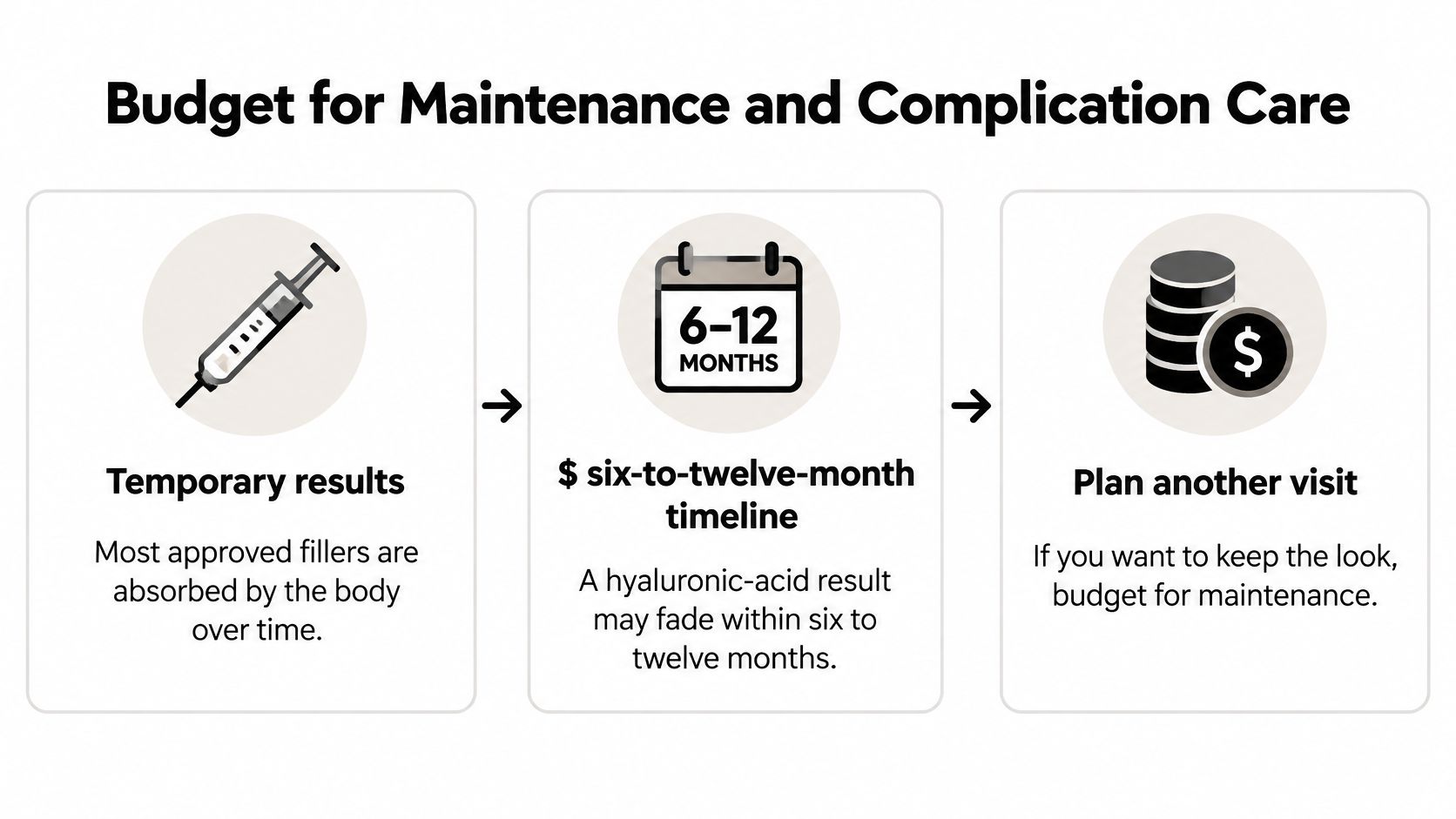
The FDA's consumer guidance on dermal fillers states that most approved fillers are temporary, that adverse effects can develop weeks, months, or years after injection, and that complications can include nodules, infection, allergic reactions, tissue necrosis, and vascular injection causing stroke or blindness. It also warns that removal may be difficult and that no FDA-approved products are indicated specifically for filler removal.
Build a budget with separate categories
- Initial treatment: Record the product, proposed amount, areas, and appointment fee. Keep elective additions separate so you can distinguish the essential plan from optional enhancements.
- Staged treatment and maintenance: Identify whether another appointment is part of the original correction or a future reassessment. Don't assume every later visit is a complimentary touch-up.
- Routine aftercare: Clarify whether a planned review is included, how concerns are assessed, and whether additional product carries a separate charge.
- Medical evaluation or complication care: Ask who manages a suspected problem and which services could generate outside bills, including diagnostic assessment or imaging.
Know when aftercare becomes urgent care
Temporary swelling and bruising aren't the same as unusual or worsening pain, skin blanching or concerning discoloration, or changes in vision. Seek immediate medical assessment for concerning symptoms rather than waiting for a routine review. Vision changes or signs of stroke require emergency care.
Keep the clinic's contact instructions available before you leave. You shouldn't have to search social media for a response while deciding whether a symptom is urgent.
Our overview of dermal filler side effects can support that discussion, but written instructions specific to your procedure remain important. Ask the treating clinician to explain what's expected and what should trigger an immediate call.
For hyaluronic-acid treatment concerns, we can discuss Hylenex or hyaluronidase as part of injectable care. That doesn't mean every complication dissolves neatly or that reversal is a free, predictable eraser.
Product traceability, an aftercare pathway, and emergency preparedness have practical value even when they don't appear as separate charges. If a bargain leaves those questions unanswered, pause before purchasing.
Factors and Quote Checks That Set Your Price
The fee pays for more than the contents of a syringe. A qualified clinician must assess facial anatomy, decide whether filler is appropriate, select a product, obtain informed consent, and remain prepared to recognize a complication.
Clinic operations also contribute to pricing. Legitimate product sourcing, clinical supplies, emergency readiness, documentation, and appointment time all carry costs. A printed syringe price may include some of those services without itemizing them.
Geography affects overhead, but a high-rent address doesn't prove better care. Likewise, a lower fee doesn't establish poor care. Compare local proposals on their clinical scope and transparency rather than assuming price alone identifies the best injector.
Why a treatment average isn't a syringe quote
In 2024, RealSelf reported an average dermal-filler treatment cost of $1,623, based on hundreds of recent patient reviews. That describes patient-reported treatment spending, not the retail cost of a standardized syringe.
An advertised promotion might cover an introductory treatment, a limited quantity, or a restricted area. Read what the offer includes. A headline price becomes useful only after the clinic explains how it applies to your proposed correction.
Use a quote checklist before paying
-
Put both proposals in the same units.
Record the exact product, proposed amount, and areas. If one clinician recommends a limited lip enhancement and another proposes lips plus surrounding support, you aren't comparing equivalent treatments. -
Identify the billing basis.
Ask whether the amount is per syringe, per treatment area, per session, or part of a package. For products billed differently, request the applicable unit and total proposed quantity. -
Confirm who will inject.
Check the treating clinician's professional credentials and relevant training. Ask for the exact FDA-approved product name and confirmation that the clinic documents its traceability. -
Separate a review from more product.
An included assessment doesn't necessarily include an additional syringe. Get the review policy and any potential product charge in writing before treatment. -
Clarify the complication pathway.
Know whom to contact after hours, how urgent concerns are triaged, and whether evaluation or treatment may carry additional charges. An emergency plan matters more than a vague promise to take care of you. -
Investigate a conspicuously low total.
Use national fee benchmarks as a reason to ask questions, not as a mandatory minimum. Confirm that the promotion covers the actual product, amount, and services you need.
Before paying a deposit: Make sure the written estimate describes the treatment you discussed, not merely the promotion that brought you in.
Staging and financing solve different problems
A staged plan spreads clinical decisions across appointments. It can allow a conservative starting point and reassessment before adding more product. It doesn't necessarily reduce the eventual total, and it shouldn't require buying an oversized package in advance.
Financing changes when you pay. If you consider third-party medical credit, review interest, fees, deferred-interest conditions, and payment obligations rather than focusing only on the advertised monthly amount.
Packages need the same scrutiny. Check expiration rules, refund terms, whether the unit price is locked, and what happens if your clinician recommends less treatment than the package includes. Buying product you don't need isn't a saving.
Leave with a written estimate containing product, quantity, areas, inclusions, potential additional charges, and a maintenance assessment window. That document is far more useful than a verbal promise that the treatment starts at an attractive price.
Support Skin Between Visits with Light Therapy
LED light therapy can complement a skin routine, but it doesn't replace filler or restore missing facial volume. Keep the budgets separate: injectables address selected contour and volume goals, while a home device targets different skin concerns.
A review of home-use LED evidence describes a randomized facial-rejuvenation study using a 660-nanometer mask for 21-minute sessions, twice or three times weekly for four weeks. Across reviewed studies, measured outcomes included wrinkles, texture, elasticity, and lines around the eyes.
That evidence supports consistency, not the expectation that one evening of use will change your skin. It also doesn't establish that every retail mask reproduces the studied devices' output or results.
A practical home-device option
I recommend considering the Barb N.P. Facial Mask, sold as the LED Light Therapy Face Mask at a sale price of $250, if you want a hands-free option you can realistically use. It's wireless, adjustable, and shaped for comfortable wear, with three lighting settings combining red, blue, and purple light for different treatment goals.

The red-light setting is intended to support collagen production, reduce the look of inflammation, and support skin healing. The other settings provide options for different device-specific goals; choose them according to the device instructions rather than assuming all colors work interchangeably.
Keep the routine realistic
- Use the device's protocol: Don't copy a study's session length unless it matches the manufacturer's instructions for this mask.
- Coordinate after procedures: Discuss when to resume home-device use after injections or other skin treatments.
- Judge adherence first: A comfortable device that fits your routine is more useful than one you rarely take out of its box.
New customers who subscribe to our email list receive an instantly sent code for 10% off their first shop order. That offer can be considered when purchasing the mask or related skincare, separately from any injectable fee.
Book a Filler Consultation with Barb N.P.
Bring the national benchmarks and illustrative area budgets to a consultation as conversation tools, not as a final invoice. Your estimate should follow an assessment of your face, medical history, existing treatments, and priorities.
At BotoxBarb, Barbara Kulik, MSN, FNP-BC, NP-C, is a board-certified nurse practitioner in Northern California specializing in precision aesthetics, advanced peptide therapies, and curated medical-grade skincare. A dermal filler consultation is the opportunity to discuss whether hyaluronic acid, a biostimulator, a staged approach, or an alternative fits your goals.
Start with the concern that matters most
You don't have to fund every area at the first visit. Identify the change you care about most, explain your spending limit, and discuss what a smaller initial plan could realistically accomplish.
Appointments can be booked for in-clinic injectable services. Purchases from our online boutique are separate from the treatment fee, so keep skincare and home-device spending distinct from your procedural estimate.
Clear patient information matters before anyone books. For practice owners, Med Spa Scalers' resource on how to attract more dermal filler patients offers a business-side perspective on presenting these services; patients should still base their decisions on an individualized clinical assessment rather than marketing alone.
Leave with a usable comparison sheet
Request a written proposal that identifies:
- The treatment: Exact product, proposed quantity, and areas.
- The financial scope: Total estimate, included follow-up, and potential additional charges.
- The longer-term plan: A maintenance assessment window and whether staged treatment is anticipated.
Schedule the consultation before committing to a promotional package. A thoughtful plan can begin conservatively and build only when reassessment supports doing more.
BotoxBarb offers in-clinic injectable appointments and a separate boutique of skincare and self-care products to support your aesthetic routine. Visit BotoxBarb to arrange a filler consultation, and ask for the product, quantity, areas, included follow-up, and maintenance window in your written estimate.