Article: How Many Units of Botox for Frown Lines: Dosing Guide

How Many Units of Botox for Frown Lines: Dosing Guide
For Botox Cosmetic, the FDA-labeled dose for moderate-to-severe frown lines is 20 Units, divided among five injection sites at 4 Units each. That's a starting reference for this specific product, not a fixed dose for every person, and a higher unit count doesn't automatically mean longer-lasting results.
The number alone can be misleading. Before comparing quotes or choosing a treatment, check which product is being used, where the units will go, and when the injector will review the result. Those details matter as much as the total.
Standard Botox Units for Frown Lines
The same total dose can describe different treatment plans. For Botox Cosmetic, the FDA prescribing information specifies 20 Units for moderate-to-severe glabellar lines, the vertical lines between the eyebrows. Its labeled technique divides that total into five intramuscular injection sites: 4 Units, or 0.1 mL, at each site. Two sites are in each corrugator muscle, and one is in the procerus. These muscles draw the eyebrows inward to form the central frown pattern. (FDA prescribing information for Botox Cosmetic)
A label is a reference, not an individual prescription. A clinician should assess your muscle activity, anatomy, brow position, previous treatment response, and preference for movement before choosing a dose and injection placement.
| Protocol or product | Total units | How the units are placed |
|---|---|---|
| Botox Cosmetic, FDA label | 20 Units | Five sites at 4 Units each: two per corrugator, one in the procerus |
| Korean protocol, 2025 international consensus | 15 Units | 3 per corrugator head, 1.5 per corrugator tail, 6 in the procerus |
The difference illustrates why a unit count needs context: the Korean protocol in a 2025 international consensus totals 15 Units and distributes them differently across the muscles. (International consensus publication) Neither pattern applies automatically to every patient, and these figures should not be used to convert doses between brands.
Product units aren't interchangeable
Botox, Dysport, Xeomin, and other botulinum toxin products use product-specific units. The FDA label states that units from different products are not interchangeable or directly comparable. A clinic's quote of 40 Units for another toxin therefore does not, by itself, show whether the dose is equivalent to, stronger than, or weaker than 20 Units of Botox.
Before accepting a dose: Ask which product the injector plans to use, which product-specific label or protocol guides the treatment, how the dose will be distributed across injection sites, and when the result will be reviewed. A larger number alone does not promise a longer-lasting result.
What Moves the Dose Up or Down
The unit count matters only alongside the product, injection sites, and follow-up. In one randomized trial, 80 women with moderate-to-severe glabellar lines received 10, 20, 30, or 40 Units of onabotulinumtoxinA. The review reporting the trial found a difference in four-month relapse rates across dose groups (p≤0.0017). That result describes the overall dose-group comparison, not proof that each increase produced a meaningful benefit. (Peer-reviewed dose-ranging evidence)
| Units injected | Four-month relapse rate |
|---|---|
| 10 Units | 83% |
| 20 Units | 33% |
| 30 Units | 30% |
| 40 Units | 28% |
In this trial, relapse was less frequent at 20 Units than at 10 Units. The measured differences among 20, 30, and 40 Units were smaller, with a modest change from 20 to 30 Units and little further change at 40 Units. A second randomized study in 142 Japanese participants reported a patient-assessed response at week 8 in 88.6% of those treated with 20 Units and 70.5% of those given 10 Units (p=0.035). The p-value applies to that response-rate comparison. Together, these results make 20 Units a useful reference point for adult glabellar treatment, not a dose that suits every face or product.
What your clinician should assess
Your clinician should assess muscle strength and mass, sex, baseline line severity, how long previous treatment lasted, brow asymmetry, and the risk of unwanted effects. A lower dose may better preserve movement when muscle strength is less pronounced or natural expression is a priority. Ask how the proposed units will be placed and what follow-up is planned, because a total dose without those details is hard to interpret.
Lines visible at rest may be etched into the skin. Toxin reduces muscle activity; it does not erase established creases. The dose studies cited here do not establish that a higher dose makes results last longer. If a clinician recommends more than the product-specific reference, ask what finding supports that choice and how they will assess the result before considering an adjustment.
Consultation Checklist Before You Book
A focused phone call or first visit should leave you clear on who will treat you, which product they'll use, and how they'll follow up. Ask direct questions and write down the answers.
- Confirm the injector's license and training. Ask, “Who will perform the injection, and what training do they have in neurotoxin treatment?” Knowing who is responsible helps you assess whether the person planning the treatment is also the person delivering it.
- Name the product. Ask whether the clinic plans Botox Cosmetic, Dysport, or another product, and whether the quoted units belong to that product. The numbers can't be compared directly across brands.
- Request the plan per site in writing. Ask for the total and how it will be distributed. A written plan makes it easier to understand the approach and discuss how it relates to the Botox reference dose.
- Share relevant health information. Tell the clinician about medications that affect nerve or muscle function, neuromuscular conditions, pregnancy or breastfeeding, and any infection near the treatment area. These details can change whether treatment should proceed; review the clinic's Botox contraindications information.
- Clarify follow-up and aftercare. Ask when the clinic wants to see you, whether an adjustment is included, and whom to contact if an eyelid droops or another concern develops.
- Bring comparison photos. Take a phone photo at rest and while frowning in the same light. Consistent images can help you and the injector judge changes without relying only on memory.
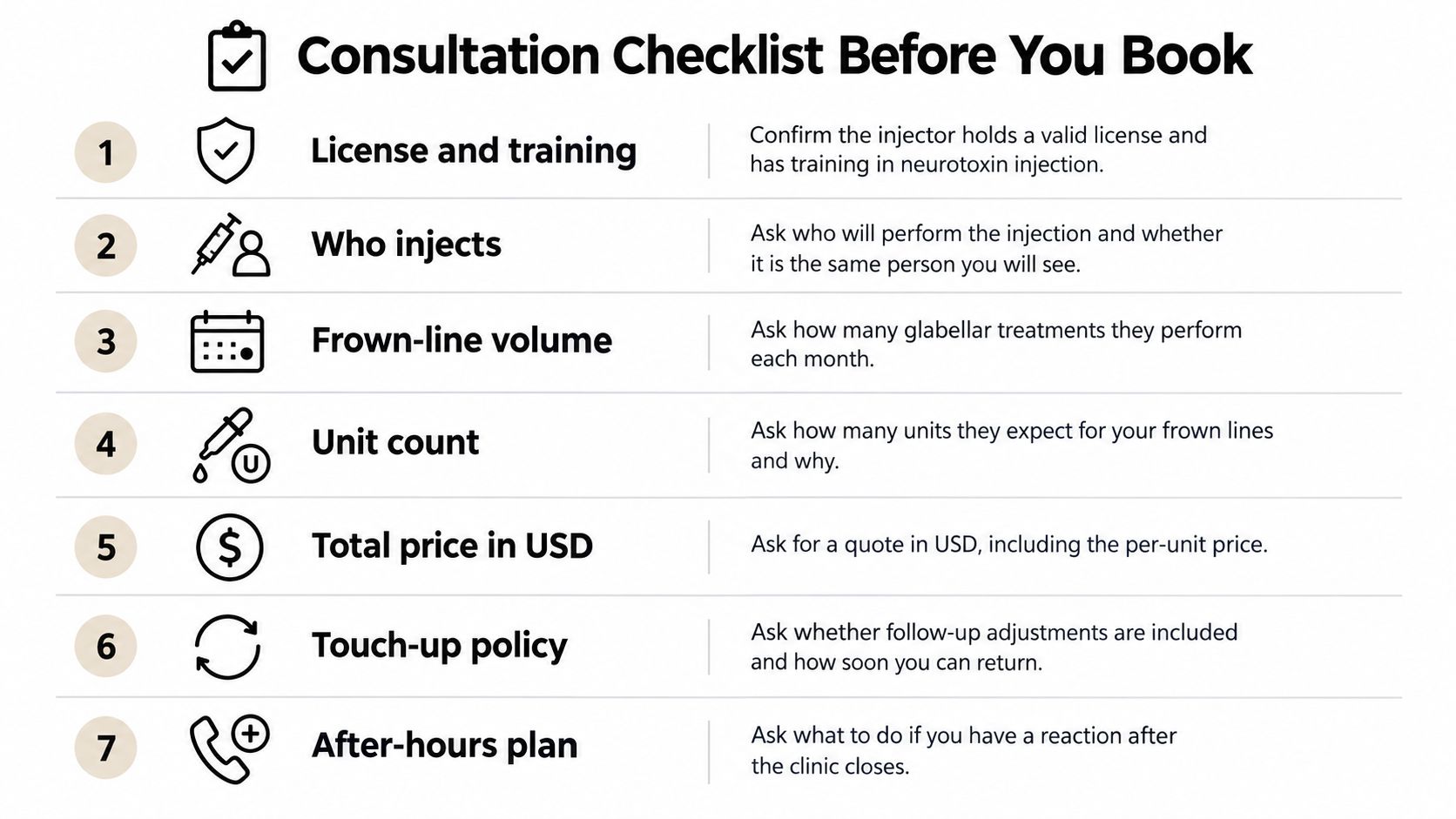
If the clinic can't tell you the product, the planned units per site, and the follow-up plan, keep looking.
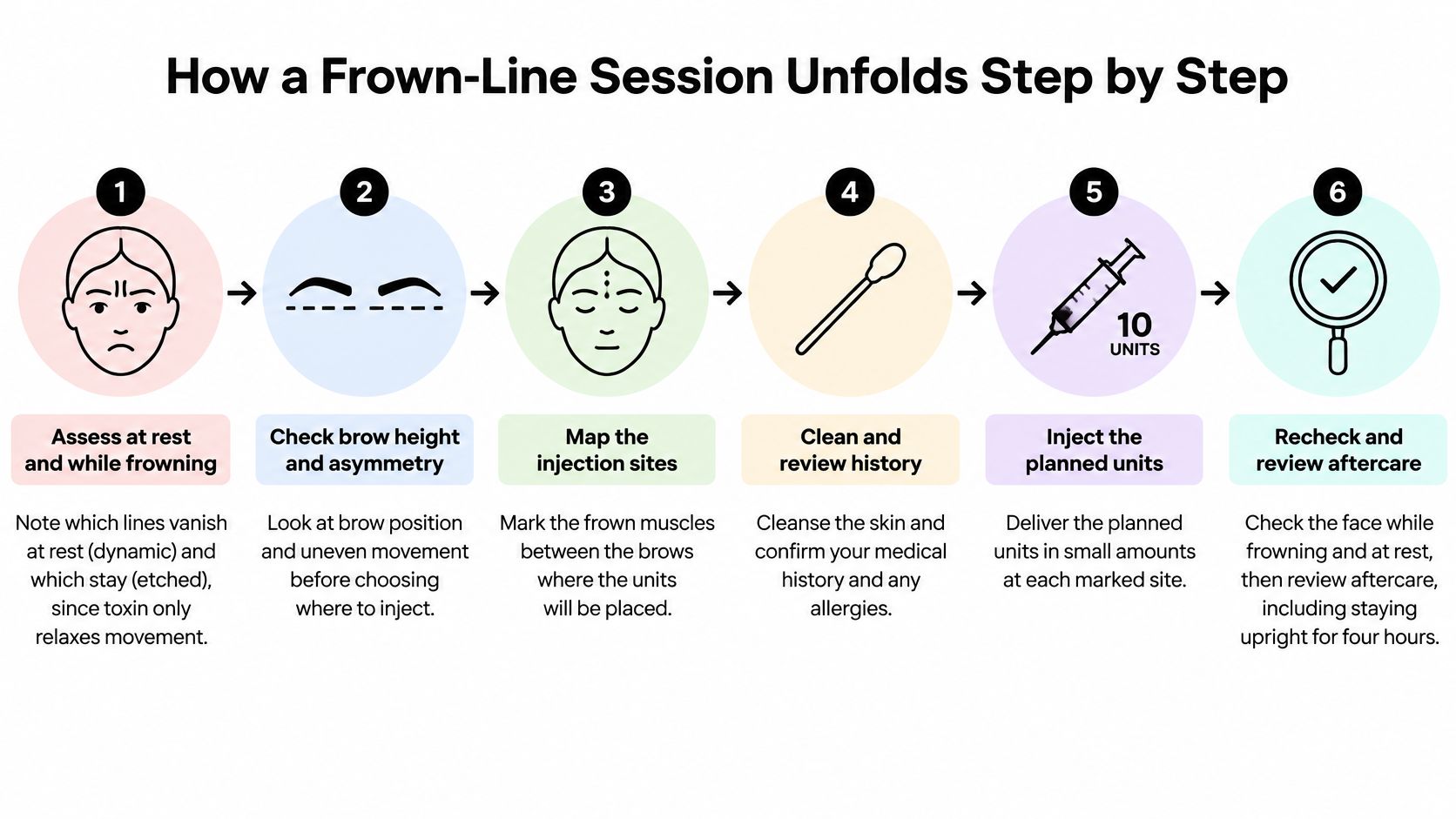
How a Frown-Line Session Unfolds Step by Step
A unit count only makes sense alongside the product, injection sites, and follow-up plan. During the session, the injector assesses how your muscles move, confirms the treatment plan, and places injections based on your anatomy.
- Assess your face at rest and while frowning. The injector checks which lines fade when your face relaxes and which remain visible. Botox relaxes muscle movement, but it does not erase established skin creases.
- Check brow position and asymmetry. The injector observes brow height, upper-eyelid position, and whether one side moves differently. These observations help guide placement for your facial muscle pattern.
- Confirm the product and dose. Before the product is prepared, confirm its name, the total units, and the planned units at each site. Units cannot be compared directly across different products, so the product matters as much as the number.
- Map the sites while you're upright. For the FDA-labeled Botox Cosmetic approach, the reference pattern uses five sites across the corrugator and procerus muscles. The injector should identify the muscles creating the movement rather than place injections by following the visible crease alone.
- Clean the skin and inject the planned dose. The labeled Botox Cosmetic protocol uses 0.1 mL, or 4 Units, per site. Your injector should follow the plan based on your assessment, not add units just because a crease looks prominent. A larger dose does not automatically produce a longer-lasting result.
- Review aftercare and arrange follow-up. Follow your injector's instructions, including whether to stay upright or avoid rubbing the area. Ask when to assess the result and what to do if the effect seems uneven. The effect takes time to settle, so the first day is too soon to judge the outcome.
The order is practical: assess movement, select sites, then confirm the dose. The FDA-approved Botox Cosmetic technique specifies sites and dosing for glabellar treatment; your injector still needs to assess how that approach applies to your facial anatomy. (FDA prescribing information for Botox Cosmetic)
Safety Risks and Warning Signs After Treatment
A unit count only has meaning alongside the product used, injection sites, and follow-up plan. A larger dose does not guarantee a longer-lasting result, and excessive weakening or inaccurate placement can leave the brows or eyelids looking or feeling different than intended. Ask your injector what to watch for and how to reach them if a concern develops.
A heavy or drooping upper eyelid needs prompt assessment. Contact your injector as soon as you notice it. The symptoms below can help you describe a change, but an individual clinical assessment is needed to identify its cause and decide what to do.
| Symptom | Possible explanation | What to do |
|---|---|---|
| Heavy or drooping upper eyelid | Toxin may have affected muscles near the brow | Contact the injector promptly for assessment and advice |
| Uneven or heavy brows | Dose distribution or brow movement may be contributing | Arrange an assessment and ask whether any adjustment is appropriate |
| Lines visible at rest | Established creases may remain even when muscle movement is reduced | Discuss options with your clinician rather than adding units without review |
| Strong frown movement remains | The dose or injection sites may need reassessment | Bring photos to your follow-up and review the treatment plan |
| Flat or unnatural expression | The muscles may have been weakened more than desired | Discuss a lower dose or different plan at a future visit |
| Response weakens after repeated treatments | Repeated use may be one factor to discuss | Review treatment spacing and alternatives with your clinician |
Know when to seek urgent help
Repeated treatment is also a reason to review your response and schedule with your clinician. A larger dose or more frequent retreatment is not automatically the answer if the effect is weaker than expected. Discuss the product, placement, and follow-up together so any change is based on your response.
Read about Botox side effects and when to contact your clinician for an overview of possible concerns. Difficulty swallowing, trouble breathing, or generalized muscle weakness after a botulinum toxin injection requires emergency care. Do not wait for a scheduled appointment.
How Long Results Last and When to Return
Botox results for frown lines are temporary, and a bigger dose does not automatically make them last longer. The unit count only has meaning alongside the product used, the injection sites, and the follow-up plan. The labeled duration for Botox Cosmetic is up to about 120 days compared with placebo, but that is not a calendar guarantee for every patient. Your own response is the best guide to when movement returns.
Movement may start to soften within the first few days. By about two weeks, the effect can be reviewed more usefully. Compare your face with the consultation photos, and keep a record of treatment dates and units at each site. That gives your injector a clearer basis for discussing the next session.
| Window | What to expect | What to do |
|---|---|---|
| Days 1-3 | Movement begins to soften | Avoid rubbing the area and lying face-down |
| About 2 weeks | Full effect is visible | Attend the review and compare with the consultation photos |
| Months 1-3 | Effect holds with gradual softening of movement | Keep a log of dates and units per site |
| Around 4 months | Movement returns and lines reappear | Plan the retreat with the injector rather than topping up early |
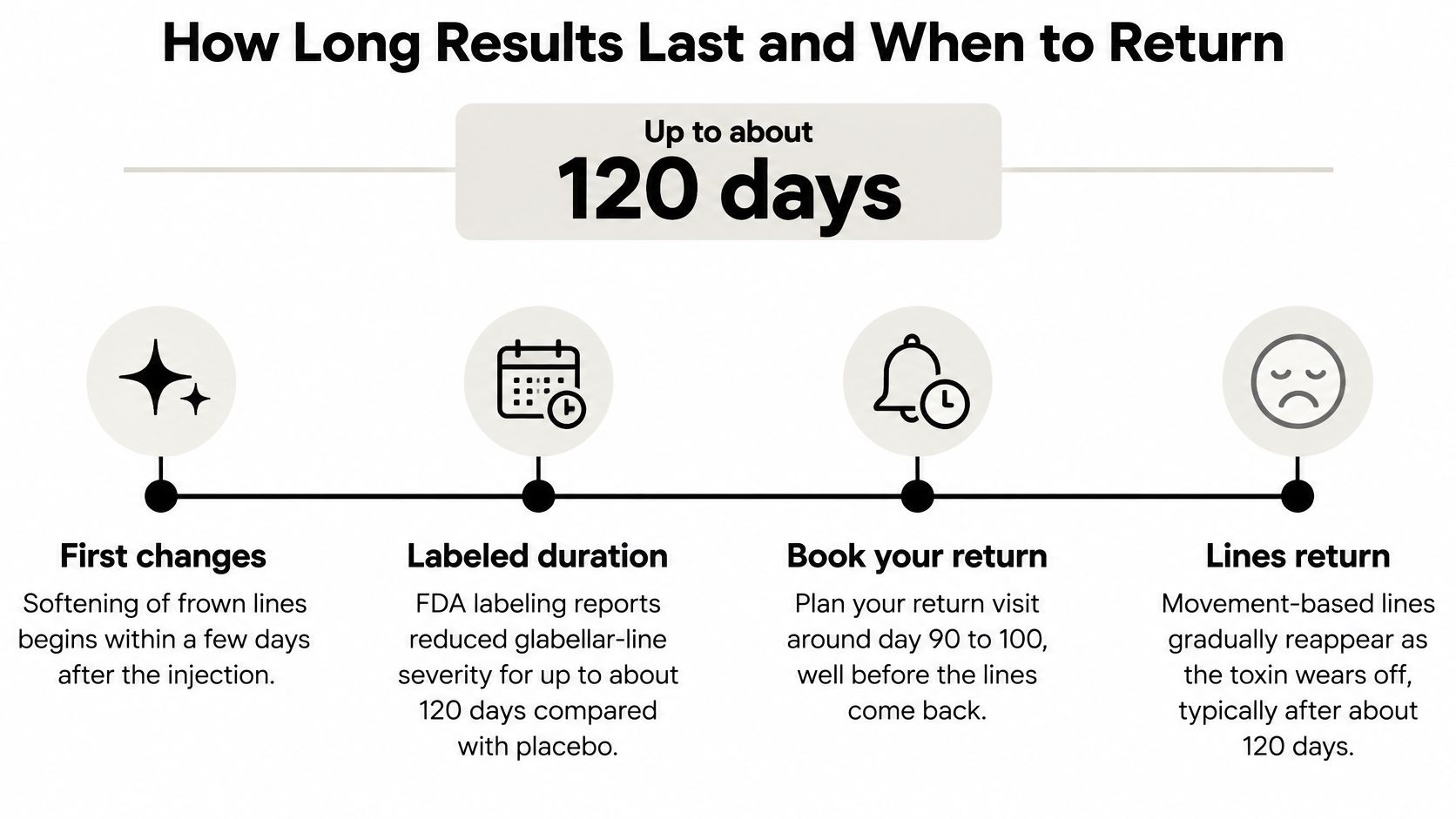
If movement returns sooner than expected, discuss it with your clinician rather than adding units yourself. Ask whether the result relates to the dose, injection placement, or the lines themselves. Review how long Botox lasts before planning a return visit, and base timing on your response and the injector's assessment.
Book a Dose Assessment Before Your First Treatment
A unit count only makes sense alongside the product, injection sites, and follow-up plan. Choose an in-clinic assessment rather than selecting a dose from a price list. The injector can assess your brow movement, discuss how much movement you want to retain, and recommend a product-specific plan.
BotoxBarb offers in-clinic Botox and Dysport treatments. If Dysport is recommended, its unit count is not directly interchangeable with Botox. Ask which product will be used, how many units are planned at each site, and when to review the result.
Book an in-clinic dose assessment through BotoxBarb, and request a written plan before treatment begins.