How to Treat Sun Spots on Face: Quick Tips for Clear Skin
If you’re serious about treating those pesky brown spots on your face, you first need to understand exactly what you’re up against. Getting rid of them for good isn’t just about slathering on a brightening cream; it’s about a smart, targeted strategy that starts with knowing your opponent.
The most effective plan begins with daily, non-negotiable sunscreen use to stop new spots in their tracks. From there, we bring in medical-grade skincare with proven ingredients to fade the discoloration you already have. For those who want faster, more dramatic results, we can layer in professional treatments and even at-home devices like LED therapy.
What Are Sun Spots and How Do They Form

Before we can treat them, let's get clear on what they are. Those flat, brown, or tan marks you see are officially known as solar lentigines. Think of them as a visible echo of your skin's history with the sun.
Here’s what’s happening beneath the surface: Your skin has pigment-producing cells called melanocytes. When you're exposed to UV light, these cells kick into gear and produce more melanin to protect your skin—that's how you get a tan.
But after years of sun exposure, some of those melanocytes get a little overzealous. They start producing melanin in overdrive, creating concentrated clusters that get stuck in the top layer of your skin. The result is a well-defined dark spot that hangs around long after your tan has faded.
Identifying Sun Spots Correctly
Knowing a sun spot from other types of hyperpigmentation is a crucial first step. They aren't the same as the patchy, often symmetrical patterns of melasma, nor are they the dark marks left behind by a pimple (post-inflammatory hyperpigmentation).
Sun spots have a few tell-tale characteristics:
- Appearance: They’re usually round or oval with a clean, defined border.
- Location: You’ll find them on the areas that see the most sun—cheeks, nose, forehead, and even your hands and chest.
- Texture: Solar lentigines are completely flat. If you run your finger over them, you won’t feel any raised texture.
Picture this: you enjoyed your twenties soaking up the sun, maybe without being as diligent with sunscreen as you are now. The small, distinct brown spots that have started popping up on the high points of your cheeks are classic solar lentigines. They’re a direct map of that past UV damage.
Key Takeaway: Sun spots are simply harmless collections of excess pigment caused by years of sun exposure. While they are not cancerous, they are a clear sign of sun damage. It’s always a good idea to have any new or changing spot looked at by a professional to rule out anything more serious.
Understanding how they form is half the battle. It makes it crystal clear why daily sunscreen is your number one priority and why our treatment plan needs to focus on breaking up the pigment that’s already there. With this knowledge, you can confidently build a routine that will bring back a clear, even-toned complexion.
Building Your At-Home Sun Spot Treatment Routine

Tackling sun spots effectively starts right on your bathroom counter. A consistent, targeted skincare routine is the foundation of any successful treatment plan. Without it, even the most advanced in-office procedures will be a temporary fix, because new pigment will keep showing up.
Fading discoloration takes dedication. Think of it as a daily practice that corrects existing damage while preventing new spots from forming. Let’s build a powerful, practical routine you can start today.
The Non-Negotiable First Step: Sunscreen
Before we even get into corrective serums, there's one rule I tell every single client: you must wear a broad-spectrum sunscreen with an SPF of 30 or higher every single day. This isn't a suggestion. It's the most critical part of treating sun spots.
Why? Sunscreen is your daily shield. It blocks the UV radiation that signals your pigment-producing cells to go into overdrive. If you skip this, you’re actively working against any progress you make.
Think of it this way: trying to fade sun spots without daily SPF is like trying to bail water out of a boat without plugging the hole first. No matter how much you scoop out, more keeps coming in.
Crafting Your Morning Routine
Your morning skincare is all about protection and prevention. It’s how you prep your skin to face the day’s environmental stressors, from UV rays to pollution.
Start with a gentle cleanser to create a clean canvas without stripping your skin. Follow that with an antioxidant serum—this is your primary defense against free radical damage, and Vitamin C is the gold standard. After your serum, lock in hydration with a moisturizer, and finish with that all-important broad-spectrum SPF 30+. Apply it generously, and don't forget to reapply every two hours if you’re spending time outdoors.
A high-quality Vitamin C serum doesn't just help lighten existing pigment; it actually boosts your sunscreen's effectiveness. This powerhouse antioxidant duo works together to neutralize aggressors before they can do more damage.
For a potent, medical-grade option, our Barb N.P. Antioxidant Serum is a concentrated formula I often recommend. It’s designed to fight oxidative stress and visibly brighten the complexion. When you consistently use a product like this, you’re actively fading sun spots and restoring a more luminous skin tone. If you're trying to figure out which product is right for you, check out our guide on finding the best brightening serum for dark spots.
Your Evening Routine for Correction and Repair
Nighttime is when your skin shifts into repair mode. This is your chance to use powerful active ingredients that break up existing pigment and accelerate cell turnover while you sleep, away from damaging UV light.
Your evening routine should be focused on correction. After thoroughly cleansing away makeup, sunscreen, and impurities from the day, it's time for a corrective serum. This is where ingredients like retinoids or azelaic acid come in to speed up the shedding of pigmented cells. Always finish with a nourishing moisturizer to support your skin’s barrier, which is especially important when using potent actives.
Essential Ingredients for Your At-Home Regimen
Choosing products with the right active ingredients is what makes a routine truly effective. These are the key players I recommend to my clients who are serious about fighting sun spots.
Here's a breakdown of the top ingredients you should look for, what they do, and how to use them for brighter, more even-toned skin.
| Ingredient | How It Works | Best For | Pro Tip |
|---|---|---|---|
| Vitamin C | A potent antioxidant that neutralizes free radicals, inhibits melanin production, and brightens overall skin tone. | Daily morning use for protection and brightening. | Look for L-ascorbic acid at a concentration of 10-20% for max effectiveness. Store it away from light and air to keep it stable. |
| Retinoids | A Vitamin A derivative that speeds up cell turnover, helping to slough off pigmented surface cells and reveal fresh skin underneath. | Evening use to address sun spots, fine lines, and texture. | Start low and go slow. Use a low concentration 2-3 times per week to build tolerance and always follow with a moisturizer. |
| Niacinamide | A form of Vitamin B3 that helps stop pigment from transferring to the surface of your skin, preventing dark spots from appearing. | Both morning and evening use. It's a team player that's well-tolerated and pairs well with other ingredients. | Niacinamide also strengthens the skin barrier, making it the perfect partner for more potent actives like retinoids. |
| Azelaic Acid | A gentle acid that exfoliates and selectively targets overactive pigment cells without affecting normal skin. | Sensitive or acne-prone skin, as it also has anti-inflammatory benefits. | Can be used once or twice daily. It’s a fantastic alternative for anyone who finds retinoids too irritating. |
By incorporating these proven ingredients into a consistent morning and evening routine, you create a powerful system that not only corrects existing sun spots but also protects your skin from future damage. This is the foundation for achieving—and maintaining—a clear, radiant complexion.
Take Your Results to the Next Level with At-Home LED Therapy
While your topical routine is the foundation for fading sun spots, you can seriously speed things up by bringing a piece of the clinic experience home. If you're ready to supercharge your brightening efforts, at-home LED light therapy is a fantastic, non-invasive way to do it.
This isn't some gimmick you see on social media; it's real, proven science. LED therapy uses specific wavelengths of light that penetrate your skin and give your cells a much-needed energy boost. Think of it like a personal trainer for your skin cells—waking them up to repair damage, calm inflammation, and, most importantly, get pigment production back under control.
A New Era of At-Home Treatments
Long gone are the days when you had to book a clinic appointment for effective light therapy. Today’s at-home devices are safe, smart, and designed to deliver actual results. They work in tandem with your skincare, helping your brightening serums and retinoids do their job even better.
Imagine finally getting your skin’s clarity on track while you’re catching up on a show or listening to a podcast. That’s the beauty of a well-designed at-home device. It fits into your life, making consistency—the key to real change—feel completely effortless.
By boosting cellular turnover and calming down the inflammatory signals that trigger pigment, LED therapy creates the perfect environment for your brightening ingredients to work their magic. It’s the ultimate support system for your skincare regimen.
Introducing the BARB N.P. Facial Mask
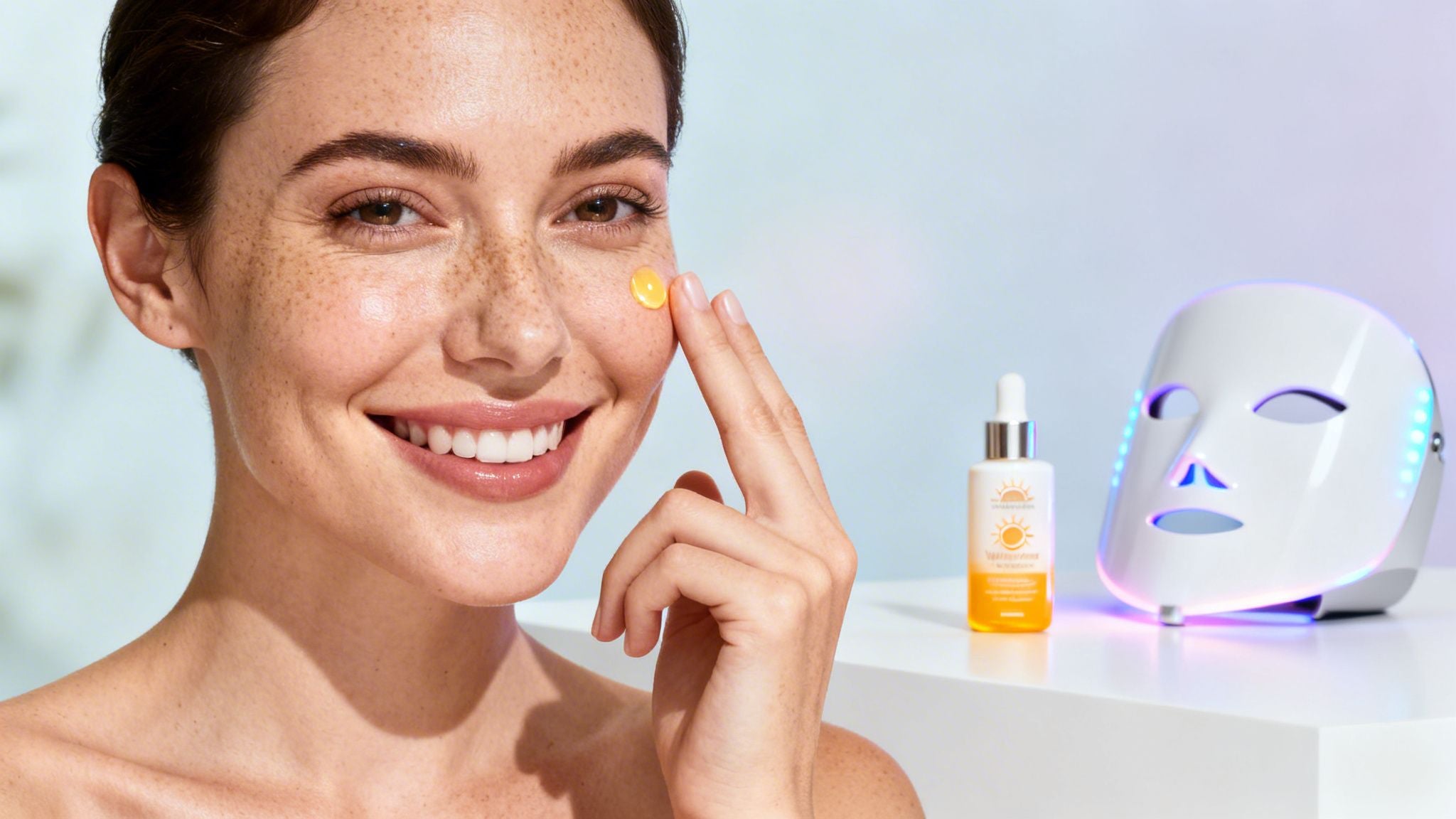
To get the most out of your at-home routine, we developed the BARB N.P. Facial Mask. We designed it specifically to overcome the clunky, restrictive feel of older models, focusing on comfort, ease of use, and clinical-level results. It’s a true investment in your skin’s long-term health.
One of its best features is the completely wireless design. You’re not stuck tethered to a wall, so you can walk around, make a cup of tea, or just relax on the couch during your 10-minute session. That freedom is what makes it so easy to use day after day.
And it's actually comfortable. The mask is built to fit securely without feeling heavy or awkward, turning your daily treatment into a self-care ritual you’ll genuinely look forward to.
Using Different Light Wavelengths to Your Advantage
The BARB N.P. Facial Mask isn't a one-trick pony. It comes with three targeted lighting settings, each with a specific job. While red light is a go-to for collagen and blue light is famous for zapping acne bacteria, the real hero for tackling sun spots is the green light.
Here’s a quick breakdown of what each setting can do for you:
- Green Light (520nm): This is your hyperpigmentation powerhouse. The 520nm wavelength is specifically calibrated to reach the layer of skin where melanin is made. It works by helping to break up existing pigment clusters while also telling your cells to slow down excess melanin production, leading to a much more even and glowing complexion.
- Red Light (630nm): This one is all about anti-aging and skin rejuvenation. The 630nm wavelength dives deep to fire up collagen production, which helps soften fine lines and improve your skin’s overall firmness and bounce.
- Blue Light (470nm): If you’re also dealing with breakouts, the 470nm wavelength is your best friend. It targets and destroys acne-causing bacteria, calming inflammation and helping to prevent future blemishes.
For anyone whose main goal is fading sun spots, making the green light setting a regular part of your routine is a must. Consistent sessions help regulate melanocyte activity and gradually diminish that discoloration. You can dive deeper into the science behind it in our article on LED light therapy for skin.
When you pair the BARB N.P. Facial Mask with your brightening topicals, you’re hitting the problem from two different angles. Your serums work from the top down to fade pigment, while the LED mask works from the inside out to regulate it at the source. That comprehensive approach is how you get clearer, brighter skin—faster than with skincare alone.
When to Consider Professional Treatments
You’ve been doing everything right at home. You’re diligent with your Vitamin C, you never forget your nightly retinoid, and sunscreen is a non-negotiable part of your morning. But sometimes, those stubborn sun spots just won’t budge, no matter how consistent you are.
If you’ve stuck to a solid routine for several months and the results aren’t what you hoped for, it’s time to bring in the heavy hitters. In-office treatments are a significant leap forward in potency, delivering the kind of deep, targeted correction that topicals alone simply can’t match. These procedures are designed to break up years of accumulated pigment right at the source.
The Power of a Professional Chemical Peel
One of the most trusted and effective tools in our arsenal for sun spots is the chemical peel. Don't let the name scare you—a professionally managed peel is a controlled, powerful way to exfoliate the skin and lift away years of discoloration.
Think of it as hitting the reset button on your skin. We apply a specific acid solution that works to dissolve the glue holding old, pigmented cells together. As your skin heals over the next few days, it sheds that dull outer layer, revealing brighter, more evenly-toned skin underneath.
Peels are customized based on your needs:
- Light Peels: Often using glycolic or salicylic acid, these have minimal downtime and are fantastic for tackling mild pigmentation or for maintenance between stronger treatments.
- Medium Peels: These peels, typically using Trichloroacetic Acid (TCA), go deeper to address more significant sun damage. Expect a few days of visible peeling and a more dramatic reveal.
- Deep Peels: Reserved for severe sun damage, these offer the most powerful results but come with a longer recovery. They are performed with extreme caution.
For most sun spot concerns, a series of light to medium peels is a winning strategy. At BotoxBarb, we tailor the peel solution to your exact skin type and goals, ensuring a safe treatment that systematically chips away at solar lentigines.
Targeting Pigment with Light: IPL Photofacials
If you want to zero in on brown spots with laser-like precision, Intense Pulsed Light (IPL) is a phenomenal option. Often called a "photofacial," IPL uses broad-spectrum light that is specifically absorbed by the melanin—the dark pigment—in your sun spots.
Here's how it works: the device emits quick pulses of light, which are soaked up by the targeted brown spots. This light energy instantly converts to heat, shattering the pigment particles without harming the lighter skin around them. Over the next week or so, your body’s natural cleanup crew clears away these tiny fragments.
The most satisfying part of an IPL treatment? Watching your sun spots get darker, almost like tiny coffee grounds on the skin, before they flake off and disappear. It’s the clearest sign that the treatment hit its mark.
IPL is especially effective for those with lighter skin tones and distinct brown spots. We typically recommend a series of 3-5 sessions, spaced about a month apart, to fully clear away stubborn pigmentation for a beautifully even complexion.
This decision tree helps visualize how at-home devices, such as the Barb N.P. Facial Mask, complement your routine by offering features like wireless freedom and targeted green light therapy.
 This visual guide highlights key features that make at-home LED therapy a convenient and effective addition to your professional treatment plan for sun spots.
Total Skin Renewal with Microneedling and PRP
For clients who want to tackle sun spots while also improving overall skin texture, firmness, and glow, Microneedling with PRP is a standout. This is a signature service at BotoxBarb because it’s a one-two punch, powerfully combining mechanical skin rejuvenation with your body’s own healing magic.
First, we perform the microneedling, where an advanced device with sterile, hair-fine needles creates thousands of tiny micro-channels in your skin. This alone triggers a powerful healing response, waking up your collagen-producing cells.
But then we take it to the next level by applying Platelet-Rich Plasma (PRP). This "liquid gold" is a concentration of platelets sourced from your own blood, packed with incredible growth factors. When applied to the skin right after microneedling, these growth factors travel deep into the micro-channels and put your skin’s repair process into overdrive.
For sun spots, the benefits of Microneedling with PRP are twofold:
- It dramatically speeds up cell turnover, helping to push out old, pigmented cells faster than your skin could on its own.
- It remodels the skin from the inside out, building a stronger, healthier foundation that’s less likely to hold onto pigment in the future.
This isn't about blasting pigment away; it's about rebuilding healthier, more resilient, and more uniform skin. It’s the perfect choice if you're concerned not just with sun spots, but also with fine lines, a loss of firmness, or a complexion that’s lost its vitality.
How To Keep Sun Spots From Coming Back
You’ve put in the work to fade those stubborn sun spots, and your skin is finally looking clear and even. The last thing you want is for them to reappear. Getting your skin to this point is a huge win, but keeping it that way is all about smart, consistent prevention.
This phase is less about active treatment and more about long-term protection. Think of it as guarding your investment. Without a solid defense, you’re leaving your skin open to the very same UV damage that caused the spots in the first place.
Make Sun Protection Your Top Priority
Your most powerful tool against returning sun spots is a broad-spectrum sunscreen with an SPF of 30 or higher. This needs to be applied every single morning, whether it's sunny or cloudy. This is your daily armor against the UV radiation that tells your skin to produce more pigment. It’s absolutely non-negotiable.
But one application at 8 a.m. won’t cut it. Sunscreen naturally breaks down with sun exposure and wears off as you go about your day. To stay truly protected, you have to reapply every two hours when you’re outside, and definitely after swimming or sweating.
Here’s how to make reapplication feel less like a chore:
- Powder Sunscreens: A brush-on mineral sunscreen is a lifesaver for reapplying over makeup. Keep one in your purse for quick, mess-free touch-ups.
- SPF Mists: A quick spritz from an SPF mist is another fantastic way to top up your protection without disturbing your look.
- Set an Alarm: If you know you'll be outdoors for a while, set a recurring two-hour alarm on your phone. It’s a simple reminder that makes a huge difference.
And protection isn't just about what you put on your skin. Even simple changes to your environment, like using specialized window films, can play a part in reducing skin cancer risks by filtering UV rays in your car or home.
Continue a Smart Maintenance Skincare Routine
Just because the spots are gone doesn't mean you should ditch your active skincare. A smart maintenance routine will keep your skin resilient and your complexion bright. The focus shifts from intense correction to daily antioxidant support and gentle cellular turnover.
This means keeping those powerhouse ingredients in your rotation. A daily Vitamin C serum helps neutralize free radicals that get past your sunscreen. Using a retinoid a few nights a week keeps skin cells turning over efficiently, preventing pigment from building up again.
Your maintenance routine is like ongoing insurance for your skin. It doesn't have to be as aggressive as your treatment phase, but consistency is what protects your investment and keeps your skin bright and healthy.
To make things easier, a multi-tasking product is a great choice. The Barb N.P. SPF 30 Moisturizer streamlines your morning by combining essential hydration with the broad-spectrum protection your skin needs every day. If you want to learn more, check out our guide on how to choose the best face cream with SPF and why you need one.
Get Serious About Sun-Smart Accessories
Sunscreen is your first line of defense, but physical barriers are your secret weapon. Shielding your skin from direct sun is just as critical.
Make these accessories a non-negotiable part of your life, especially during peak sun hours (10 a.m. to 4 p.m.):
- Wide-Brimmed Hats: A chic hat with a brim of at least three inches is one of the best ways to protect your face, neck, and scalp.
- UV-Protective Sunglasses: Don’t forget the delicate skin around your eyes! Choose large frames that offer 100% UV protection.
- Seek Shade: This is a habit that adds up. Opt for the shady side of the street, sit under an umbrella at lunch, and be mindful of where you stand.
Ultimately, preventing sun spots from returning is an ongoing commitment. By combining diligent sun protection, a smart maintenance routine, and sun-safe habits, you can enjoy your clear, radiant complexion for years to come.
Common Questions About Treating Sun Spots
When you're working hard to clear up sun spots, questions are bound to come up. As you invest in your skin, you want to know what to expect, how long it will take, and if the results will actually last. Here are the answers to the most common questions we get from clients, straight from our experts.
How Long Until I See Results From Sun Spot Treatments?
When it comes to treating sun damage, consistency is everything, but you should still have a clear timeline in mind. With a dedicated at-home routine using potent products, you can expect to see gradual fading and a brighter look within 8 to 12 weeks. The speed of your results really depends on the strength of your products and your daily commitment.
For more dramatic or faster improvement, professional treatments are the way to go.
- In-Office Procedures: A single IPL or chemical peel session can create a noticeable difference right away. But for deep, lasting correction, we typically recommend a series of 3-4 treatments.
- At-Home Devices: You can boost your results by adding a device like the BARB N.P. Facial Mask to your routine. It works with your topical products to help you reach your skin goals faster.
Can Sun Spots Come Back After I Treat Them?
The short answer is yes, they absolutely can. This is something every client needs to understand. Whether you use at-home products or professional treatments, you are removing the existing pigment that has built up in your skin. You aren't making your skin immune to future sun damage.
Think of it as wiping a slate clean—it can easily be written on again. The minute you have unprotected sun exposure, those overactive pigment-producing cells can get triggered, and new spots can form, often in the exact same places.
This is exactly why a broad-spectrum sunscreen, used every single day, all year round, is the most critical part of maintaining your results. It’s the only way to protect your investment and prevent sun spots from returning.
Are At-Home LED Masks As Good As Professional Lasers?
It’s better to see at-home LED masks and professional lasers as two different tools for two different jobs. They aren't interchangeable; instead, they complement each other in a smart skincare plan.
At-home devices like our BARB N.P. Facial Mask are perfect for daily maintenance and enhancing your skin's health. They use non-invasive, lower-energy light to stimulate your skin cells, calm inflammation, and improve your skin’s overall look safely and consistently. A few features make all the difference:
- Wireless Freedom: Being able to move around during your session makes it so much easier to use it every day.
- Comfortable Fit: It’s lightweight and secure, so you’ll actually want to wear it.
- Targeted Settings: With three light options, you can use green light specifically for pigmentation, red for anti-aging, and blue for breakouts.
Professional lasers and IPL, on the other hand, are the heavy lifters. They deliver a powerful, high-intensity blast of energy to break up deep or stubborn pigment for rapid, significant results. One is for daily support; the other is for a major reset.
When Should I See a Professional for My Dark Spots?
If you've been diligently using medical-grade products at home for 3-4 months and still aren't seeing the results you want, it's time to see a professional. An aesthetic expert can assess your skin and introduce more powerful treatments that aren't available over the counter.
Even more importantly, you must see a board-certified dermatologist right away if you notice any spot on your skin changing in shape, size, or color. If it develops an irregular border, or starts to itch or bleed, get it checked immediately. While most sun spots are benign, only a professional can rule out skin cancer.
Sun spots are just one type of discoloration, and it's helpful to know the difference; you can learn more about how to treat post-inflammatory hyperpigmentation to see how other kinds of spots are managed. For a personalized plan to tackle your solar lentigines, an aesthetic provider like Barb N.P. can build the perfect combination of products and procedures for your skin.
At BotoxBarb, we're here to give you the knowledge and tools you need to get and keep your best skin. The BARB N.P. Facial Mask is the ideal at-home partner to your professional treatments, designed for real results, comfort, and convenience. Step up your routine and explore the entire collection of curated, medical-grade products at https://barbnp.shop.