Article: Mineral Sunscreen Benefits for Radiant, Protected Skin
Mineral Sunscreen Benefits for Radiant, Protected Skin
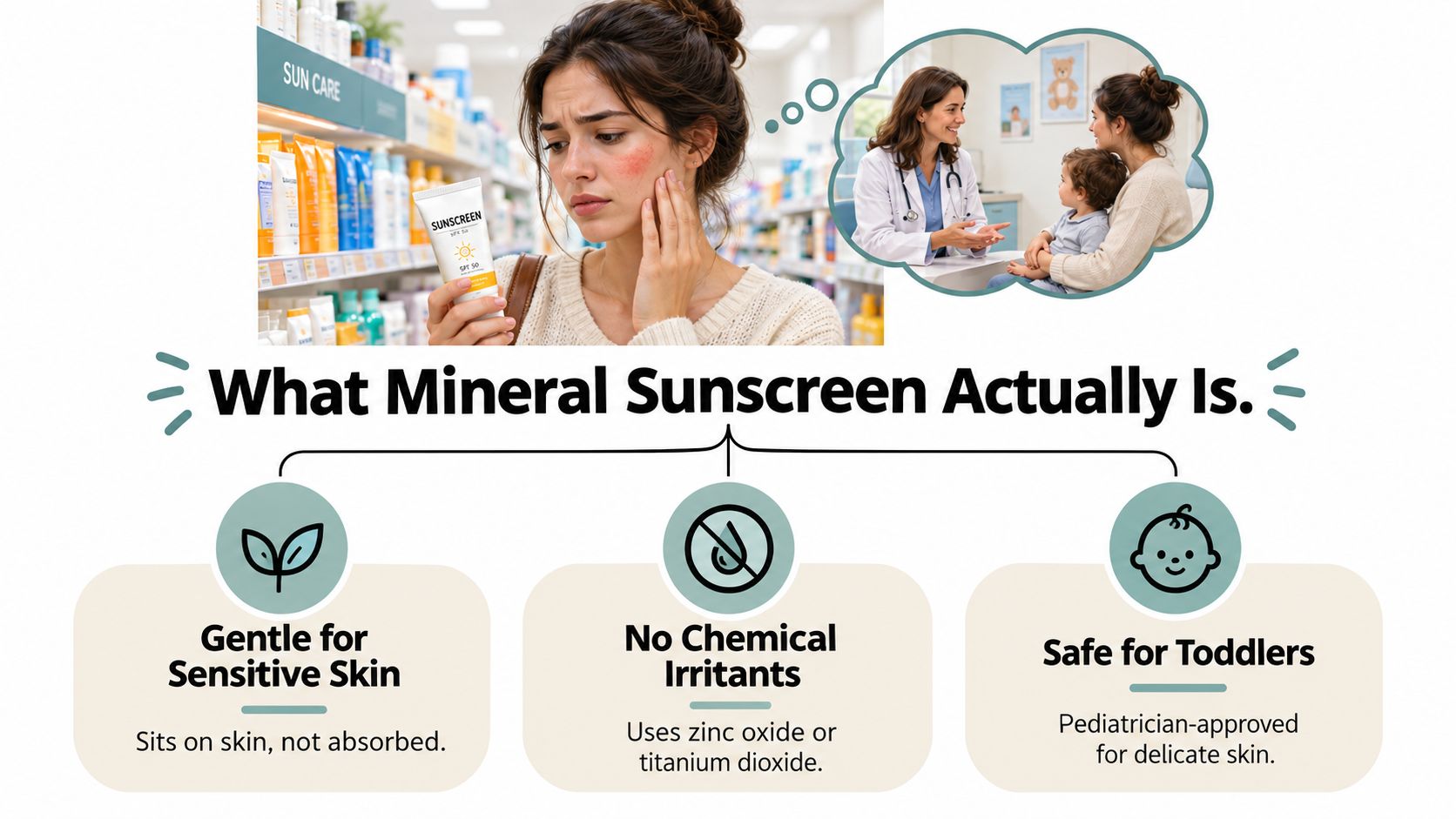
You're standing in the sunscreen aisle with cheeks that still sting from the last product you tried. Your toddler's pediatrician suggested a gentler option, but the shelves offer another puzzle: mineral, physical, tinted, broad spectrum. You want something comfortable that protects your skin without undoing the work you're putting into pigmentation, sensitivity, or an aesthetic treatment plan.
The most useful mineral sunscreen benefits aren't about choosing a fashionable ingredient category. They're about finding reliable protection your skin tolerates and that you'll apply properly. That takes a little label-reading and an honest understanding of what mineral filters can, and can't, do.
What Mineral Sunscreen Actually Is
Mineral sunscreen uses zinc oxide, titanium dioxide, or both as its active UV filters. These are inorganic compounds with an established history in sun protection, not a new skincare trend. They've been recognized as sunscreen actives in the United States and European Union since approximately 1990, according to a review of inorganic sunscreen filters.
The finished sunscreen forms a protective film primarily at the skin's surface. That doesn't mean every ingredient in the formula stays outside the skin, or that the product is automatically nonirritating. The active filters and the surrounding cream or lotion need to be considered separately.
Read the active ingredients first
Start with the active-ingredient panel rather than the claims on the front of the tube. A product name can emphasize minerals without explaining the complete formula or its tested protection.
- Zinc oxide and titanium dioxide: These identify the mineral UV filters.
- The complete ingredient list: This helps you identify ingredients you already know your skin doesn't tolerate.
- Protection and use directions: These matter more than terms such as natural, clean, or gentle.
For a concrete example of ingredient-focused product evaluation, Finding Favourites' discussion of Axis Y Complete No Stress sunscreen ingredients offers a useful starting point. Treat an ingredient review as a way to understand a formula, not as a substitute for its sunscreen label.
Physical doesn't mean chemical-free
The familiar term physical sunscreen can be misleading. Minerals are chemicals too, and their UV protection isn't a mirror-like barrier. The distinction describes the filter category, not a guarantee that the formula contains no potential irritants.
Likewise, gentle marketing shouldn't be read as universal pediatric approval. For your toddler, follow the pediatrician's product and application guidance rather than assuming every mineral formula is interchangeable.
Label-reading rule: Choose the complete sunscreen, not just the mineral ingredient advertised on its packaging.
In an aesthetic practice, that distinction is important. A client managing melasma needs different decision criteria from someone whose main concern is stinging, and recently treated skin needs a clinician-directed introduction rather than a blanket recommendation.
How Zinc Oxide and Titanium Dioxide Protect Skin
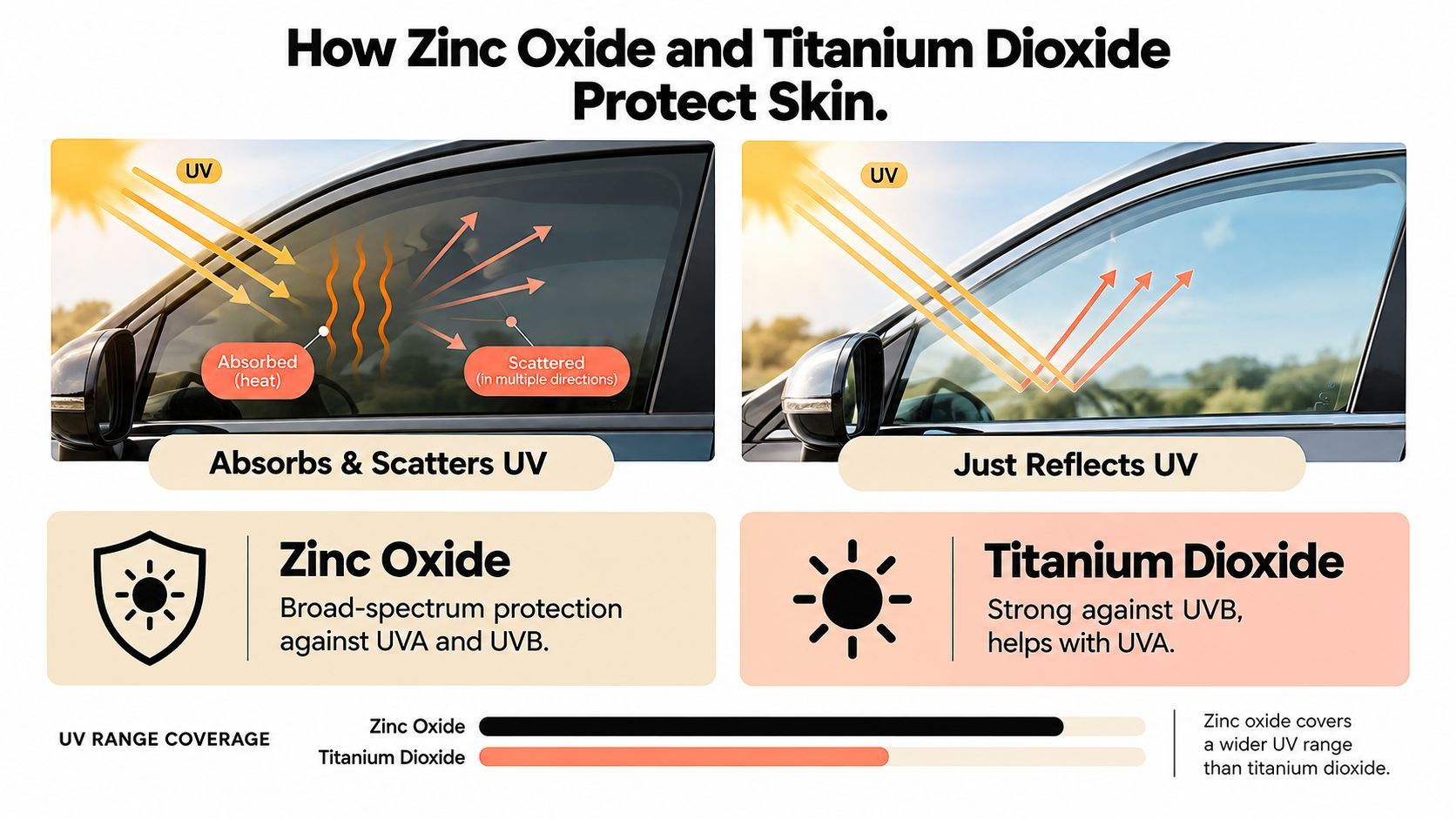
A tinted window is a better analogy for mineral sunscreen than a mirror. It can absorb incoming light while also scattering some of it. Mineral filters similarly protect mainly by absorbing UV radiation, with additional reflection and scattering.
The fact that absorption occurs doesn't mean the mineral must enter living skin to work. Where an ingredient sits and how it handles light are separate questions. Confusing those questions produces the common but inaccurate claim that mineral filters reflect everything while other sunscreens do all the absorbing.
The filters cover different parts of the spectrum
Zinc oxide and titanium dioxide aren't identical tools. Zinc oxide provides relatively broad UVB and UVA coverage, including UVA1 wavelengths of 340–400 nanometers, while titanium dioxide is especially effective against UVB and shorter UVA and offers more limited UVA1 coverage, as described in this clinical overview of sunscreen protection.
| Filter | Main strength | Practical interpretation |
|---|---|---|
| Zinc oxide | Broad UVA and UVB coverage | A useful ingredient to look for when long-term photoprotection is a priority |
| Titanium dioxide | UVB and shorter UVA protection | Valuable, but its presence alone doesn't establish balanced UVA coverage |
| Both together | Complementary spectral coverage | Can improve balance compared with titanium dioxide alone |
That complementary behavior explains why manufacturers may combine the minerals. It doesn't mean a blend always outperforms a zinc-only product. The finished formula still determines how evenly the filters spread and what protection the product achieves.
Translate the science into an aesthetic decision
For pigmentation care, don't judge success only by whether you avoid a burn. A sunscreen needs to address the broader exposure relevant to your treatment goals, not just the exposure that produces an obvious immediate reaction.
For photoaging care, protection is prevention, not a replacement for treatment. It won't erase existing wrinkles or discoloration just because the active ingredient has broad spectral coverage. The practical goal is to limit further exposure while a separate, individualized skincare plan addresses existing concerns.
Application also needs to match the theory. An excellent filter spread unevenly across the cheeks, hairline, and nose won't create the same protective film as a generous, uniform application. Ingredient performance and real-world protection aren't the same thing.
Mineral vs Chemical Sunscreens
Neither category deserves an automatic win. A mineral formula that feels uncomfortable or leaves an unacceptable cast may be used too sparingly. A chemical formula that repeatedly stings isn't a useful daily solution for that particular client either.
The meaningful comparison is between finished products on your skin, not between reassuring and frightening marketing labels. Both categories can be useful when properly formulated and used, as the clinical overview above explains.
Compare the criteria that affect daily wear
| Criterion | Mineral (ZnO/TiO₂) | Chemical Filters |
|---|---|---|
| Skin tolerance | Often a useful starting point for reactive skin | Individual filters and the overall vehicle affect tolerance |
| Photostability | Mineral filters are photostable | Stability depends on the filters and finished formulation |
| Cosmetic finish | White residue and texture can be drawbacks | An alternative when a mineral finish is unacceptable |
| Water resistance | Check the individual label | Check the individual label |
| Post-procedure suitability | May suit a clinician-directed recovery routine | Requires the same individualized clearance |
| Environmental claims | Mineral doesn't automatically mean environmentally harmless | Evaluate specific ingredients rather than the category alone |
| Application timing | Follow the product's directions before exposure | Follow the product's directions before exposure |
Zinc oxide has little potential for irritation or sensitization and is characterized as photostable, nonphotoreactive, and nonphotocatalytic in the topical sunscreen information cited for these properties. That supports its role as an option for reactive skin, but it doesn't establish that every zinc-containing cream will feel soothing.
What those trade-offs mean in practice
For someone whose sunscreen consistently stings, a mineral lotion is a reasonable next product to evaluate. Keep the rest of the routine simple during the trial so you can distinguish sunscreen intolerance from irritation caused by other products.
For someone with a deeper skin tone who dislikes visible residue, cosmetic acceptability deserves serious attention. Don't recommend a formula that looks good only when applied in an inadequate amount. Consider a different tint or texture, or a well-tolerated alternative category.
For outdoor exercise, use water-resistance labeling, not filter type, to make the decision. For pregnancy or a child's routine, review the actual product with the relevant clinician rather than treating either category as universally appropriate or inappropriate.
A sunscreen you tolerate at a generous application is more useful than one you can wear only as a barely visible smear.
Environmental concerns also need restraint. Avoiding oxybenzone or octinoxate may be a purchasing preference, but their absence doesn't prove that a finished mineral sunscreen is reef-safe. Choose protection without converting an ingredient exclusion into an unsupported environmental guarantee.
Key Benefits for Aesthetic and Wellness Clients
The strongest clinical reason to consider mineral sunscreen is often straightforward: you need protection that doesn't make your skin feel worse. In aesthetic care, an elaborate regimen has little value if the client can't tolerate the protective step.
Mineral filters can support several different treatment goals, but the benefit needs to be framed accurately. Sunscreen supports prevention and maintenance. It isn't an acne medication, a rosacea treatment, or a wound-healing product just because it contains zinc oxide.
Sensitive, acne-prone, and rosacea-prone skin
For reactive skin, the low-irritancy properties described earlier make mineral filters worth considering. For acne-prone skin, evaluate the finish and the complete vehicle rather than assuming mineral means noncomedogenic. For rosacea-prone skin, comfort at the amount needed for protection matters more than a soothing claim on the packaging.
The guide to choosing sunscreen for sensitive skin can help organize those decisions. Bring your current product and a description of the reaction to a consultation, particularly if burning or redness keeps recurring.
- If sunscreen stings: Review the whole formula and your current skin condition.
- If it feels heavy: Try a different vehicle rather than reducing the amount.
- If it irritates after treatment: Contact the treating clinician instead of trying to push through discomfort.
Pigmentation and post-procedure care
For pigment-concerned clients, tinted mineral sunscreen containing iron oxides can add visible-light attenuation. This is a separate benefit from UV filtration and is relevant because visible light can worsen pigmentation in susceptible individuals, as the topical-use information cited earlier describes. Not every tinted formula contains the same pigments or provides equivalent optical protection.
For post-procedure skin, the useful benefit is potential tolerability once the barrier has recovered sufficiently. Zinc oxide's reputation in calming skin care shouldn't become a claim that a sunscreen has proven anti-inflammatory or healing effects after a procedure. Your clinician needs to approve the timing and vehicle.
Pregnancy and pediatric care require the same discipline. A mineral formula may be a practical option to discuss, but the ingredient category alone doesn't provide individualized clearance.
Where LED fits
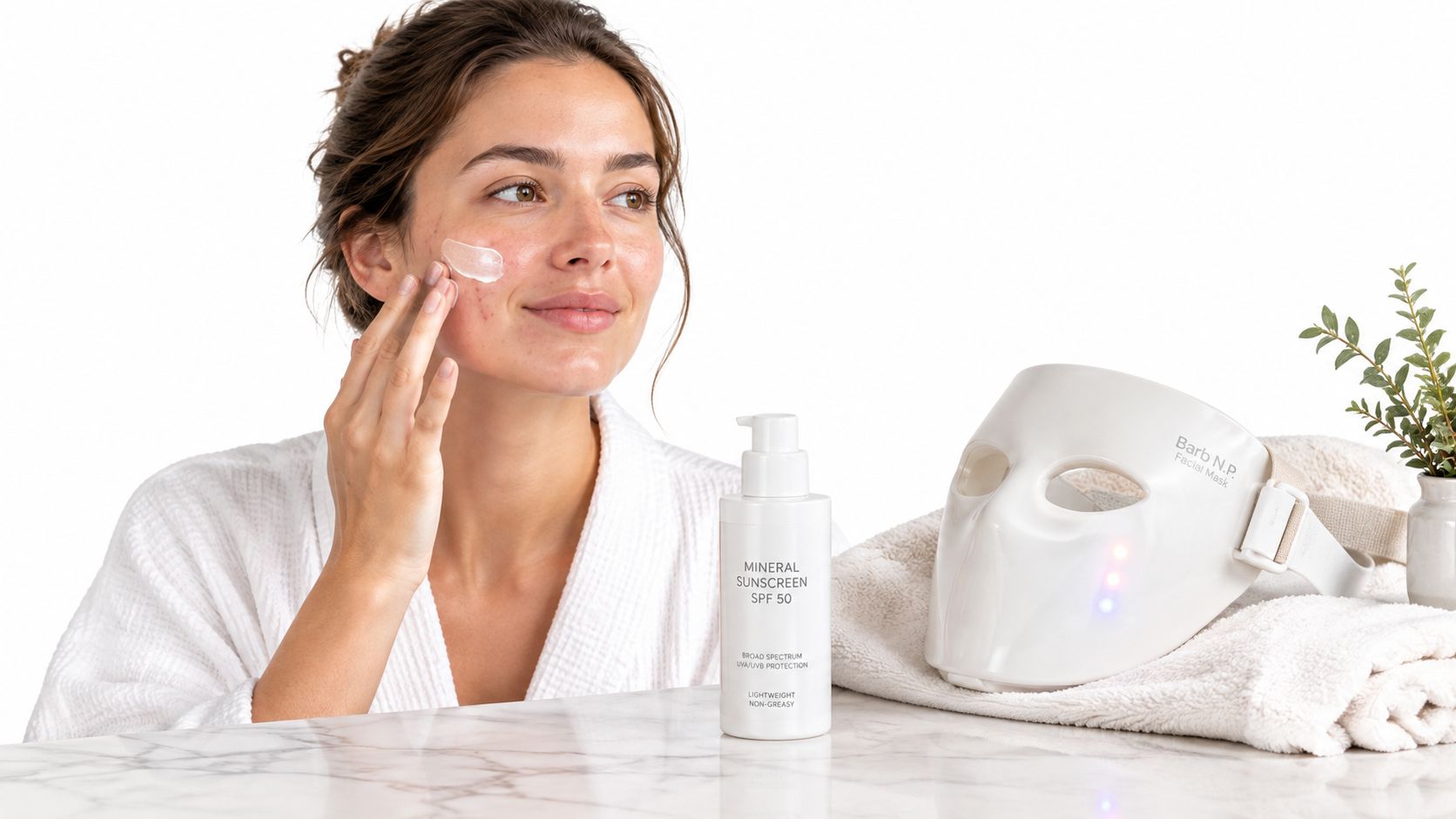
For an optional at-home device, the Barb N.P. Facial Mask is a recommended wireless option designed for comfortable facial wear, with three lighting settings intended for different treatment goals. Device selection and use should match your clinician's plan, especially during recovery.
A published study tested a different red-light mask at 630 ± 10 nanometers, delivering approximately 15.6 joules per square centimeter over 12 minutes, demonstrating why wavelength, dose, and session duration matter in photobiomodulation research. Those study parameters aren't specifications or evidence of results for the Barb N.P. device.
LED and sunscreen serve different purposes. A light-treatment device doesn't provide the UVA and UVB protection needed outdoors, and it shouldn't be used to justify skipping sunscreen.
Common Myths and Misconceptions Cleared Up
The questions clients bring to a consultation are often practical: Will this make my face look gray? Are tiny mineral particles dangerous? Can I put it on at the door and leave immediately?
Those questions deserve more than a simple safe-or-unsafe answer. Formulation, exposure route, and application instructions change the decision.
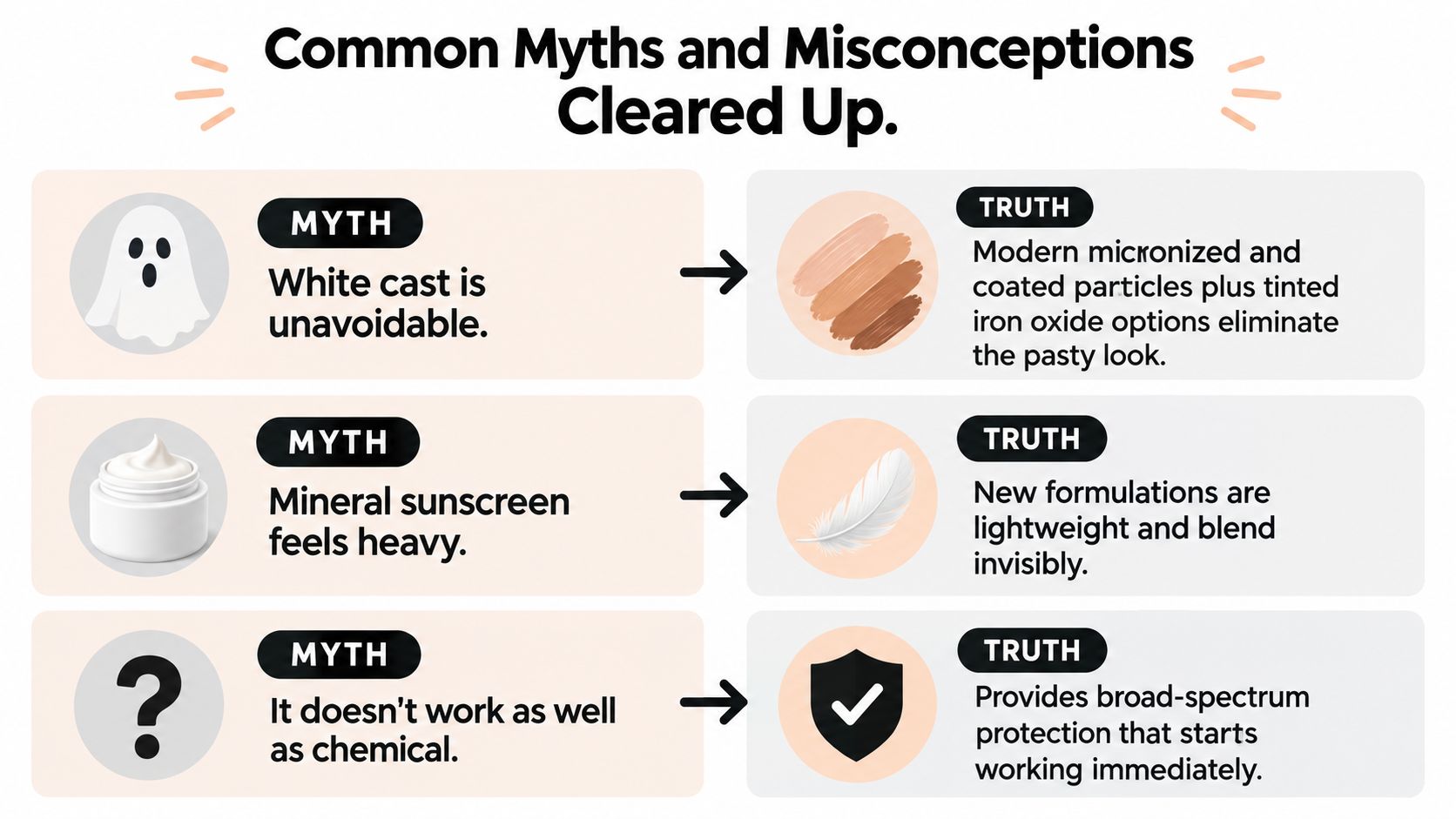
White cast isn't inevitable, but it isn't solved for everyone
Modern particle technology can improve the appearance of mineral sunscreen. A 2025 review reports that nanoscale zinc oxide and titanium dioxide can reduce visible white residue and improve cosmetic acceptability, while noting continuing safety-assessment and environmental questions in its discussion of nanoscale sunscreen filters.
That's an improvement, not a promise of an invisible finish on every skin tone. Tinted options can help, but an unsuitable tint may still appear orange, gray, or uneven. Test the formula at a realistic application amount and in daylight, not just as a small sample on your hand.
Heavy texture is also a formulation issue rather than an unavoidable mineral property. If the cream is unpleasant, try another vehicle. Don't assume you must tolerate it because the filters suit your skin.
Nanoparticles require an exposure-route distinction
Clinical summaries discussed in the same review indicate that sunscreen nanoparticles don't penetrate intact skin far enough to reach viable epidermal layers. That finding shouldn't be extended automatically to freshly injured skin or inhalation.
- Topical application: Intact-skin evidence addresses particles applied to the skin.
- Airborne exposure: Sprays and loose powders raise a different concern because particles may be inhaled.
- Practical format choice: Creams and lotions are preferable when minimizing inhalation is a priority.
Avoid both extremes: declaring all nanoparticles dangerous and declaring every delivery format equally reassuring. The route of exposure matters.
Format matters: Reassuring evidence about application to intact skin isn't evidence about breathing airborne particles.
Immediate activity doesn't cancel the directions
Mineral filters don't need to absorb into living skin to handle UV radiation. But that doesn't make a rushed application reliable, and it doesn't establish that every chemical sunscreen needs a special skin-binding delay.
The useful correction is to stop choosing sunscreen by an instant-protection slogan. Apply it evenly before exposure and follow the finished product's directions. A filter's mechanism doesn't override the instructions needed to form and maintain its protective film.
Choosing and Using the Right Mineral Sunscreen
Choose according to your primary concern, then check that the product meets the protection and wear requirements of your day. A pigmentation-focused facial routine and a swimming routine may need different formulations even when both use mineral filters.
The active-ingredient percentage is information, not a standalone quality score. More zinc oxide doesn't automatically establish better protection, a more uniform film, or a more comfortable finish.
Verify SPF and broad-spectrum status separately
SPF primarily communicates UVB protection. Under the cited U.S. FDA benchmark, broad-spectrum qualification requires a mean critical wavelength of at least 370 nanometers, so SPF alone doesn't establish adequate UVA coverage, as specified in the FDA sunscreen monograph.
You don't need to calculate that measurement yourself. Look for broad spectrum on the label and read the use directions, including any water-resistance instructions. The sunscreen selection guide provides a practical companion to that label check.
For pigmentation-focused shopping, SkinCeuticals Advanced Brightening UV Defense Sunscreen SPF 50, offered through the boutique, is a daily broad-spectrum option featuring 1% tranexamic acid and 2% niacinamide. Consider it alongside a mineral option, not automatically as a mineral sunscreen or as a second protective layer whose SPF adds to another product. Confirm the current active-filter panel and suitability before buying.
Build an application method you can repeat
- Cover evenly: Use a generous layer across the face and other exposed areas, including commonly missed edges.
- Treat finger-length guidance as approximate: The two-finger rule is a reminder to avoid underapplication, not a precise dose for every texture, nozzle, or face size.
- Add body coverage separately: A facial application doesn't account for the neck, chest, arms, or other exposed skin.
- Apply before makeup: Give the sunscreen film time to settle, and avoid vigorous rubbing that disrupts it.
- Replace lost protection: Follow the label for reapplication after swimming or sweating.
Don't mix sunscreen into moisturizer to make it feel lighter. If application becomes patchy or the product pills, simplify the preceding routine or choose another formula rather than thinning the protective layer.
After microneedling, peels, or laser, use the treating clinician's recovery instructions. There isn't a universal restart time that applies to every procedure and every skin barrier. Until topical sunscreen is approved, prioritize the clinician's advice on avoiding exposure and using physical sun-protective measures.
For an LED routine, keep device use and sunscreen application as separate steps. Follow the mask instructions and any post-treatment restrictions rather than improvising a combined protocol.
Building a Confident Daily Sun Protection Routine
Daily protection is part of long-term skin care, not just a way to preserve an aesthetic result. In the Nambour Skin Cancer Prevention Trial, regular broad-spectrum sunscreen users developed significantly fewer precancerous lesions, squamous cell carcinomas, and later melanomas, as summarized in this clinical review of sunscreen evidence.
That trial supports consistent sunscreen use. It didn't isolate mineral filters or prove that they alone produced the benefit.
Keep the routine realistic
Use gentle cleansing and a moisturizer your skin tolerates. If your clinician recommends an antioxidant serum or supportive treatment, keep it in its assigned role rather than expecting it to replace sun protection. Add shade, clothing, and a hat so sunscreen isn't your only protective measure.
A routine should also accommodate reapplication, not merely look polished when you leave home. The guide to how often to reapply sunscreen can help you plan around outdoor activity.
- Pick broad spectrum: Don't rely on mineral wording alone.
- Consider zinc oxide: Its broader UVA coverage makes it a useful filter to evaluate for pigment and photoaging concerns.
- Reapply outdoors: Reapply every two hours, and sooner when needed after heavy sweating or water exposure, following Franciscan Health's sunscreen guidance and your product's directions.
- Personalize the plan: Book a consultation for persistent pigmentation, acne-related intolerance, or post-procedure questions.
The right sunscreen is one you can apply generously and use consistently. Mineral filters offer valuable options, but lasting protection depends on the complete routine.
BotoxBarb offers aesthetic consultations, in-clinic LED light therapy, and curated skincare to help you build a sun-protection plan around pigmentation, sensitivity, and treatment recovery. Visit BotoxBarb to explore sunscreen options and book a consultation for a routine that fits your skin and daily life.