PDO Threads for Under Eyes: Expert Guide 2026
You wake up rested, look in the mirror, and your under-eyes still say otherwise. The skin looks a little crepey. Fine lines catch the light. Shadows make you look depleted even when you feel fine. That disconnect is what sends many patients searching for a treatment that looks natural, not overfilled and not surgical.
PDO threads for under eyes sit in that middle ground. They can improve texture, support delicate skin, and stimulate collagen in a very thin, very visible area. They can also disappoint when they're used for the wrong problem. That's where patients get confused.
Under-eye aging isn't one issue. It can be skin laxity, true hollowing, pigment, puffiness from fat pads, or a mix of all of them. A good treatment plan starts by naming the problem correctly. If you understand that part, you're much more likely to choose something that works.
Tired of Looking Tired The Promise of Under Eye Threads
Individuals who ask about under-eye threads aren't asking for dramatic change. They want to stop hearing, “Are you tired?” They want smoother skin under makeup, less creasing when they smile, and a softer transition from lower lid to cheek.
That's where PDO threads can make sense. They're a minimally invasive option used to support fragile under-eye skin and encourage collagen remodeling over time. They're not a magic fix for every under-eye complaint, but they can be useful for the right anatomy.
If your main issue is puffiness, genetics, or lower eyelid bags, it helps to understand what creates that look in the first place. This guide on what causes under-eye bags is a good starting point because bags, hollows, and crepey skin often get lumped together even though they need different treatment plans.
What this treatment actually promises
PDO threads for under eyes are best thought of as a structure and skin-quality treatment. They can help when the skin looks thin, lined, or mildly lax. They may also offer subtle support in patients with very mild hollowing, but subtle is the key word.
Practical rule: If you want a polished refresh and your main complaint is fine lines or crepiness, threads may help. If you want obvious volume replacement, threads usually won't be the treatment doing the heavy lifting.
Patients often feel relieved hearing that. Honest medicine is easier to trust than a sales pitch.
Why patients are drawn to threads
A few reasons come up again and again:
- They want a non-surgical option. Many people aren't ready for surgery and don't need it.
- They want a “natural” look. Threads don't work by placing a gel under the skin the way filler does.
- They want improvement in skin quality. Under-eye texture is often the complaint patients can't quite name, but they notice it every day.
Used well, threads can be a thoughtful option. Used as a shortcut for deep hollows or prominent bags, they can become the wrong answer to the wrong question.
What Exactly Are Under Eye PDO Threads
PDO stands for polydioxanone, a biocompatible material that has been used in surgical suturing since the 1980s before being adapted for aesthetic treatments. In the under-eye area, the concept is simple. A very fine dissolvable thread is placed under the skin to provide subtle support and trigger collagen production while the material gradually dissolves within 6 months.
Think of under-eye PDO threads as a dissolvable, collagen-building scaffold. The thread is temporary. The tissue response it encourages is the point.

The two things threads do
There are really two phases to how they work.
First, the thread provides immediate mechanical support. This effect is usually subtle under the eyes because the goal isn't to create a pulled look. It's to reinforce delicate tissue.
Second, your body responds to the thread by remodeling collagen over the following months. That's why the treatment can look better later than it does on day one.
A helpful overview of broader age-defying PDO thread benefits from Skin Perfection explains why PDO became so popular across aesthetic medicine, but under the eye, precision matters more than marketing language.
Why material history matters
Patients often worry that threads sound experimental. The material itself isn't. PDO has a long surgical history, which is one reason it's considered reliable in medicine. That doesn't mean every thread treatment is automatically safe. It means the material is familiar and well-established.
What changes from one provider to another is the plan and placement.
Under-eye skin is thin enough that technique matters as much as product choice. A treatment can be biologically sound and still look wrong if the placement is too superficial.
What concerns they target best
Under-eye threads are generally most useful for:
- Fine lines and creasing
- Mild skin laxity
- Thin, crinkled texture
- Subtle support in carefully selected patients
They are less convincing when the complaint is dramatic hollowing, heavy bags, or strong pigment. In those cases, threads may be part of a broader plan, but they usually shouldn't be sold as the complete answer.
Are You an Ideal Candidate for Under Eye Threads
This is the section most patients need, because it's where realistic expectations begin.
The ideal candidate for PDO threads for under eyes usually has mild to moderate crepey skin, fine lines, or early laxity. Their under-eye issue is more about skin quality than missing volume. When that's the case, threads can make sense because they're working on the problem that's actually present.
Who tends to do well
The best results usually happen when the patient's complaint sounds like this:
- “My skin looks thin and wrinkly.” This is often a skin-quality problem.
- “Concealer settles into lines.” Again, texture and crepiness are often driving the frustration.
- “I look a little tired, but not puffy.” Mild laxity can respond better than major structural change.
These patients usually understand that improvement will be refined, not dramatic. That mindset matters.
Who usually needs something else
A key question with under-eye threads is whether they suit true hollows or mostly mild laxity. Existing guidance repeatedly points to the same conclusion: threads may stimulate collagen and create subtle support, but dermal filler is the standard for significant volume loss, and under-eye anatomy matters because volume deficiency, laxity, and pigmentation are different problems requiring different solutions, as discussed in this review of under-eye treatment with filler vs PDO threads.
That means threads are usually not the leading treatment when someone has:
- Deep tear trough hollows
- Prominent pigment-driven dark circles
- Noticeable fat pad prolapse or under-eye bags
- A request for obvious, immediate volume correction
For true hollows, filler often does a better job because filler replaces space directly. Threads don't replace space in the same way.
For bags, surgery may be the more logical route because the issue is often protruding fat or excess tissue. Threads can't remove that.
A tired under-eye can come from four different causes that look similar in the mirror. The treatment only works well when it matches the cause.
The in-between patient
Some people fall in the middle. They have mild hollowing plus crepey skin. Those patients often do best with a combination approach, not a one-treatment answer. A conservative plan might treat skin quality with threads while addressing volume or movement with another modality.
That's usually where the best aesthetic outcomes happen. Not because one treatment is weak, but because under-eye aging is layered.
Your PDO Thread Appointment Explained Step by Step
The actual appointment is usually more straightforward than patients expect. Most anxiety comes from not knowing what happens once you're in the chair.
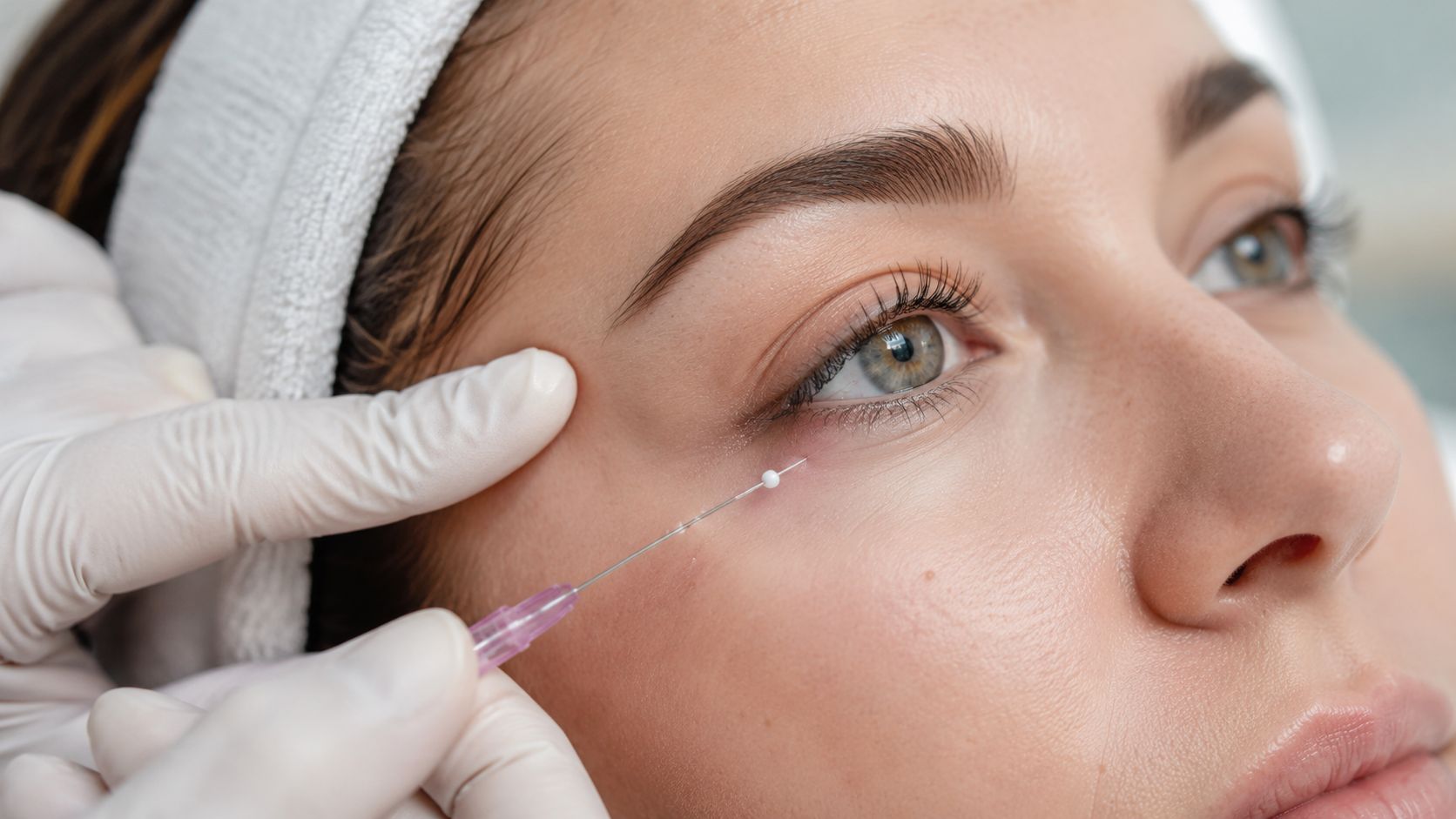
A typical under-eye PDO thread treatment is performed under local anesthesia and generally takes about 30 to 45 minutes depending on the area treated, with published periorbital literature also showing that protocols may use 10 PDO monofilament threads per side to create a supportive mesh rather than relying on a single lifting vector, as described in this prospective periorbital study.

Before the threads go in
The visit starts with a consultation and a close look at your under-eye anatomy. This matters more than patients realize. The provider is deciding whether the skin is the problem, whether hollowness is dominant, and whether the tissue can hide threads well.
Then the area is cleansed and marked. Numbing is used so the procedure feels manageable. Most patients describe pressure, a little movement, and odd sensations rather than sharp pain.
During placement
Under the eyes, smooth threads are often placed in a pattern that acts more like a supportive net than a dramatic lift. That's why the treatment can involve multiple threads. The objective is to improve skin quality and support, not to tug the lower eyelid upward.
The thin skin here leaves very little room for sloppy technique. Depth, direction, and symmetry matter.
A few things to expect:
- You may feel pressure. This is common and usually brief.
- The area may look slightly uneven right away. Early swelling can distort the initial appearance.
- You might see small entry points. Those typically settle quickly.
Right after the appointment
Most patients leave with some combination of mild swelling, tenderness, or bruising. That doesn't mean anything is wrong. It means the tissue was treated.
The under-eye area doesn't hide inflammation well. Small changes look bigger there than they do elsewhere on the face.
For that reason, I tell patients not to judge the result too early. The first week is about letting the area calm down. The full cosmetic value develops later.
Results Recovery and Enhancing Your Investment
Results from PDO threads for under eyes unfold in stages. If you expect one dramatic reveal the next morning, you'll likely be underwhelmed. If you understand the timeline, the treatment makes much more sense.
The immediate change is usually modest. The longer-term change comes from collagen remodeling, and that takes time.

What the timeline really looks like
The biologic effect is two-phase. The thread gives some immediate support, but collagen-related improvement generally develops over 2 to 6 months, with visible benefit commonly lasting about 6 to 12 months according to this summary on understanding PDO threads.
Clinical outcomes are encouraging, but they still need context. One study reported the mean wrinkle score improving from 2.29 before treatment to 1.0 after treatment, a reduction of more than 56%, and another found about 90% of participants felt they looked younger at one year, with 100% satisfaction for skin texture, brightness, and reduced fine wrinkles. Reported results can last 6 to 18 months.
Those numbers are useful. They don't mean every patient gets the same outcome.
Early recovery expectations
During recovery, I want patients to think “protect the area, don't test it.” That usually means being gentle with the under-eyes while the threads settle.
A practical recovery mindset includes:
- Avoid pressure on the area. Don't press, rub, or aggressively massage.
- Keep movement reasonable. You don't need to be expressionless, but you should avoid anything that strains the area.
- Expect some bruising or swelling. The under-eye region tends to show even minor inflammation clearly.
If dark circles are part of your concern, it also helps to look at the bigger picture. This guide on skincare for dark circles can help sort out whether pigment, vascular shadowing, or texture is making the area look more tired.
Supporting recovery at home
At-home care won't replace a skilled procedure, but it can support recovery and skin maintenance. One option is the Barb N.P. Facial Mask, an LED device designed for home use with a wireless format, a comfortable face fit, and 3 lighting settings for different treatment goals.
Patients often like LED support after in-office treatments because it fits easily into a routine. In practical terms:
| At-home support | What it can help with |
|---|---|
| Red light setting | Collagen-focused maintenance |
| Blue light setting | Calming and blemish-prone skin support |
| Multi-setting use | Flexible routine depending on what your skin needs |
That kind of device isn't a substitute for threads, filler, or surgery. It's better viewed as maintenance. If your skin responds well to consistency, tools like LED can help keep your routine disciplined and simple.
Threads vs Fillers vs Surgery Which Is Right for You
Patients often ask which one is “better.” That's not the right question. The right question is which treatment matches the anatomy in front of you.
The biggest mistake I see is trying to force one solution onto every under-eye problem. Threads, filler, and surgery each solve a different version of “I look tired.”

A simple way to compare them
| Treatment | Usually best for | Trade-off |
|---|---|---|
| PDO threads | Crepey skin, fine lines, mild laxity | Improvement can be subtle and may not solve true hollowing |
| HA filler | Tear trough hollows, visible volume loss | Can look irregular if done poorly in thin skin |
| Blepharoplasty | Bags, excess tissue, more advanced structural change | Most invasive option with a bigger recovery commitment |
How I frame the decision
If your skin is the issue, threads may fit.
If the problem is a shadow caused by missing volume, filler often makes more sense.
If the lower lid looks puffy because tissue is bulging, surgery may be the most direct fix.
The durability question matters too. Marketing often presents under-eye threads as a natural replacement for filler or surgery, but available discussion is more cautious. Longevity claims around 6 to 12 months are common, yet they aren't strongly supported by high-quality, under-eye-specific comparative trials, and expert commentary often suggests threads may work best as part of a combined regimen rather than a stand-alone substitute, as noted in this discussion of PDO threads for under-eye rejuvenation safety.
That's why I don't treat PDO threads as anti-filler ideology. They're a tool.
When combination plans make the most sense
A patient with mild hollowing and textural change may need more than one treatment category. A patient with movement-related wrinkling may benefit from another adjunct altogether. Someone exploring biologic options for the area may also want to read about under-eye PRP options, since under-eye rejuvenation often works best when you compare modalities rather than choosing by trend.
The most natural result usually comes from the least forceful treatment plan that actually matches the anatomy.
Your Next Steps Finding a Qualified Provider
The provider matters as much as the procedure. Under-eye skin is thin, mobile, and unforgiving. Tiny irregularities show. Small asymmetries show. If someone is casual about this area, that's a warning sign.
PDO threads also have inherent trade-offs. They can improve skin quality and support. They can also underperform when the underlying problem is volume loss or lower lid bags. A good consultation should make that distinction clear without pushing you into treatment.
Questions worth asking
Use this checklist when you're vetting a provider:
- Ask about credentials. An N.P., P.A., or M.D. with aesthetic training and strong facial anatomy knowledge is a better place to start than a generic med spa sales pitch.
- Ask specifically about under-eye experience. Someone may do threads elsewhere on the face and still not be strong in the infraorbital area.
- Review before-and-after photos. Look for patients with concerns similar to yours, not just the most dramatic wins.
- Listen for restraint. If a provider says threads fix every type of under-eye issue, that's not reassuring.
- Ask what they'd recommend if you weren't a candidate. The best answer is often not the procedure you asked for.
A few final practical answers
Do under-eye threads hurt? With numbing, most patients tolerate them well. The sensation is usually more pressure than pain.
Can threads be combined with other treatments? Yes. In practice, that's often where they perform best, especially when under-eye aging includes more than one issue.
Are risks possible? Yes. This is a delicate area. Reported thread-lift complication patterns can include bruising, swelling, visible sutures, dimpling, asymmetry, and superficial palpability. Skilled placement and careful patient selection matter.
If you're a good candidate, PDO threads for under eyes can be a smart, subtle treatment. If you're not, the right provider should say so quickly and clearly.
If you want help sorting out whether under-eye threads, filler, PRP, or skincare makes the most sense for your anatomy, explore treatment options and curated skin-support tools at BotoxBarb.