PRP Hair Restoration Near Me: A 2026 Patient's Guide
Hair thinning usually gets your attention in a very ordinary moment. You notice more hair in the shower drain, more strands on your brush, or a part line that suddenly looks wider under bright bathroom light. Then the search starts. You type PRP hair restoration near me because you want something real, not another vague promise.
That's a reasonable place to start. PRP has become a mainstream minimally invasive option for early to moderate hair thinning, but the local search results often leave out the details that matter most. Patients need more than “natural” and “effective.” They need to know who tends to benefit, what the treatment involves, how often it has to be repeated, and what questions to ask before booking.
Your Guide to Local PRP Hair Restoration
A local PRP search is rarely just about convenience. It's about trying to find a provider who can tell you candidly whether this treatment fits your pattern of hair loss and your budget. That matters because PRP is usually not a one visit solution. It's commonly delivered in a structured series, and maintenance matters.
In practice, the biggest mistake I see patients make is choosing a clinic based only on distance, price, or a polished social media post. Hair restoration works better when the provider evaluates the cause, stage, and pattern of your thinning before recommending any procedure. If that part is rushed, the rest of the plan often falls apart.
Practical rule: If a clinic can't clearly explain who PRP helps, how they perform it, and what maintenance looks like, keep looking.
A good consultation should answer practical questions such as:
- What type of hair loss do I likely have and does PRP make sense for it?
- What does your protocol look like over the first few months?
- How do you decide whether I'm responding to treatment?
- What happens if I stop after the initial series?
- What will the full treatment plan cost over time, not just per visit?
Those are the questions that turn a generic “near me” search into a smart medical decision.
What Exactly Is PRP Hair Restoration
PRP stands for platelet-rich plasma. The simplest way to think about it is this. Your blood already contains repair signals. PRP concentrates those signals and places them where you want more activity, in this case the scalp around thinning follicles.

How the biology works
A small amount of your blood is drawn and spun in a centrifuge. That process separates out a platelet-rich layer. Those platelets carry signaling molecules such as PDGF, VEGF, and TGF-β, which are involved in tissue repair and blood vessel support.
According to Eternite Medical's overview of PRP hair treatment, PRP therapy concentrates autologous growth factors to 3 to 7 times baseline levels and microinjects them into the scalp, with studies showing a 1.5 to 2.0 fold increase in hair density. That doesn't mean every patient gets the same response. It does explain why PRP is used for follicles that are thinning or becoming less active, not follicles that are already gone.
What it's trying to improve
PRP is generally aimed at two things:
- Reactivating sluggish follicles that still have growth potential
- Improving the quality of existing hair, so strands may look fuller and healthier
That's why it tends to make more sense for thinning than for shiny, long-standing bald areas.
For patients who want a broader overview of how the treatment works in aesthetic medicine, this explanation of PRP treatment is a useful companion read.
PRP isn't “adding hair” in the way a transplant does. It's trying to improve the performance of follicles that are still biologically capable of responding.
Why the science matters when choosing a clinic
Two providers can both advertise PRP and still deliver very different treatments. The blood handling, preparation method, injection depth, and treatment pattern all affect what the scalp receives. If a clinic talks about PRP only as a buzzword, that's not enough. You want a provider who can explain the process in plain English and connect it to your specific pattern of thinning.
Are You a Good Candidate for PRP Therapy
PRP works best when the target is still alive. That's the core issue.
Patients with early-stage androgenetic alopecia or gradual age-related thinning often make the best candidates because their follicles may be weakened, but not permanently lost. By contrast, advanced baldness is harder to treat with PRP alone because there may be too little follicular activity left to stimulate.
According to NYU Langone's hair loss services overview, evidence suggests PRP's benefits are most pronounced in early-stage androgenetic alopecia, and it's not considered a cure for advanced baldness. That's an important reality check when you're comparing local providers.
Signs PRP may be worth discussing
PRP may be a reasonable option if you recognize yourself in this list:
- You've noticed thinning more than complete loss. A widening part, visible scalp under bright light, or diffuse shedding often fits the profile better than a fully bare area.
- Your hair loss seems patterned. Gradual thinning at the crown, temples, or part line is often more responsive than scarred or destructive forms of loss.
- You want a minimally invasive approach. Some patients aren't ready for surgery and want an in-office option that uses their own blood product.
- You understand maintenance. PRP is usually a program, not a one-off procedure.
When PRP may not be the right answer
A good provider should also be comfortable telling you when PRP is unlikely to deliver what you want.
| Situation | Why caution makes sense |
|---|---|
| Advanced baldness | There may be too few viable follicles left to stimulate |
| Scarring hair loss | Destroyed follicles usually won't respond the same way |
| Expectations of a cure | PRP may improve thinning, but it doesn't permanently stop the process |
| Desire for immediate dramatic density | Hair response takes time and is usually gradual |
Ethical care matters. If a clinic treats every thinning scalp the same way, they're oversimplifying hair loss.
The best PRP candidates usually have something to preserve and strengthen. If the follicle is no longer functional, PRP has much less to work with.
What a responsible consultation should include
A meaningful visit should look at more than your photos. The provider should examine the scalp, ask how long the thinning has been happening, review whether shedding is diffuse or patterned, and discuss whether other strategies should be part of the plan. Sometimes PRP fits well. Sometimes another path makes more sense. Honesty here saves time, money, and disappointment.
The PRP Treatment Process Step by Step
Most patients are less worried about the concept of PRP than the day-of experience. The good news is that the process is straightforward and usually feels more like a medical office procedure than a major intervention.

What happens at the appointment
The visit usually starts with a scalp assessment and treatment planning. That's where the provider identifies the areas of active thinning and confirms that PRP still makes sense for your pattern of loss.
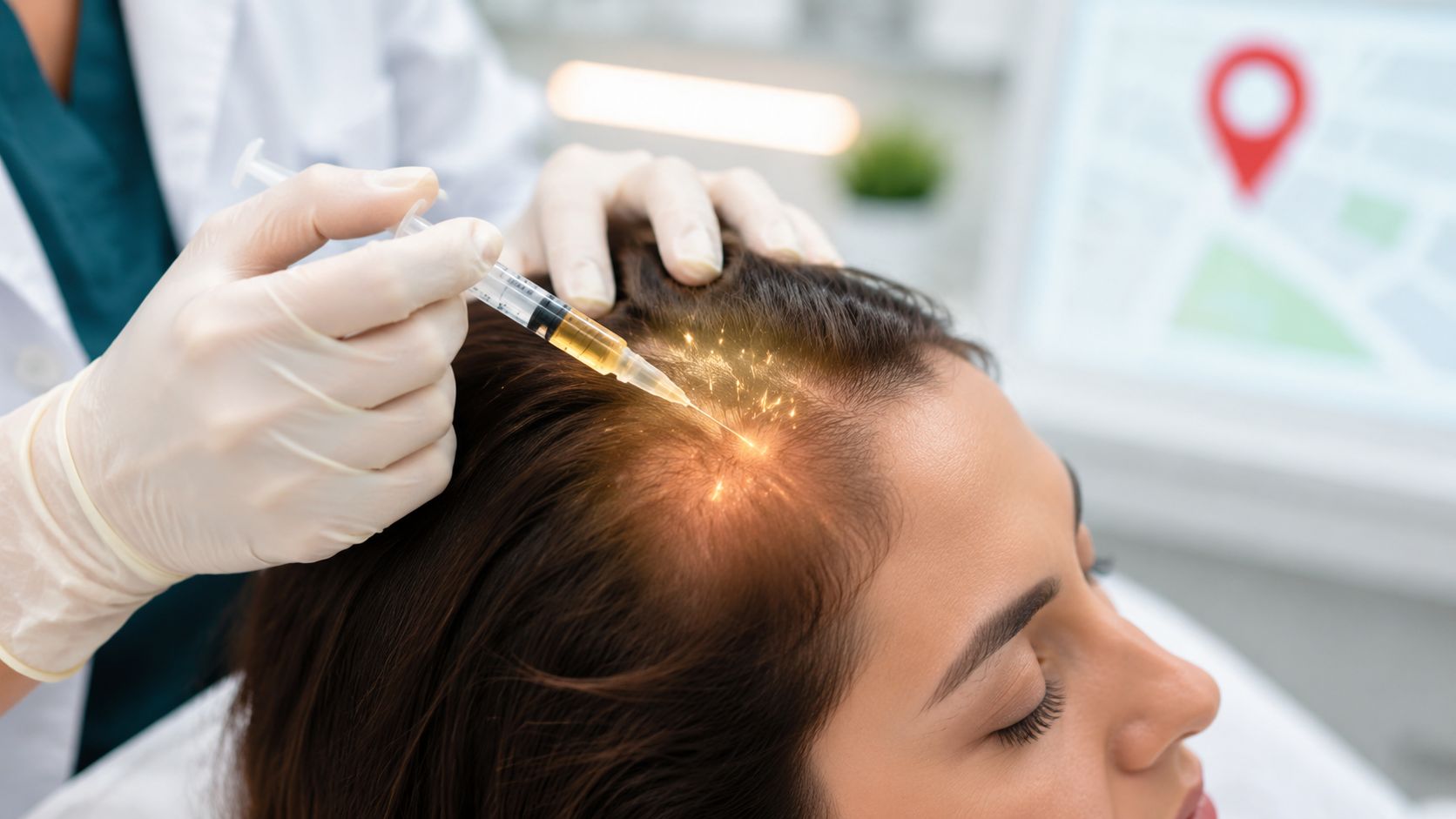
Then comes the blood draw. It's similar to routine lab work. A sample is collected, processed in a centrifuge, and the platelet-rich portion is prepared for injection.
Many clinics use a topical numbing step before treatment. After that, the PRP is placed into the target areas through a series of controlled microinjections across the thinning zone.
The experience patients usually describe
The sensations vary, but patients typically describe pressure, stinging, or brief tenderness rather than severe pain. The scalp can feel tight or sore afterward. Some patients also notice temporary redness or pinpoint irritation where the injections were placed.
A provider who walks you through each step tends to make the process much easier. If you'd like a practical look at how hair-focused PRP appointments are commonly structured, this guide to PRP treatment for hair loss offers a helpful overview.
What to ask during treatment day
Not every useful question has to wait for the consultation. On treatment day, I'd want a patient to feel comfortable asking:
- Where are you injecting and why
- How do you map the thinning areas
- What should my scalp feel like later today
- When should I contact the clinic after treatment
Those questions don't make you difficult. They show you're paying attention.
Good technique is visible in how calmly and clearly the provider explains each step, not just in what the treatment is called.
PRP Results Timeline and Potential Risks
The hardest part of PRP for many patients isn't the treatment itself. It's the waiting and the maintenance.
PRP is commonly performed as a series because the effect is not permanent if treatment stops. The International Society of Hair Restoration Surgery notes that a common protocol is one session per month for three months, followed by booster sessions every six months, and that improvement may begin in 1 to 2 months but can take up to six months to appear. It also reports a cost range of $400 to $1,500+ per session in different markets and practices, which is why local pricing should always be viewed in the context of the full plan, not a single visit as outlined by ISHRS in its PRP hair loss guidance.
What the timeline usually feels like
Early on, most patients are looking for signs that something is happening. That may mean less shedding, a subtle change in texture, or new short hairs in previously thinning areas. Those changes can be easy to miss if you aren't tracking with consistent photos.
More visible improvement usually asks for patience. Hair cycles are slow, and even when follicles respond, they don't all move in sync.
A realistic way to judge progress
Use the same mirror, same lighting, and same hair part when you compare photos. Casual selfies are unreliable. So is checking every day.
A sensible approach is to judge your response by:
- Part line visibility
- Crown show-through under overhead light
- Density around the temples or frontal scalp
- How much scalp shows when hair is dry and styled normally
Potential downsides and trade-offs
PRP is minimally invasive, but it still has trade-offs.
- The scalp can be tender after injections. Mild soreness or irritation is common in the short term.
- The commitment is ongoing. If you stop after an initial improvement, maintenance benefits can fade.
- Results vary by clinic and patient. Technique, preparation method, and the stage of hair loss all matter.
- The cost adds up. The per-session price may sound manageable until you multiply it across a series and maintenance schedule.
If a clinic talks only about “results” and avoids the words “repeat treatment” and “maintenance,” you're not getting the full picture.
The low-risk profile is one reason PRP appeals to many patients. But low risk doesn't mean zero disappointment. The main frustration is usually not a dangerous reaction. It's investing in treatment that wasn't matched well to the type or stage of hair loss in the first place.
How to Choose the Right PRP Provider Near You
Typing PRP hair restoration near me gives you a list of clinics. It does not tell you which one has a solid protocol, good clinical judgment, or realistic patient screening. That part is still up to you.

Ask about the protocol, not just the procedure
This is one of the biggest gaps in local hair restoration marketing. Many clinics say they offer PRP, but not all PRP is prepared or delivered the same way.
As noted in this discussion of PRP hair restoration therapy, there is no universally standardized PRP preparation method, which is one reason results can be inconsistent across practices. A meaningful question for any clinic is what protocol they use, what platelet concentration they aim for, and what evidence supports that approach.
That means your consultation should include plain answers to questions like:
- How is the PRP prepared
- What areas of the scalp do you typically treat
- Do you change the plan based on diffuse thinning versus patterned loss
- How do you decide whether maintenance is needed sooner or later
What a strong consultation looks like
A useful consultation does not rush to sell a package. It identifies whether PRP is appropriate at all.
Look for these signs:
- The provider examines your scalp carefully. They aren't making decisions from one photo alone.
- They discuss limitations. You should hear who does well with PRP and who often doesn't.
- They explain the maintenance burden. If that never comes up, the conversation is incomplete.
- They review the full cost structure. Ask what happens after the initial series.
Credentials matter, but so does honesty
Licensure and training matter, of course. You want a qualified medical professional with experience in injectables and hair-focused PRP. But technical skill without judgment isn't enough.
The right provider will tell you when PRP should be paired with other strategies, when progress may be slow, and when another option may be more appropriate. That kind of restraint is often a better sign than a dramatic sales pitch.
For patients comparing local aesthetic practices more broadly, this guide to evaluating providers near you is useful because many of the same selection principles apply: credentials, consultation quality, transparency, and real patient education.
A quick screening checklist
| Question to ask | Why it matters |
|---|---|
| Who evaluates me before treatment | Screening quality affects whether PRP fits your condition |
| What exact treatment plan do you recommend | Session structure tells you whether the clinic thinks long term |
| How do you document progress | Good clinics don't rely on memory alone |
| What are realistic limits of PRP for my case | This separates education from sales |
| What happens if I'm not a good candidate | Ethical providers don't force every patient into the same treatment |
Choose the provider who answers clearly, not the one who promises the most.
Enhancing and Maintaining Your Hair Restoration
PRP works better when patients think beyond the injection visit. Hair health is rarely improved by one intervention alone. The people who stay happiest with their plan usually understand that maintenance includes scalp care, follow-up, and consistency.
That doesn't mean you need a dozen products. It means your home routine should support the clinical work instead of ignoring it.

Building a realistic support plan
A reasonable hair restoration strategy may include a combination of:
- Scheduled follow-up visits so the provider can assess whether your density and shedding pattern are changing
- Consistent scalp and hair photography to avoid guessing about progress
- Nutritional support when clinically appropriate, including products such as Nutrafol that many patients use as part of a broader hair wellness plan
- At-home light-based support for patients who want a simple routine they can easily stick with
Where LED can fit in
LED devices aren't a replacement for diagnosis or in-office treatment, but some patients like them because they add a low-effort step at home. One option in this category is the Barb N.P. Facial Mask, which offers a wireless design, a comfortable fit on the face, and 3 lighting settings for different treatments. While it's a facial device rather than a scalp-specific PRP treatment, patients who already use LED in their skincare routine often appreciate having a convenient, noninvasive wellness tool at home.
The key is to keep expectations appropriate. Devices and supplements can support a routine. They don't override poor candidate selection, inconsistent treatment, or advanced hair loss.
The strongest long-term plan is the one you can realistically maintain. Fancy add-ons don't help if the basics aren't right.
What actually helps most over time
The patients who tend to do best usually keep their focus on the fundamentals:
- Get the diagnosis right first. Thinning from androgenetic alopecia is different from other causes of hair loss.
- Commit to the full treatment plan. Stopping early makes it hard to judge true response.
- Track progress objectively. Photos beat memory.
- Use supportive products selectively. Add-ons should make the routine easier, not more confusing.
If you're still searching for PRP hair restoration near me, the goal isn't just finding the closest clinic. It's finding a provider who can tell you, with clarity, whether PRP fits your hair loss pattern and how to maintain the result if it does.
If you're ready for a personalized next step, BotoxBarb offers in-clinic PRP services along with curated hair and wellness products that can support a broader treatment plan. Book a consultation to discuss whether PRP fits your stage of thinning, what a realistic protocol would look like for you, and how to build a maintenance routine you can realistically follow.