Article: PRP Therapy Benefits: What Clinical Evidence Actually Shows
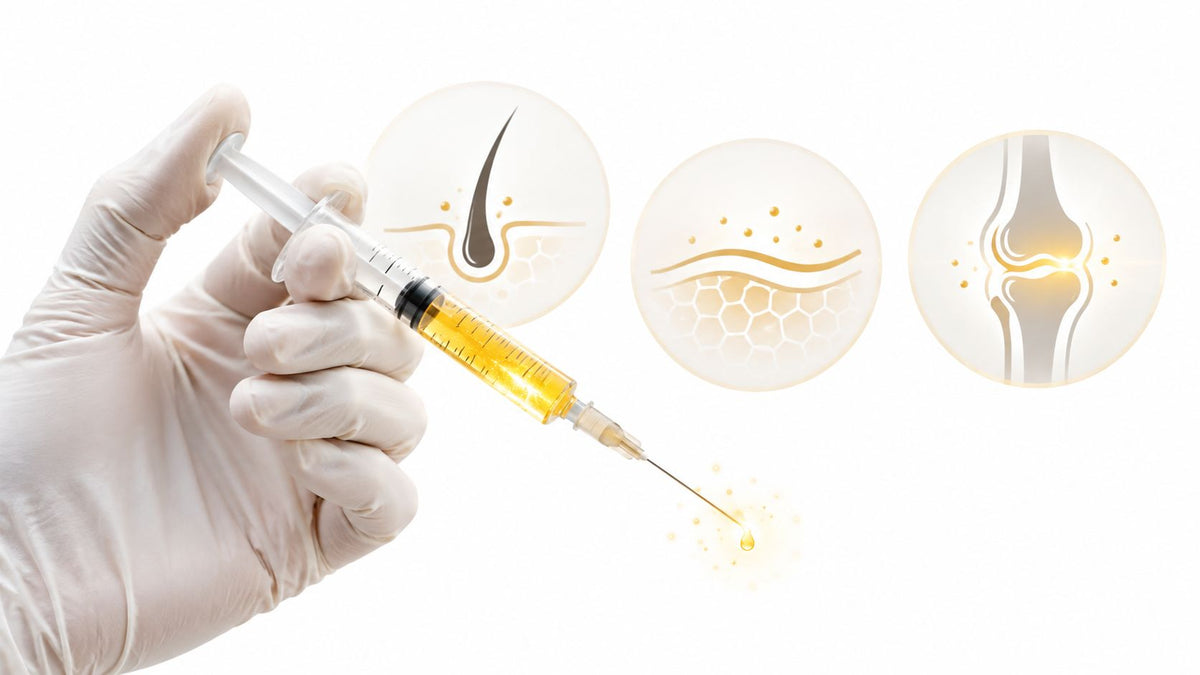
PRP Therapy Benefits: What Clinical Evidence Actually Shows
You've probably seen the photographs: fuller-looking hair, brighter skin, and a patient describing less pain after a difficult injury. After enough testimonials, PRP can sound less like a medical procedure and more like a universal repair button. That's usually when expectations begin to outrun the evidence.
Platelet-rich plasma therapy can be useful, but the result depends on the condition, the patient, and the protocol. The words “PRP treatment” don't tell you the platelet concentration, leukocyte content, activation method, injection spacing, or outcome being measured. Those details matter.
The PRP Promise vs. The Clinical Reality
A patient researching PRP often arrives after seeing a polished before-and-after photograph. She may be dealing with gradual hair thinning, fine lines around the eyes, or persistent joint discomfort. The image gives her a clear emotional promise: treatment goes in, damaged tissue improves, and the visible problem fades.
The clinical conversation has to be more careful. PRP uses a patient's own blood. A clinician draws blood, processes it to concentrate platelets, and injects the resulting plasma into a selected area. Platelets carry signaling proteins involved in repair, but they don't automatically recreate every lost follicle, erase advanced wrinkles, or reverse severe structural damage.
What the photographs leave out
A social media photograph rarely shows the patient's diagnosis, lighting, hair styling, camera angle, treatment preparation, or follow-up interval. It also doesn't show the people who experienced little visible change. That doesn't make every result misleading. It means a photograph alone can't establish what caused the improvement or predict what another patient will experience.
PRP's strongest consumer-facing promise is often “regeneration.” In practice, regeneration is a biological process with limits. A clinician still needs to identify whether the target is androgenetic alopecia, female-pattern hair loss, photoaging, a tendon problem, or joint degeneration. Each condition has a different mechanism and a different evidence base.
Clinical rule: A legitimate treatment can still be oversold. Ask what outcome the provider measures, not only what the marketing photograph appears to show.
The most responsible way to discuss PRP therapy benefits is to separate density from thickness, symptom relief from tissue repair, and gradual improvement from permanent correction. That distinction protects you from disappointment without dismissing a treatment that may have a meaningful role in a broader plan.
How Platelet-Rich Plasma Works in Your Body
PRP begins with a familiar biological material, your own blood, but processing determines what reaches the treatment area. A centrifuge separates blood components, allowing the clinician to collect a platelet-containing plasma fraction. Platelets then release growth factors and other signals that can influence local repair activity.
Some educational explanations describe platelet concentrations of three to five times baseline levels. That range appears in the required visual for this article, but it shouldn't be treated as a universal clinical specification. Preparation systems, collection methods, and reporting standards differ, which is one reason the label PRP doesn't describe one identical product.
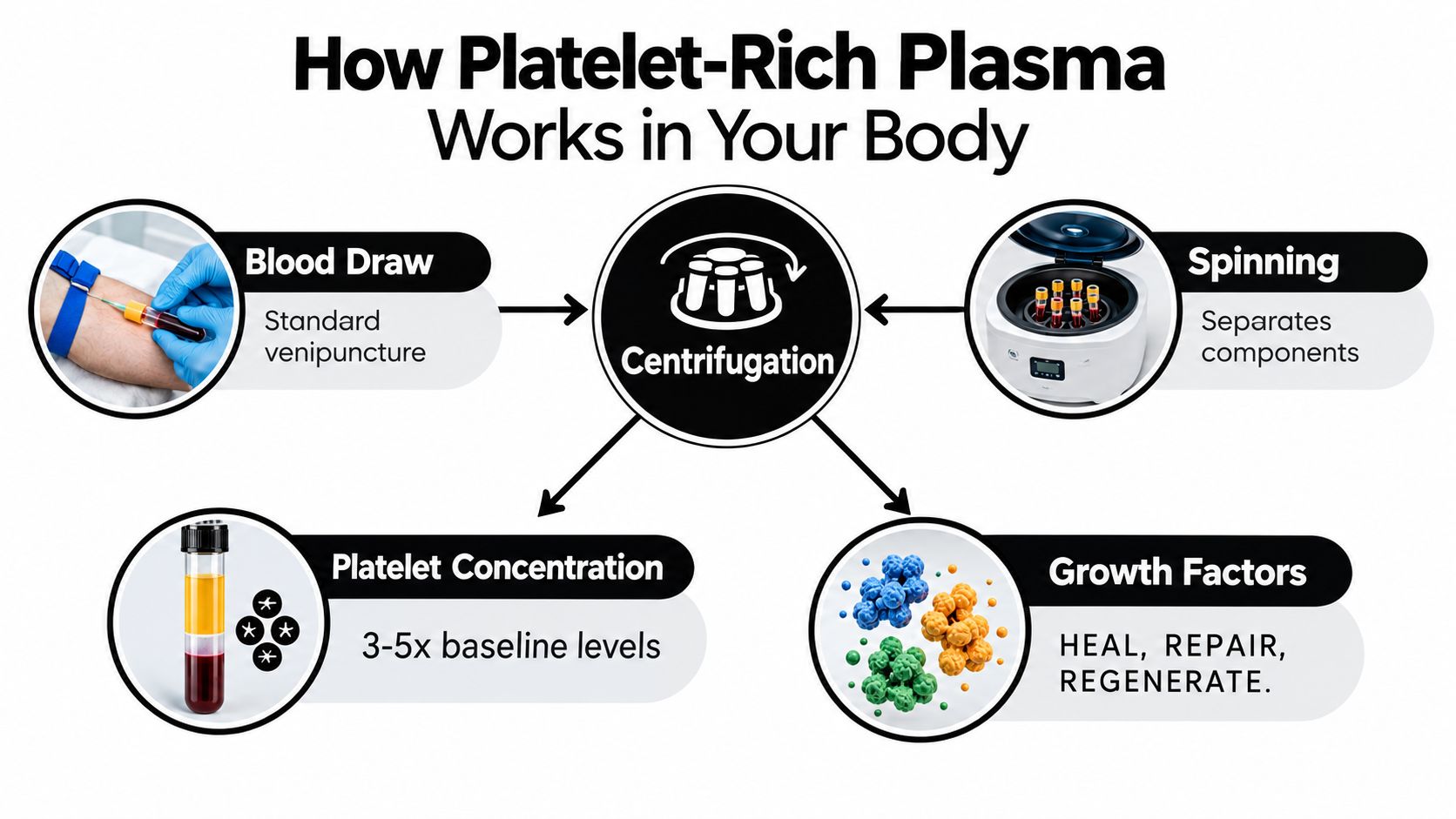
A biological signal, not replacement tissue
The practical analogy is an alarm signal. Injected platelets can release mediators that encourage surrounding cells to participate in repair. Depending on the tissue, those signals may influence fibroblast activity, vascular responses, extracellular matrix remodeling, or follicular behavior.
That doesn't mean PRP supplies new hair follicles, replaces cartilage, or inserts collagen into the skin. It attempts to amplify the body's existing repair response. The quality of that response depends on the tissue, the diagnosis, the patient's health, and the way the material is prepared and delivered.
Patients considering musculoskeletal applications may find it useful to review how clinicians frame injection therapy in Aurora Colorado as part of a broader regenerative-care discussion. For a straightforward overview of the procedure itself, what PRP treatment involves is also worth reading before a consultation.
Why patient biology matters
A dormant follicle, inflamed tendon, aging skin, and arthritic joint don't respond to the same signal in the same way. A person's age, disease stage, medication profile, blood characteristics, and tissue condition can all influence the response. This is why a provider who promises the same outcome for every patient is skipping the most important part of the assessment.
The mechanism is biologically plausible, but plausibility isn't proof of a predictable cosmetic result. Good treatment planning connects the biology to a diagnosis, a defined protocol, and a measurable endpoint.
Evidence-Backed Benefits for Skin, Hair, and Healing
The phrase PRP therapy benefits covers several very different clinical goals. Evidence for hair density shouldn't be used as proof of dramatic skin rejuvenation, and findings from orthopedic PRP shouldn't be presented as evidence for cosmetic effectiveness.
| Treatment goal | What the evidence supports | What remains uncertain |
|---|---|---|
| Pattern hair loss | Pooled trials report increased hair density compared with controls | Individual response, preparation, timing, and durability vary |
| Female-pattern hair loss | Reviews report improvements in density and shaft caliber in some analyses | Endpoint definitions and protocols produce mixed conclusions |
| Skin rejuvenation | PRP may support gradual changes in texture and appearance for selected patients | Dramatic or uniform wrinkle correction isn't established |
| Joint and tissue care | PRP has clinically meaningful evidence in selected musculoskeletal applications | Results differ by diagnosis, product, injection plan, and rehabilitation |
Hair density is not the same as thicker hair
A 2023 meta-analysis of 10 randomized controlled trials, involving 318 participants and 555 treatment units, found that PRP increased hair density by an average of 25.09 hairs per square centimeter compared with control treatments. The 95% confidence interval was 9.03 to 41.15 hairs/cm², with p = 0.002. The same analysis found no statistically significant improvement in hair diameter, with a standardized mean difference of 0.57, a 95% confidence interval from −0.23 to 1.38, and p = 0.16 (2023 PRP meta-analysis).
That distinction matters in the consultation room. More visible coverage can result from increased density or reduced shedding, while individual strands remain fine. Patients exploring PRP hair restoration treatments should ask whether the clinic tracks density, diameter, shedding, standardized photographs, or all of these.
A separate 2022 meta-analysis of 17 trial groups reported mean density rising from 141.9 ± 108.2 hairs/cm² before treatment to 177.5 ± 129.7 hairs/cm² afterward, an approximate gain of 35.6 hairs/cm², with p = 0.0004. It also found a positive correlation between monthly treatment count and percentage change in density, r = 0.50, p = 0.03, while older treatment-group age correlated negatively with improvement, r = −0.56, p = 0.016 (2022 PRP hair-density meta-analysis). Correlation doesn't prove that more frequent injections are always better.
Skin and healing require narrower claims
For female-pattern hair loss, a meta-analysis of 21 studies comprising 628 participants found significant increases in hair density and thickness, alongside fewer positive hair-pull tests. Pain or discomfort wasn't significantly different from control, with a risk ratio of 1.01 and a 95% confidence interval of 0.87 to 1.18 (female-pattern hair-loss review). The same evidence also showed that dosage, injection duration, and ethnicity can affect response.
For orthopedic uses, a 2025 meta-analysis of 18 randomized controlled trials involving 1,995 patients with knee osteoarthritis reported clinically meaningful improvements in pain and function, with platelet concentration influencing outcomes (knee osteoarthritis PRP meta-analysis). That finding supports careful protocol selection. It doesn't prove that an orthopedic preparation will produce comparable results in facial skin or scalp tissue.
Why PRP Protocols Vary So Much Between Providers
A patient can book “PRP” at two reputable clinics and receive products that are biologically different enough to produce different experiences and different outcomes. That is the gap between the promise and the reality. The label sounds standardized. The protocol usually is not.
The variables that change the intervention
Platelet concentration changes the product itself. A preparation at two times baseline is not the same as one at five times baseline, and neither number is meaningful in isolation unless the clinician can explain why that range suits the tissue being treated.
Leukocyte content changes the inflammatory profile. Leukocyte-rich and leukocyte-poor PRP are not interchangeable, and this is one of the clearest examples of why the acronym can mislead patients. In practice, the better choice depends on the diagnosis, the treatment goal, and how much inflammation the provider is deliberately trying to create or avoid.
Activation method matters too. Some protocols use calcium chloride or thrombin, while others rely on activation after injection. That choice can affect how growth factors are released, but there is no single method that makes sense across scalp injections, facial rejuvenation, tendon treatment, and joint work.
Injection technique also changes the intervention. Depth, spacing, total volume, number of injection points, and whether imaging guidance is used all affect where the PRP ends up and how evenly the tissue is treated. A scalp session and an under-eye session should not look the same because both are sold as PRP.
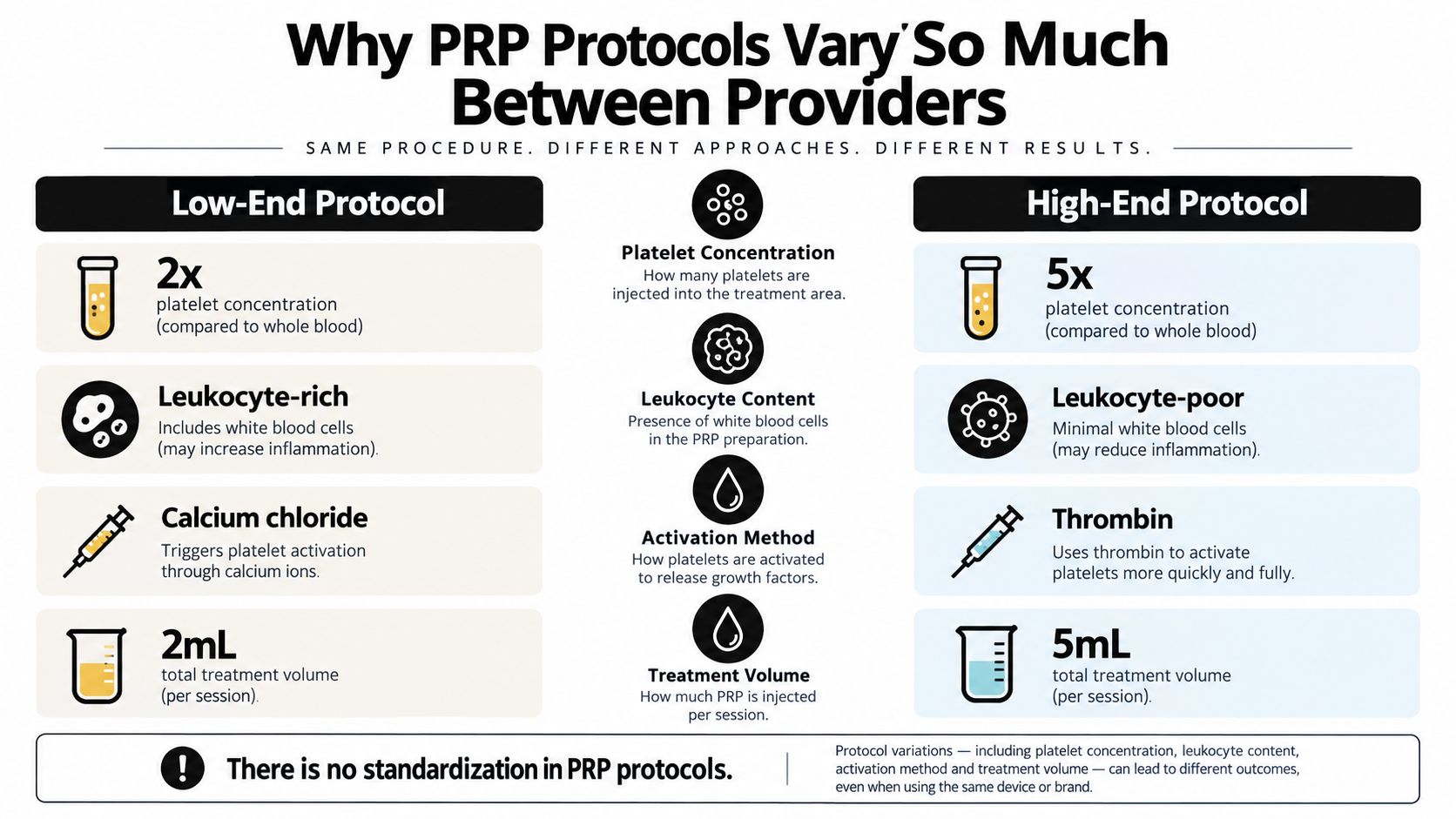
Why the label isn't enough
The orthopedic evidence discussed earlier found better results with higher-platelet PRP than lower-platelet PRP, but that does not give cosmetic clinics a free pass to claim that more concentration is always better. Tissue response is context-specific. Hair follicles, facial skin, tendons, and arthritic joints do not behave the same way.
This is why protocol details matter more than the acronym. I would rather hear a clinician explain platelet concentration, leukocytes, activation, volume, and spacing clearly than promise a premium PRP treatment with no usable detail.
Patients considering microneedling with PRP should ask one more question. Is the PRP being injected, applied topically after needling, or used in both ways? Those are different protocols, with different tissue exposure and different expectations. If a clinic cannot describe those distinctions in plain English, it is reasonable to keep asking.
Building Your PRP Treatment Plan with Realistic Expectations
A responsible plan begins with a diagnosis and an endpoint. “I want better skin” is a reasonable starting concern, but it needs to become something a clinician can assess, such as visible texture, fine lines, shedding, hair density, or joint function.
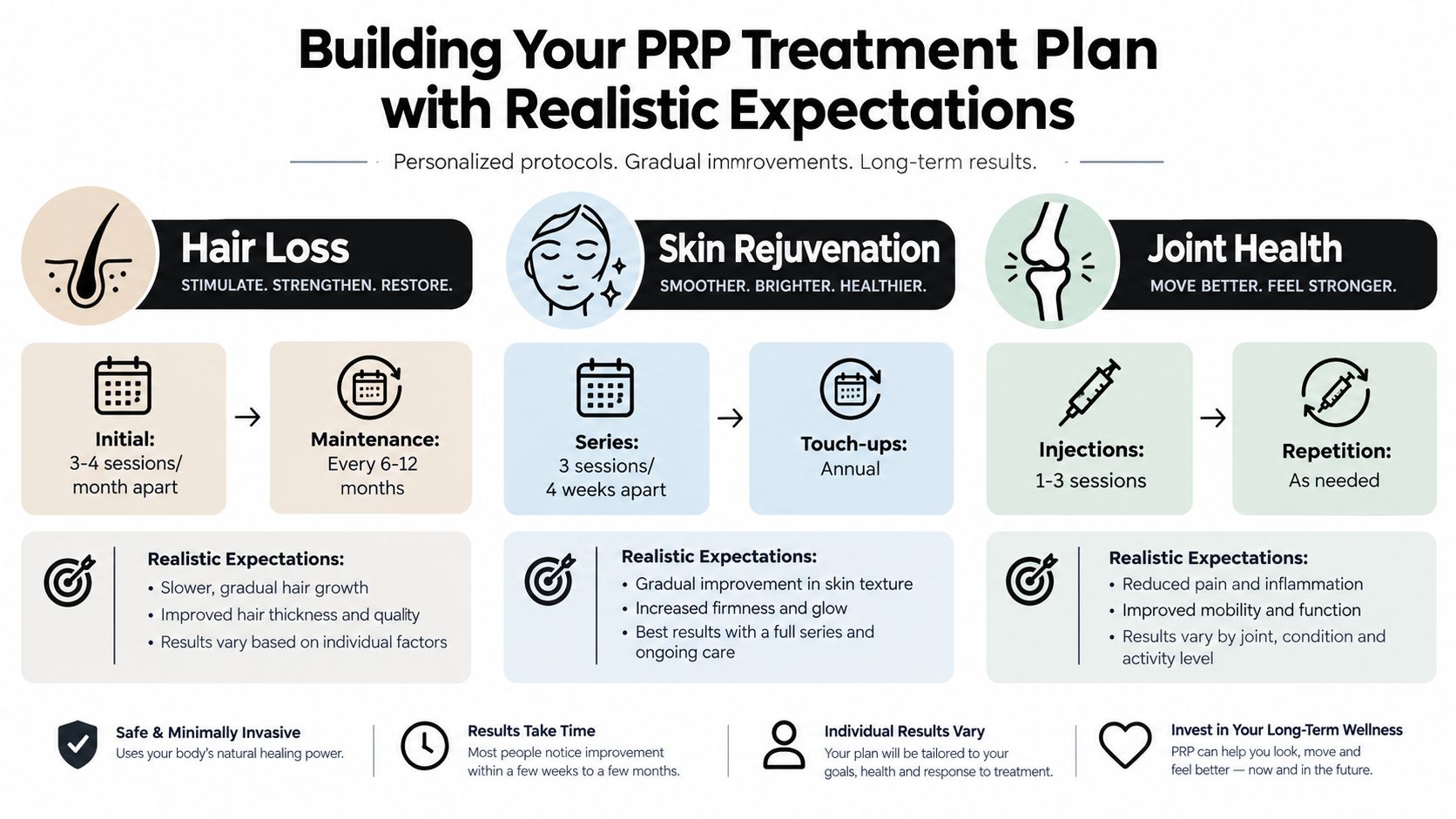
Build the consultation around five questions
- What diagnosis are you treating? PRP is more defensible when the provider can explain the condition and why this intervention fits it.
- What exactly will be injected? Ask about platelet concentration, leukocytes, activation, preparation system, volume, and whether the product is measured or only described with broad marketing language.
- How will you measure progress? For hair, request consistent photographs and a defined density or shedding measure. For skin, agree on the features being evaluated. For joints, discuss pain and function rather than relying on appearance.
- What is the schedule, and why? There isn't one universally proven schedule. Historical reviews have associated monthly treatment frequency with density change, but that relationship doesn't establish that more frequent treatment is always superior.
- What will happen if the response is limited? A credible provider should explain alternatives, combination therapy, reassessment, and the point at which continuing injections no longer makes sense.
Combining treatments without confusing the evidence
PRP may sit inside a broader plan rather than replace every other intervention. Depending on the goal, that may include medical hair-loss treatment, sun protection and skincare, physical therapy, or carefully selected device-based care.
The Barb N.P. Facial Mask is one product option for facial photobiomodulation. It is described as wireless, designed for comfort while worn on the face, and offers three lighting settings for different treatments. It should be considered a complementary device, not proof that PRP will work better.
LED isn't a single standardized exposure. One randomized, double-blind facial-rejuvenation trial protocol specified red light at 660 ± 10 nm, 92 LEDs, irradiance of 6.4 mW/cm², an energy dose of 8.02 J/cm², and 21-minute sessions, scheduled at either two or three applications per week over four weeks (LED facial photobiomodulation trial protocol). Those parameters describe a specific research mask, not every consumer device.
Ask for reproducibility: If a provider can't tell you what was prepared, where it was placed, and how improvement will be measured, you can't meaningfully compare the treatment with the evidence.
Common Misconceptions About PRP Therapy
Misconception one, PRP is permanent. PRP may support a temporary or gradual biological improvement, but it doesn't stop the underlying causes of androgenetic alopecia, skin aging, or joint degeneration. Maintenance may be discussed, yet the timing should reflect the patient's response and diagnosis rather than an automatic promise.
Misconception two, it works for everyone. A 2025 systematic review of 43 randomized controlled trials involving 1,877 people with alopecia reported improved hair density, reduced hair loss, and increased clinical improvement and patient satisfaction, but it didn't find a significant improvement in hair thickness (2025 alopecia systematic review). The evidence supports potential benefit, not a guaranteed response for every stage or pattern of hair loss.
Misconception three, more sessions must produce better results. More treatment can mean more cost, discomfort, and exposure to an intervention without ensuring a better outcome. A correlation between monthly treatment number and hair-density change doesn't establish a universal dosing rule, especially when protocols differ among studies.
Misconception four, PRP is a standalone miracle. Severe hair loss, deep wrinkles, advanced joint damage, or an undiagnosed medical condition may require a different primary treatment. PRP can be an adjunct, but calling it a complete solution can delay a more appropriate evaluation.
Alopecia reviews also reported that activated PRP improved density and reduced recurrence compared with placebo, while non-activated PRP was associated with more adverse effects. That finding still doesn't establish one universally superior preparation, so the provider should explain what activation means in the specific protocol.
For routine cosmetic care, a product such as Mina Beauty Cosmetics lip oil addresses surface lip hydration and appearance, not the deeper biological targets of PRP. Keeping those categories separate helps patients avoid treating every beauty concern as a regenerative-medicine problem. Before treatment, review practical risks and recovery considerations in PRP hair-treatment side effects.
Making an Informed Decision About PRP
PRP is biologically credible, but the phrase PRP therapy benefits is too broad to guide a decision on its own. The most consistent hair evidence supports increased density rather than reliably thicker individual strands. Joint applications have meaningful evidence in selected conditions, while dramatic cosmetic skin claims require more restraint and careful measurement.
Your decision should rest on four questions:
- Is the diagnosis clear?
- Is the protocol specific and defensible?
- Can the provider measure the intended outcome?
- Do the likely benefits justify the cost, discomfort, time, and uncertainty?
A qualified clinician should also screen for circumstances that may make treatment inappropriate, including active infection, bleeding disorders, pregnancy, or expectations that no biological treatment can realistically meet. A consultation should include alternatives and the possibility of limited response, not only a projected transformation.
Bring photographs from your own clinic's patients into the discussion, but treat them as examples rather than guarantees. Ask whether the images use consistent lighting, positioning, hair styling, and follow-up conditions. For hair, distinguish density from diameter. For skin, define the specific texture or line concerns. For joints, track function and symptoms.
The best outcome isn't blind enthusiasm or reflexive skepticism. It's informed confidence, built around a clear diagnosis, transparent preparation, measurable goals, and a willingness to change course if the evidence of personal benefit isn't there.
BotoxBarb offers PRP treatments for hair regrowth, microneedling with PRP, and under-eye PRP-focused aesthetic care, alongside LED light therapy and medical-grade skincare. Visit BotoxBarb to review the available services and products, then schedule a consultation focused on your goals, protocol options, and realistic outcomes.