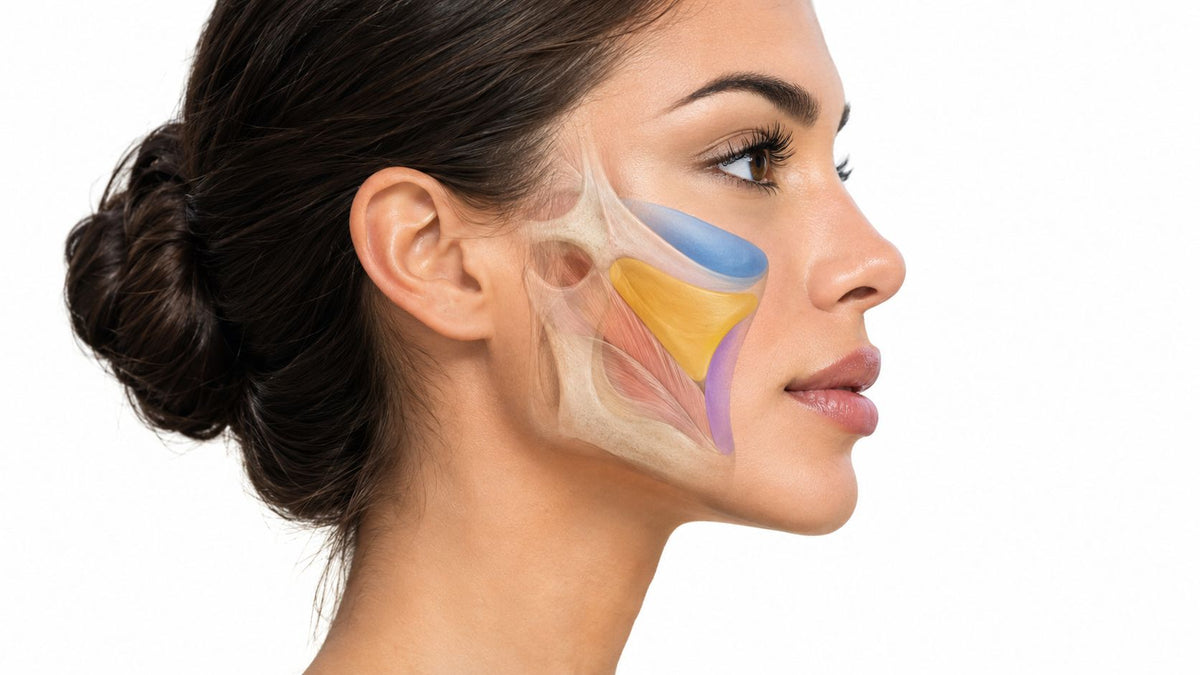
Best Dermal Fillers for Over 50: A Complete Guide
The most popular advice about the best dermal fillers for over 50 is also the least useful: choose the brand that lasts the longest. A longer-lasting product isn't automatically safer, more natural, or better suited to your face. In mature skin, the more important questions are where volume has been lost, how mobile or thin the tissue is, what result you want, and how easily the treatment can be adjusted.
A good plan may use a temporary hyaluronic-acid filler for one area, a firmer structural product for another, or no filler at all where lax skin is the main concern. The injector's anatomical judgment matters more than a product ranking. This guide compares HA, calcium hydroxylapatite, and poly-L-lactic acid, then organizes the decision by treatment area, safety, maintenance, and consultation questions.
| Filler type | Typical role | Onset | Approximate longevity | Reversibility | Best suited for |
|---|---|---|---|---|---|
| Hyaluronic acid, HA | Immediate volume and line correction | Immediate | Approximately 6–12 months, depending on product, site, and patient factors | Enzymatically degradable | Versatile correction, cheeks, folds, lips, chin, selected under-eye concerns |
| Calcium hydroxylapatite, CaHA | Structural contouring and collagen stimulation | Immediate contour, later collagen response | Approximately 12–18 months | Not readily reversible | Deeper contour support, cheeks, chin, jawline, selected hand treatment |
| Poly-L-lactic acid, PLLA | Collagen biostimulation | Progressive over several months | Maintained effects for up to 25 months | Not readily reversible | Diffuse volume loss when gradual change is acceptable |
Why Age Alone Does Not Determine the Best Filler
Turning 50 doesn't create a new filler category. It doesn't mean every patient needs a denser gel, a longer-lasting product, or a “stronger” injection. The right choice depends on anatomy, treatment goal, tissue behavior, and injector expertise, not the birthday on your medical chart.
A global consensus review found no statistically significant difference in complication rates between older patients, with a mean age of 69.1 years and a complication rate of 1.94%, and younger patients, with a mean age of 39.2 years and a complication rate of 1.84%. The review also concluded that there is no upper age limit at which patients stop benefiting from volume restoration (global consensus review). That doesn't make every patient an automatic candidate. It does challenge the assumption that older skin requires one particular brand.
Replace the age question with four clinical questions
The first question is location. Cheek tissue behaves differently from lip tissue, and the tear trough has different risks from the chin. A product designed to provide projection in deeper tissue may look or feel inappropriate in a thin, mobile area.
The second question is the goal. Are you trying to restore midface support, soften a fold, improve chin proportion, refine the jawline, address hand volume loss, or improve skin quality? Volume replacement, contouring, line softening, and collagen stimulation aren't interchangeable objectives.
The third question is adjustability. HA is often attractive for first-time patients because it provides immediate correction and can be degraded enzymatically if overcorrection or certain complications occur. That flexibility can matter more than maximum duration.
Expertise changes the result
A skilled injector does not just select a syringe and follow a standard map. They assess skin thickness, bone structure, facial movement, previous filler, surgery, medications, and how the face looks at rest and in motion. They also decide whether the best result requires staged treatment rather than a large single appointment.
The best filler for your age is usually the filler that matches your tissue and your tolerance for adjustment.
For patients over 50, natural results often come from restoring proportion rather than filling every visible line. Chronological age may influence screening and tissue assessment, but it shouldn't determine the product by itself.
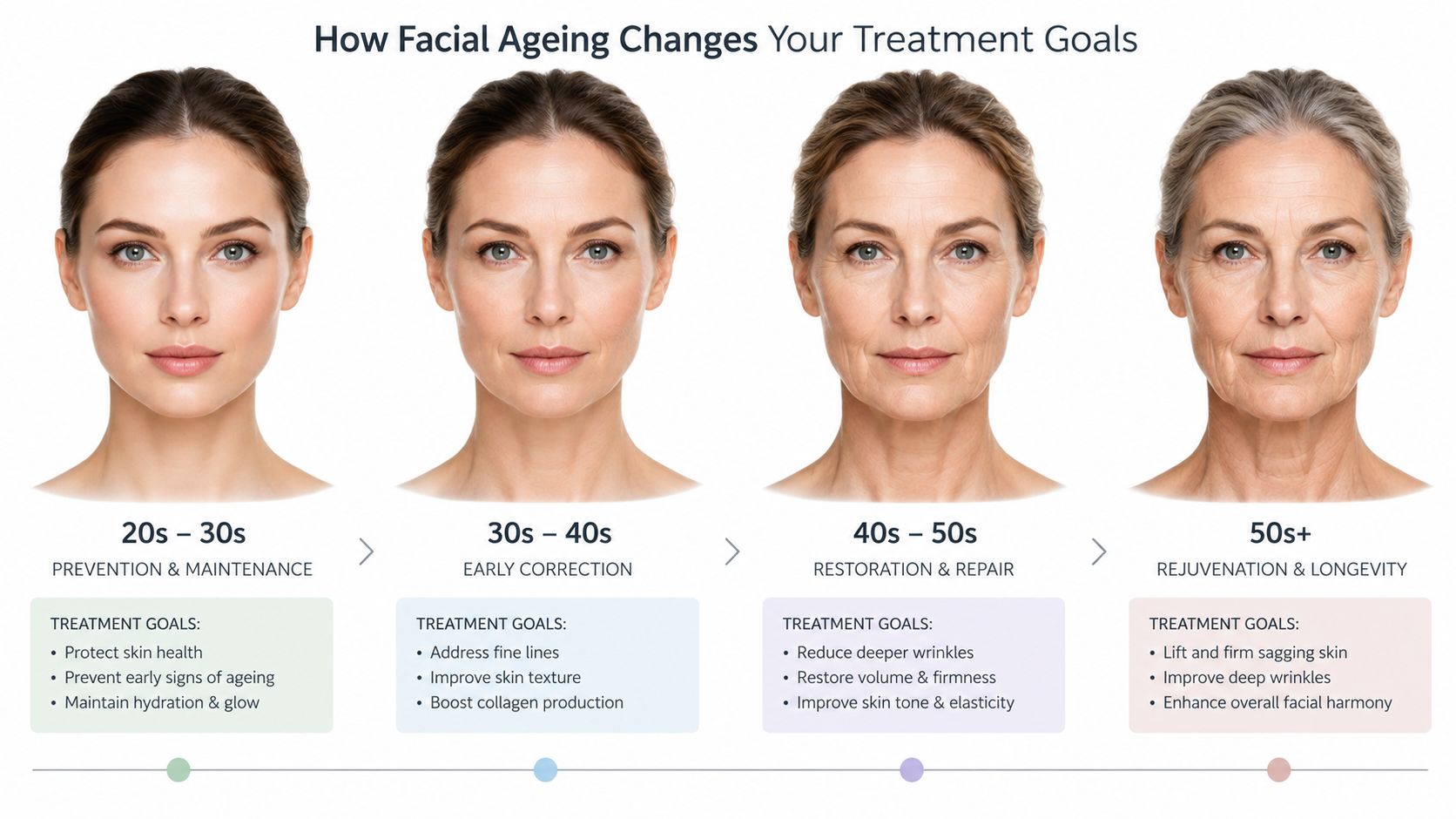
How Facial Ageing Changes Your Treatment Goals
The face over 50 isn't just a younger face with more wrinkles. Several structural changes occur at the same time, and each one alters how filler should be planned.
Thinner skin changes how much product you can see
Mature skin often has less dermal thickness and less tolerance for visible irregularity. A product placed too superficially, or too much product placed in a small area, can create projection, lumpiness, or an overfilled appearance. Thin skin doesn't necessarily rule out filler, but it favors conservative placement, softer gels in delicate tissue, and gradual correction.
This is one reason a firm filler that works well for deep cheek support may be a poor choice for the lips or tear trough. The same material can behave differently depending on depth, mobility, and how close it sits to the surface.
Skeletal change reduces the foundation beneath the soft tissue
Age-related skeletal resorption can reduce support around areas such as the cheek, chin, and jaw. When the foundation changes, lines may deepen even though the line itself isn't the primary problem. Restoring selected structural support can improve facial balance more effectively than repeatedly injecting the crease.
Ligament laxity permits downward movement
Facial ligaments help hold soft tissue in position. As support weakens, the cheek and lower-face tissues can descend, contributing to folds, jowls, and a less defined jawline. Filler can't remove excess skin or reproduce the result of a facelift, but carefully placed structural volume may improve proportion and support in appropriate candidates.
A plan that treats every fold directly can add weight to the lower face. A plan that first evaluates the midface, chin, and jawline may produce a fresher result with less product.
Fat compartments shift and lose volume
Facial fat doesn't disappear uniformly. Some compartments become smaller, while others descend or become more prominent. That uneven change can make the face look tired, flattened, or heavier in the lower third.
Mature-face filler should restore support and proportion, not erase every sign of movement.
For this reason, I generally favor a staged approach when the face has thin skin, laxity, prior surgery, or diffuse volume loss. The first appointment can address the most influential structural area, followed by reassessment once swelling has settled and the result can be judged in motion. The aim is not to create a tight, frozen face. It's to make the face look rested without making the treatment obvious.
Comparing HA CaHA and PLLA Fillers
Age does not determine the right filler. Anatomy, tissue depth, treatment goal, and your willingness to accept delayed or less adjustable results matter more than the brand name or a longevity claim. The three main materials solve different problems, so compare their trade-offs rather than ranking them by duration alone.
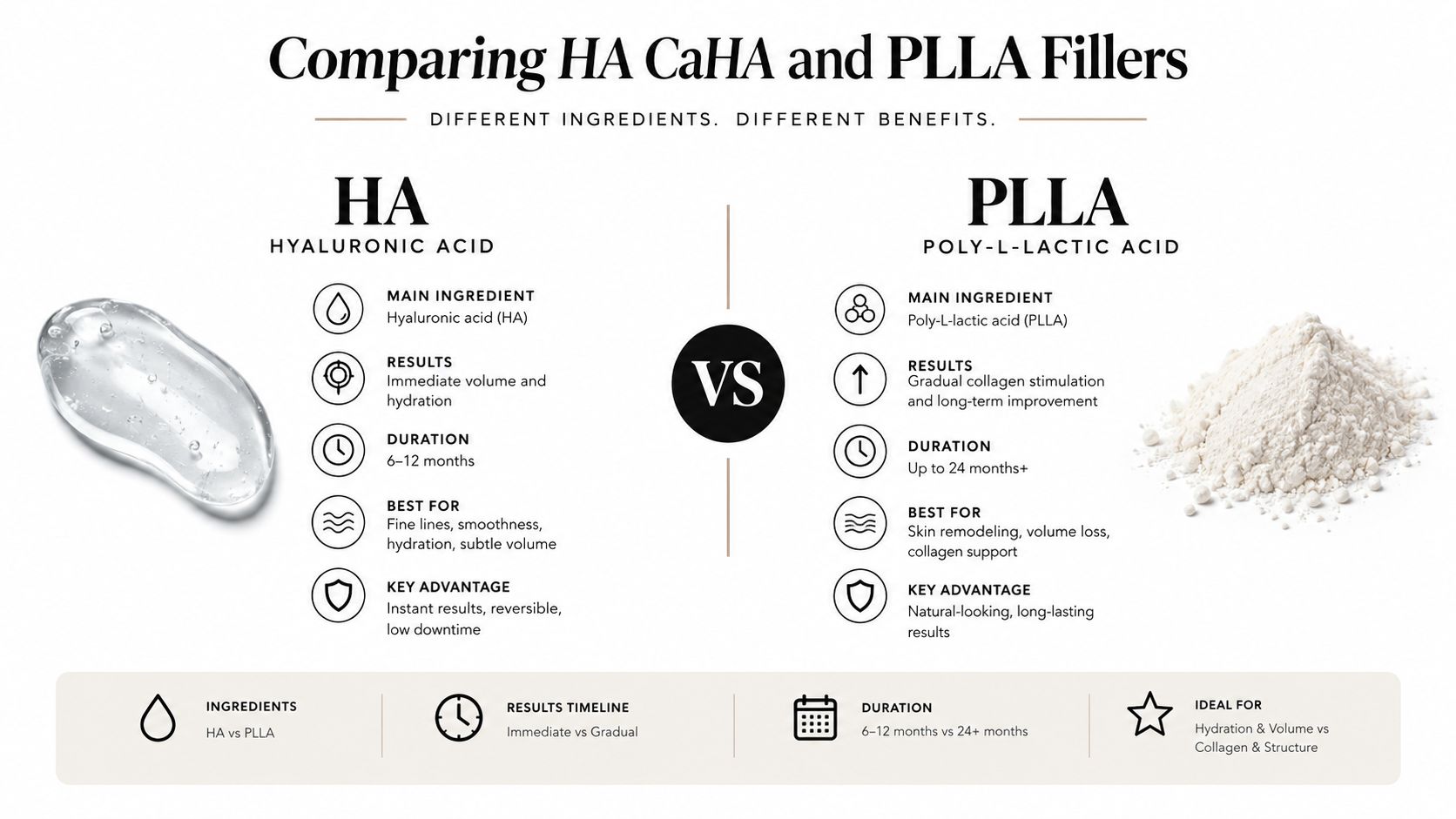
| Filler Type | Onset | Longevity | Reversibility | Best Suited For |
|---|---|---|---|---|
| HA | Immediate | Approximately 6–12 months | Can be enzymatically degraded | Versatile correction and areas where adjustability matters |
| CaHA | Immediate contour, progressive collagen response | Approximately 12–18 months | Not readily reversible | Deeper structural support and contouring |
| PLLA | Gradual improvement over several months | Maintained effects for up to 25 months | Not readily reversible | Diffuse volume loss and gradual collagen stimulation |
Hyaluronic acid offers the widest margin for adjustment
HA is a sugar naturally found in body tissues. In gel form, it binds water and creates smoothing or volume. The FDA states that HA effects generally last approximately 6–12 months, with durability varying by product, injection site, and patient factors (FDA-approved dermal fillers).
HA ranges from soft, spreadable gels to firmer, more cohesive products. Softer HA may blend well in thin, mobile tissue, while a higher-elasticity gel can provide support in selected cheek or chin planes. Its practical advantage is immediate results and enzymatic adjustability, which can make it a sensible starting point for a first treatment or an area where precision matters.
HA's practical advantage: It provides an immediate, temporary, and potentially adjustable result.
The trade-off is maintenance, since some patients need treatment sooner than they would with CaHA or PLLA. HA is not automatically suitable for every site. The injector still needs to match the gel's firmness and behavior to tissue depth, movement, and vascular anatomy.
A softer HA such as Belotero Balance differs from traditional dermal filler approaches in how it is selected and placed, as outlined in Belotero Balance vs traditional dermal fillers. A broader overview of types of dermal fillers can also help patients prepare for a consultation.
Calcium hydroxylapatite provides firmer structural support
CaHA supplies immediate contour through its gel carrier and may stimulate collagen over time. Its firmer particle-and-gel structure generally suits deeper volumization and contour support better than delicate sites such as the lips or tear trough.
A systematic review reported CaHA durability of approximately 12–18 months (systematic review of CaHA and PLLA). CaHA is not readily reversible, so conservative dosing and accurate placement matter. In mature tissue, the injector must account for thin skin, changing support, and the risk that excess product may look heavy.
Poly-L-lactic acid requires patience
PLLA is primarily a collagen biostimulator. Improvement develops progressively over several months, rather than appearing fully at the appointment. The same review reported maintained effects for up to 25 months and emphasized careful dilution and patient counseling.
PLLA can suit diffuse volume loss when gradual improvement is preferable to an immediate contour change. Its delayed response is also its main limitation. The final result cannot be judged immediately, and the material is not readily adjustable like HA. Staged planning and realistic expectations are part of choosing it safely.
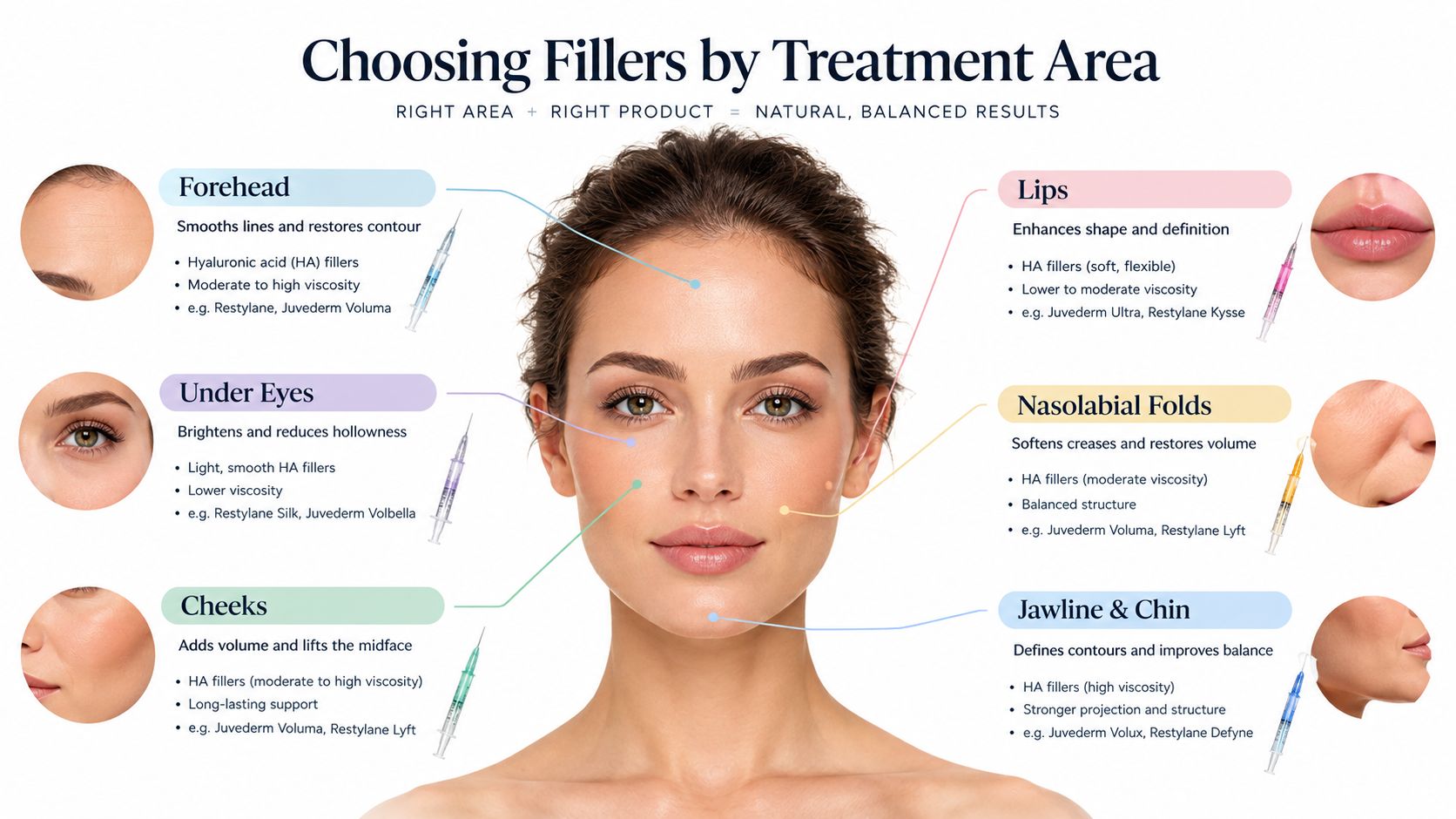
Choosing Fillers by Treatment Area
The treatment area usually matters more than the brand on the box. A cheek filler may be too firm for a mobile lip, while a soft gel that blends well in a facial line may not create enough support for the chin. In patients over 50, tissue thickness, facial movement, prior treatment, and the depth of volume loss should guide the plan more than age alone.
Cheeks and midface
Cheek treatment works best when it restores structural support rather than filling every nearby fold. A firmer, cohesive HA may suit a selected deeper plane, while CaHA can provide deeper contour support in carefully assessed patients. The aim is a balanced transition from the lower eyelid to the cheek, not prominent projection.
Thin skin, previous surgery, existing filler, and facial laxity can all change the injection plan. Staged correction is often safer and more natural when the midface has both volume loss and descent. The injector should assess the whole transition before deciding where product belongs.
Nasolabial folds and marionette lines
Nasolabial folds and marionette lines may result from midface descent, lower-face movement, or loss of support around the mouth. Direct treatment can soften a crease, but filling the fold alone may add weight without correcting the structure that created it.
As noted in the earlier comparison of filler types, cleared uses include areas such as nasolabial folds, cheeks, lips, chin, and the backs of the hands, and HA duration varies by product, site, and patient. Effects in nasolabial folds commonly last approximately 6–12 months. The consultation should determine whether the fold itself or the surrounding support is the main concern.
Temples
Temple hollowing can make the face appear more skeletal, yet this region contains important vessels and may have little soft-tissue coverage. Product selection, injection depth, needle or cannula technique, and conservative volume all affect the risk and result.
Some patients need structural correction in the temple or cheek. Others need skin-quality treatment instead of more filler. A careful assessment prevents a single product from being used to address every sign of ageing.
Chin and jawline
Precisely placed filler can improve chin projection, facial balance, and profile. Firmer HA or CaHA may be considered for structural contouring when the patient's anatomy and the product's authorized use support that choice. Jawline treatment must also account for lax skin and jowls. Added volume cannot substitute for skin removal when laxity is advanced.
Lips and tear troughs
Lips are mobile and often have thin tissue, so softer, more spreadable HA usually integrates more easily than a firm structural material. CaHA is generally not the first choice for delicate lip or tear-trough treatment.
Under-eye hollows need especially cautious assessment. Dark circles, thin skin, prominent fat, and true volume loss can look similar but require different approaches. In some patients, avoiding filler gives the most sensible result.
The backs of the hands
Selected fillers can restore volume on the backs of the hands, where thin skin makes veins, tendons, and product irregularities more visible. The appropriate goal is modest softening, not completely smooth-looking hands. For broader guidance on non-surgical facial rejuvenation DC, choose advice that assesses anatomy and treatment goals rather than ranking brands by longevity.
Safety and Contraindications for Older Adults
Dermal fillers are minimally invasive, not risk-free. FDA briefing materials cite roughly 6.2 million U.S. dermal-filler treatments from 2023 to 2024 (FDA briefing materials). Short-term effects can include swelling, bruising, redness, tenderness, firmness, itching, and discoloration. These usually settle within days to weeks, but delayed complications may appear weeks, months, or years later.

Routine effects deserve realistic planning
Patients over 50 may bruise or swell more because of thinner skin, reduced tissue support, medications, or previous procedures. Anticoagulants and other medicines can affect treatment planning. Never stop a prescribed medication without first speaking with the clinician who manages it.
A responsible consultation should cover:
- Medication use: Discuss anticoagulants, antiplatelet medicines, supplements, and allergies.
- Previous procedures: Report filler, surgery, threads, implants, and any earlier complications.
- Active conditions: Skin infection, inflammation, or an unresolved dental or medical problem may require postponement.
- Recovery needs: Explain upcoming work, travel, photography, and the time available for bruising or swelling.
FDA-reviewed evidence on approved absorbable fillers found treatment-related adverse events in 40 of 109 participants aged 61–81, or 36.7%, compared with 33 of 91 participants aged 38–60, or 36.3%. All reported events were mild or moderate, with no severe events, deaths, or withdrawals caused by treatment-related adverse events (FDA dermal-filler safety evidence). The findings support individual assessment rather than excluding someone solely because of age.
Vascular risk changes the injector standard
The most serious complication is accidental injection into a blood vessel. This can obstruct blood flow and cause tissue necrosis, visual impairment or blindness, or stroke. The risk is particularly relevant in complex vascular areas such as the nose, glabella, and around the eyes, per the FDA briefing materials cited above.
Ask who manages vascular occlusion emergencies, what protocol is available, and how you can reach the practice after treatment.
An experienced injector should understand facial vascular anatomy, select an appropriate injection strategy, use conservative technique, and maintain an emergency plan. Before booking, review this practical guide to dermal filler side effects, then ask the practice to explain its screening and aftercare process in plain language. Age should prompt careful planning, not automatic exclusion.
Costs Maintenance and Combining Treatments
Filler maintenance works best as a schedule built around anatomy and priorities, not as a string of isolated purchases. The right interval depends on the product, injection area, tissue movement, metabolism, and whether the original goal was support, contour, or softening a specific line.
HA commonly becomes a maintenance discussion around the 6–12 month duration noted in the comparison above. That does not mean booking automatically at the same interval. Reassess the treated area, how much correction remains, and whether the concern has changed before repeating treatment. Budgeting also becomes clearer when the plan accounts for the amount needed per area, the number of syringes recommended, and the possibility that treatment will be staged rather than completed in one visit.
A staged plan can be easier to live with
A practitioner may begin with the area that most affects facial balance, then review the result after swelling has settled. This approach helps separate genuine correction from early post-treatment fullness and reduces pressure to add product for a dramatic first-day change.
A practical maintenance plan may combine:
- Structural support: Cheek, chin, or selected temple treatment when the anatomy supports it.
- Fine-line treatment: Softer HA or another suitable modality for carefully selected superficial concerns.
- Skin-quality care: Daily sun protection, medical-grade skincare, and treatments directed at texture rather than volume.
- Review appointments: Reassessment before repeating the same product, area, or amount.
The comparison above outlines why different filler families create different maintenance conversations. The more useful question for scheduling is whether the result still serves the patient's goal, not whether a calendar date has arrived.
Filler cannot address every part of facial ageing. Neuromodulators may reduce dynamic muscle movement, while energy-based or other skin-quality treatments may better address laxity and crepiness. Combining modalities makes sense when each procedure has a defined job. Adding treatments just because they are available increases cost without necessarily improving balance.
LED can support the skin-quality part of the plan
An at-home LED device is not a substitute for filler and should not be presented as a lifting or volumizing treatment. It may fit between appointments as part of a broader skin-quality routine.
The BotoxBarb Facial Mask is a wireless device designed for hands-free use, with a fit that rests on the face without requiring you to hold it in place. It includes three lighting settings for different treatments, which may suit patients seeking a simple option between professional visits. It can complement volume restoration, but it cannot replace structural assessment, precise injection, or treatment of significant laxity.
Our Recommendation and Your Consultation Checklist
For a first-time patient, or anyone who values adjustability, HA is usually the most practical starting point. It offers immediate correction, comes in a range of firmness and spreadability, and can be enzymatically degraded when clinically appropriate. It may suit cheeks, folds, lips, chin, and other selected areas, but the exact product and placement still require an examination.
CaHA may suit a patient seeking longer-lasting structural contour, particularly in deeper tissue such as selected cheek, chin, or jawline areas. Its firmness and limited reversibility make injector experience and conservative dosing essential. It isn't a universal solution for thin skin, lips, or tear troughs.
PLLA can suit diffuse volume loss when gradual change is acceptable. It requires patience, precise dilution, and realistic counseling because the final effect doesn't appear entirely at injection. A patient who wants instant, easily adjustable correction may prefer HA instead.
FDA-approved dermal fillers are authorized for adults aged 22 and older for specified uses. Absorbable fillers may be approved for moderate-to-severe facial wrinkles and folds, lip, cheek, chin, or hand augmentation, so treatment should match the product's approval, the anatomical area, and the actual concern (FDA authorization and indications).
Bring these questions to your appointment
- Why this product: What tissue depth, mobility, and treatment goal make this filler appropriate?
- Why this area: Should the fold be treated directly, or does the surrounding structure need support first?
- What is the endpoint: How will you avoid overcorrection in thin or lax skin?
- What happens if I dislike it: Is the product reversible, and what is the plan for a complication?
- Should we stage it: Would treating one priority area first produce a safer, more natural assessment?
- What are the risks: Which short-term effects are expected, and which symptoms require urgent contact?
- Who handles emergencies: Is there a written vascular-occlusion protocol and after-hours contact?
The most useful consultation doesn't end with a brand name. It ends with a clear explanation of why that material, in that plane, in that area, at that amount, matches your goals. BotoxBarb's personalized approach to Botox, Dysport, dermal fillers, and LED light therapy can support that kind of staged treatment discussion for patients seeking a measured plan rather than a one-size-fits-all ranking.
If you're considering dermal fillers over 50, visit BotoxBarb to explore personalized consultations, dermal filler services, and complementary LED light therapy. Bring the checklist above and ask for a plan based on your anatomy, treatment goals, desired adjustability, and realistic maintenance needs.