Skin Care Kids: A Nurse Practitioner's Guide
You're probably here because your child asked for skin care products, copied a routine they saw online, or started having real skin issues and you're trying to tell the difference. That's where many parents get stuck. One child wants a foamy cleanser because a friend has one. Another has dry patches behind the knees. A tween suddenly has forehead bumps and wants “the good stuff.” Most families don't need more products. They need a calm, medical filter.
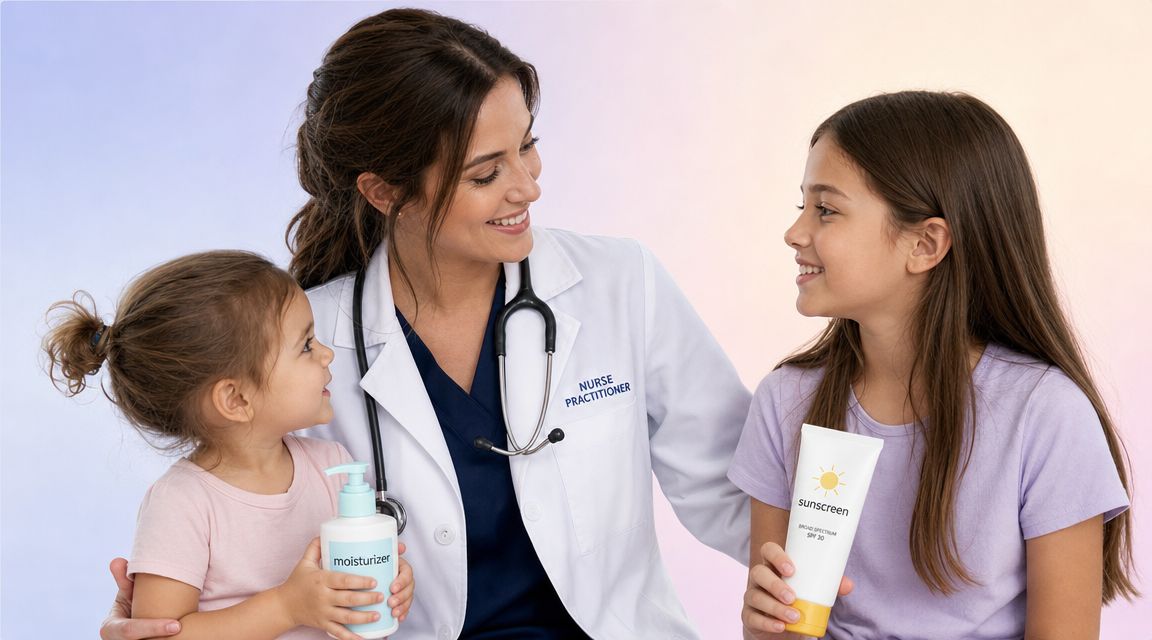
I'm Barb N.P., and my advice to parents is simple. Kids' skin care should be built around protection, comfort, and restraint. Children's skin usually does best when adults resist the urge to over-treat it. The challenge is that normal curiosity, social pressure, and true skin conditions can look similar at first.
That's why I use a practical framework. Start with the least amount of product that keeps the skin comfortable. Avoid strong active ingredients unless there's a clear reason. And know the signs that mean it's time to stop experimenting at home and get professional help.
The New Reality of Kids Skincare
Parents aren't imagining this trend. In an August 2024 U.S. household survey, about 68% of parents with children ages 7 to 11 said their child already had a skincare routine, and related behaviors included frequent daily use and multi-product routines, according to Statista's survey data on kids with skincare routines. The same source summary notes Yale Medicine's observation that 20% of preteens and teens were spending more than $50 per month on products they didn't need.
That helps explain why so many parents feel pressured. The issue isn't just hygiene. It's consumer culture reaching younger kids, often before puberty and before there's any real medical need for a shelf full of products.
Practical rule: If a routine sounds like something designed to correct aging, brighten tone, resurface texture, or “detox” skin, it was almost certainly not made with a child's skin in mind.
What worried parents are seeing
A lot of what gets labeled as skin care for kids is really imitation. Children copy older siblings, friends, and social media creators. Parents then end up sorting through mixed messages: one voice says skin care is harmless self-care, another says every ingredient is dangerous, and neither gives a clear plan.
The better approach is less emotional and more clinical.
- Normal interest can look like wanting a gentle face wash after sports or asking for sunscreen that doesn't feel sticky.
- Trend-driven overuse often looks like layered serums, exfoliating acids, or anti-aging language.
- Medical skin concerns show up as recurring rashes, eczema flares, acne that persists, or lesions that change.
Even outside skin care, parents are making similar judgment calls with household and body-care choices. The same mindset used for choosing lower-exposure options in the yard, such as crabgrass control for Georgia lawns, applies here too. Look past marketing. Choose the simplest effective option.
The standard I use in practice
I don't shame families for wanting routines. Routines can teach hygiene and consistency. But a child's routine has to answer one question: What problem is this product solving, and is that problem real?
If there's no dryness, no acne, no eczema, and no sun exposure concern beyond the usual, the answer is often very basic care. That's good medicine, not neglect.
Understanding Your Child's Unique Skin
Children's skin isn't just “smaller adult skin.” It behaves differently, and that difference matters when you choose cleansers, moisturizers, and sunscreen. Pediatric guidance emphasizes that children's skin is thinner and more irritation-prone, and that the goal is barrier preservation, not anti-aging. The evidence-based baseline is a gentle cleanser, moisturizer, and SPF 30+ sunscreen, as outlined by Children's Mercy pediatric skin care guidance.
I often explain the skin barrier to parents like a newly finished wall in a house. It works, but it's still easier to scuff, dry out, and damage than an older, sturdier surface. Strong products that an adult tolerates can push a child's skin into redness, stinging, flaking, or itch.
Why kids react faster
The outer layer of skin, the stratum corneum, is central here. When that layer gets disrupted, the skin loses water more easily and becomes less tolerant. That's why a child may suddenly complain that a face wash “burns” even when it smells nice and is marketed as gentle.
Common reasons kids' skin gets irritated include:
- Too many steps that strip and then overcompensate
- Fragrance exposure from washes, lotions, or mists
- Scrubbing with textured pads, brushes, or exfoliating beads
- Adult actives like retinoids, acids, or vitamin C formulas
A lot of parents assume “more moisture” is always the answer. Sometimes it is. But often the better fix is stopping the irritating product first.
What healthy skin care kids routines focus on
A good routine for a child should do three things:
| Goal | What helps | What usually backfires |
|---|---|---|
| Keep skin clean | Mild cleanser, lukewarm water | Foaming harsh cleansers, scrubs |
| Keep barrier comfortable | Lightweight, fragrance-free moisturizer | Layered serums, essential oils |
| Prevent sun injury | Broad-spectrum SPF 30+ | Skipping sunscreen on cloudy days |
If you're shopping for very young skin, even a simple gentle infant wash can be a useful example of the kind of low-fragrance, low-drama formulation parents should look for.
Kids usually don't need products that “fix” the skin. They need products that leave the skin alone while protecting it.
That shift in thinking prevents a lot of trouble. Children don't need a cosmetic agenda. They need the skin barrier respected.
Age-by-Age Skincare Routines
The safest way to think about skin care kids routines is by developmental stage, not by trends. A newborn's needs are minimal. A school-age child may need face washing after sweat and dirt exposure. A teen may need a true acne plan. The products don't stay the same, but the principle does. Keep the routine as small as the skin condition allows.

Newborns and infants
For babies, skin care is mostly about not causing problems.
Morning
- Leave skin alone when it looks healthy. Most infants don't need facial products every morning.
- Use soft water cleanup. Milk residue, drool, and spit-up can usually be wiped away with water and a soft cloth.
- Protect exposed skin from weather. If skin looks dry, apply a bland, fragrance-free moisturizer only where needed.
Evening
- Skip daily full soap baths if skin gets dry easily. Gentle cleansing is enough.
- Use minimal product in folds. Dry skin creases gently rather than rubbing.
- Moisturize after bathing if needed. This helps trap water in the skin.
What doesn't help: perfumed washes, bubble baths, and “spa” baby products. Those are common triggers for irritation.
Toddlers and preschoolers
This stage is less about skin treatment and more about teaching habits. These kids get messy, sweaty, and sun-exposed. They still don't need fancy products.
A simple routine might look like this:
- Face and hands after play Use lukewarm water and, if needed, a mild cleanser after sunscreen, sweat, or dirt buildup.
- Moisturizer only on dry areas Elbows, cheeks, and areas irritated by weather or frequent wiping often need the most support.
- Daily sunscreen when exposed If your child is outside, sunscreen becomes part of the routine, not an occasional add-on.
Parents often ask whether they should start a “real” routine here. Usually, no. This is still mostly hygiene plus sun protection.
School-age kids
This is the age when children start asking for products because friends have them. It's also the age when many routines get more complicated than they need to be.
For most school-age children, this is enough:
Basic morning routine
- Rinse or cleanse lightly. If the face isn't oily or dirty, water may be enough.
- Moisturize if dry. Use a lightweight, noncomedogenic, fragrance-free product.
- Apply broad-spectrum sunscreen. This is the most important daily skin habit.
Basic evening routine
- Cleanse off sweat, dirt, and sunscreen.
- Moisturize when skin feels tight, flaky, or rough.
A child in this age group generally does not need:
- exfoliating pads
- anti-aging serums
- retinol
- brightening acids
- peptide stacks
- harsh acne washes unless breakouts have clearly started
A school-age child with comfortable skin doesn't need a routine that looks impressive. They need one they can tolerate every day.
Pre-teens and teens
Puberty changes the conversation. Oil production rises, pores clog more easily, and acne can become real rather than occasional. In these situations, skin care can become useful, but only if it stays targeted.
If the skin is mostly normal
Keep the routine simple:
- Morning with gentle cleanse if oily, light moisturizer if needed, sunscreen every day
- Evening with cleanser and moisturizer
If early acne appears
Make careful adjustments:
- Choose a gentle cleanser first. Many teens over-wash, which worsens irritation.
- Use noncomedogenic moisturizer. Acne-prone skin can still be dehydrated.
- Add one acne-focused product only if needed. Don't combine multiple strong actives at once.
If sports or sweating are factors
Focus on behavior before adding products:
- wash after practice
- change out of sweaty clothing
- keep helmets, headbands, and pillowcases clean
- avoid picking
A quick age guide
| Age group | Main goal | Best routine |
|---|---|---|
| Newborn to infant | Protect delicate barrier | Minimal cleansing, moisturize as needed |
| Toddler to preschool | Basic hygiene and sun habits | Gentle wash, spot moisturize, sunscreen |
| School-age | Simple consistency | Cleanse, moisturize if needed, sunscreen |
| Pre-teen and teen | Manage changes without overdoing it | Gentle cleanse, moisturizer, sunscreen, acne care only when warranted |
If your child's routine keeps expanding, pause and ask whether the skin is improving. In practice, I see more kids helped by subtraction than addition.
Reading Product Labels for Kids
A good label-reading habit protects your child better than any trend forecast. Many products aimed at kids or tweens are marketed with soft colors and friendly language, but the ingredient list tells you much more than the packaging ever will.
There's also a broader exposure issue to keep in mind. A U.S. study involving children found common use of makeup and body products, and George Mason University reported that use of products such as lotions and sunscreen was associated with higher levels of phthalates and phthalate-replacement compounds in urine, as discussed in this peer-reviewed report on children's product use and exposure relevance. That doesn't mean families should fear every product. It means each product should earn its place.

Green flags on a kid-friendly label
These ingredients usually make sense in simple routines:
- Glycerin helps pull water into the skin and supports comfort.
- Ceramides help support the skin barrier.
- Hyaluronic acid can be useful in straightforward moisturizing formulas.
- Niacinamide may be helpful in moderation, especially for older kids or teens, if the product is otherwise gentle.
- Zinc oxide or titanium dioxide are useful sunscreen filters for sensitive skin.
What matters just as much as the ingredient itself is the formula around it. A good ingredient in an overly fragranced or highly active product can still irritate.
Red flags that usually mean pass
These are the ingredients or product categories I'd be cautious about for children:
- Fragrance or parfum because scent is a common irritation trigger
- Essential oil-heavy formulas because “natural” doesn't always mean gentle
- Scrubs that mechanically irritate the skin
- Retinoids and acid blends because they can disrupt the barrier in younger skin
- Alcohol-heavy formulas that leave the skin tight and dry
A useful parent skill is reading labels the same way you'd assess other daily-care products. If you've ever looked into choosing safe kids' toothpaste, you already know the pattern. Marketing language on the front can sound reassuring while the ingredient list tells a different story.
A fast screening method
Use this three-step check when you pick up any product:
- Read the first several ingredients That tells you what the formula is mostly made of.
- Look for unnecessary extras Fragrance, dyes, and strong actives often add more risk than benefit for kids.
- Ask what job the product has Cleanser, moisturizer, sunscreen. If it doesn't clearly fit one of those jobs, your child probably doesn't need it.
For parents who want a broader framework, my best advice is similar to the screening method described in this guide on how to choose skincare products. Simpler formulas usually win for young skin.
Mastering Sun Protection for Children
If a parent asks me for the single most important skin care habit for a child, the answer is sun protection. Not because it sounds responsible, but because it changes long-term skin health in a way no serum ever will.
Children over infancy spend time in cars, by windows, on playgrounds, at sports practice, and outdoors on cloudy days. UV exposure still happens when the weather doesn't feel hot. That's why sunscreen shouldn't be reserved for beach days.

What kind of sunscreen makes sense for kids
For many children, mineral sunscreen is the easiest place to start. Formulas with zinc oxide or titanium dioxide are often well tolerated by sensitive skin. They also fit the broader pediatric goal of reducing irritation wherever possible.
When parents ask what to shop for, I tell them to keep it boring in the best way:
- Broad-spectrum SPF 30+
- Fragrance-free if possible
- Comfortable enough that your child will wear it
- Easy to reapply
A product I trust in this category is SkinCeuticals Physical Fusion UV Defense SPF 50. It's a practical option for families who want a cosmetically elegant mineral sunscreen that layers well and doesn't feel overly heavy. If you want a better understanding of why mineral filters are often favored, this overview of zinc oxide sunscreen benefits is helpful.
Common application mistakes
Most sunscreen failures happen because families use too little, forget key areas, or don't reapply.
Keep these points in mind:
- Apply enough product. A thin swipe isn't enough coverage.
- Cover easy-to-miss areas. Ears, neck, scalp part, tops of feet, and around swimsuit edges are common misses.
- Reapply during outdoor time. Especially after sweating, towel drying, or swimming.
- Use other protection too. Hats, shade, and sun-protective clothing still matter.
The best sunscreen is the one your child will wear generously and repeatedly, without a daily fight.
What doesn't belong in the sunscreen conversation
Children do not need bronzing SPF, shimmer SPF, anti-aging SPF, or products with extra “treatment” claims. In kids, sunscreen has one job. Protect skin from UV damage with as little irritation as possible.
That focus keeps the routine clean. It also saves parents from buying products that solve adult concerns children don't have.
Managing Common Skin Issues Like Acne and Eczema
Two skin problems push parents from “simple routine” into “what now?” mode more than anything else. Those are eczema and acne. They're common, but they don't respond to the same strategy.

If your child has eczema
Eczema management is mostly barrier management. Families often make it worse by chasing a perfect cleanser or using too many soothing products at once. The basics work better.
Start here:
- Use a gentle cleanser sparingly. Some children with eczema do better when soap use is limited to the areas that need it.
- Moisturize generously after bathing. Apply a thick, fragrance-free moisturizer while the skin is still slightly damp.
- Avoid fragrance in everything possible. Lotions, body wash, laundry products, and sprays all count.
- Watch for rubbing triggers. Heat, sweat, rough fabrics, and over-bathing can all aggravate skin.
If eczema patches sting after product application, the formula may be too active or the barrier may be quite inflamed.
If your pre-teen or teen has acne
Acne care needs restraint too. Many teens panic and try to dry the skin out. That usually increases irritation and doesn't solve the clogged pores or inflammation underneath.
A sensible home routine looks like this:
Morning
- gentle cleanse if oily
- lightweight noncomedogenic moisturizer
- sunscreen
Evening
- cleanse
- moisturize
- add one acne-directed product only if needed and tolerated
What helps most is consistency. What hurts most is rotating products every few days because a friend recommended something stronger.
When device-based help may fit
For older teens with persistent mild inflammatory acne, some families ask about non-drug options. That's where LED therapy can enter the conversation carefully.
The Barb N.P. Facial Mask is the kind of device I'd consider only for an older teen, with parental supervision and a clear discussion about whether the acne pattern is appropriate for at-home LED use. The features matter. It's wireless, which makes it easier to use consistently. The mask is designed for comfortable wear on the face, which matters because an uncomfortable device ends up in a drawer. It also has 3 lighting settings for different treatments, including settings commonly used in acne and calming routines.
I wouldn't treat an LED mask as a first step for a child. It's an option for a narrower group: older teens, mild inflammatory breakouts, and families willing to follow a consistent plan rather than chase quick fixes. For broader barrier support and gentle product pairing, this resource on the best skincare for sensitive skin can help narrow the field.
Parents should be cautious with any acne treatment that causes burning, peeling, or escalating redness in the first place. “Strong” is not the same as “effective.”
Problems that are often mistaken for simple acne or dryness
Some children don't have straightforward acne or eczema at all. They may have perioral irritation, contact dermatitis, fungal issues, or a reaction to a flavored lip product, sports gear, or fragranced cleanser. If the pattern is odd, asymmetric, painful, or keeps recurring in the same spots, pause the routine and get it assessed.
That's one of the biggest mistakes I see in skin care kids advice online. Too many people assume every bump needs a product. Some bumps need a diagnosis.
When to Get Professional Skincare Advice
This is the part most blogs skip, and it's the most important one. Not every skin question should be solved in the bathroom mirror.
Dermatologists advise that while many kids' routines are unnecessarily complex, persistent acne, eczema flares, sudden rashes, or changing moles should prompt clinical evaluation, as noted in UCLA Health's dermatologist guidance for kids' skin care. That distinction matters because families often lose time trying products for what is a medical issue.
Home care is reasonable when
You can usually start at home if the issue is mild and short-lived:
- Dry cheeks in winter that improve with a bland moisturizer
- Occasional sweat-related breakouts after sports
- Minor irritation clearly linked to a new fragranced product
- Skin curiosity where the child wants a routine but doesn't have a true skin problem
In these situations, reducing products and returning to a basic cleanser, moisturizer, and sunscreen approach often works.
Book a professional evaluation when
These are the red flags I tell parents not to ignore:
- Acne keeps worsening or becomes painful, deep, or widespread
- Eczema flares repeatedly despite gentle skin care
- A rash appears suddenly or spreads quickly
- A mole changes in color, shape, or appearance
- The skin burns with basic products even after simplifying the routine
- You're not sure what you're treating anymore
That last point matters. Confusion itself is a valid reason to ask for help.
The decision filter I use
Ask yourself three questions:
- Is this cosmetic, or does it look medical?
- Has a simple routine already failed?
- Is the skin getting more inflamed instead of calmer?
If the answer to the last two is yes, stop adding products. Get guidance.
Parents don't need to become dermatologists. They need a reliable threshold for when home care is enough and when it isn't. That's how you keep children safe while still giving them practical, age-appropriate care.
If you want help choosing a simple routine, finding a sunscreen that sensitive skin can tolerate, or deciding whether your older teen is a fit for more advanced options, BotoxBarb offers curated skin care and expert-guided wellness support grounded in real clinical judgment.