Your Skin Care Night Routine: A Nurse Practitioner's Guide
By the time the skin care night routine begins, the day is often already done. Makeup is half removed with a towel, cleanser feels optional, and the bathroom shelf looks like a chemistry set no one has time to decode. That's exactly when bad habits take hold. People either skip everything or overcorrect with too many products, too many actives, and too much irritation.
From a clinical standpoint, neither approach works well. Skin responds better to a routine that's repeatable, well-matched to your barrier, and adjusted around any in-office treatments you're getting. A good night routine isn't about owning more products. It's about giving your skin the right support when repair is already underway.
Why Your Night Routine Is Non-Negotiable for Skin Health
A lot of patients tell me the same thing at consults. They mean to be consistent at night, but that's when motivation drops and decision fatigue kicks in. If the routine feels complicated, it usually gets skipped.
That's a problem, because nighttime is when skin shifts into repair mode. The skin's circadian rhythm moves into regeneration while you sleep, and one expert summary notes that collagen production is highest at night as skin repairs daytime damage and rebuilds support structures tied to firmness and anti-wrinkle function, which is why a structured bedtime routine built around cleansing, treatment, and moisturizer aligns with standard dermatology guidance for skin health maintenance in the Estée Lauder skin-at-night overview.
What that means in real life
If your skin has sunscreen, makeup, oil, sweat, or city grime sitting on it overnight, you're not giving treatment products a clean surface to work with. If you cleanse but don't moisturize, you can leave the barrier exposed and more vulnerable to tightness or irritation by morning. If you pile on too many actives because you missed a few nights, you often create the very redness and flaking you were trying to fix.
Clinical mindset: At night, consistency matters more than ambition.
This is also why I prefer simple routines for those aiming for consistency. A routine you can follow when you're tired is better than a seven-step plan you only do on Sundays.
Environment matters too. Sleep quality, friction from pillowcases, and room dryness can all affect how skin feels in the morning. If you want a useful companion read on that angle, the SouthShore blog on clear skin looks at how overnight habits can support clearer skin without turning bedtime into a project.
The Foundational Night Routine Framework
By the time you get to the bathroom sink at night, the goal is not to do the most. The goal is to do the few things that keep skin clear, calm, and able to tolerate treatment over time.
For most patients, that framework is simple. Cleanse. Treat. Hydrate. It is the structure I recommend before anyone adds masks, tools, or extra serums, especially if they also get in-office treatments like Botox or PRP and need their home routine to support healing instead of stirring up irritation.
A structured routine tends to perform better than random layering because each step prepares the skin for the next one. Cosmetics & Toiletries summarizes clinical testing showing that a planned routine can improve hydration and repair-related outcomes more effectively than a minimal approach that is not built with sequence in mind.
Cleanse
Cleansing sets the tone for the rest of the evening. If makeup, sunscreen, sweat, and oil are still sitting on the skin, treatment products are working through a film instead of reaching the surface evenly.
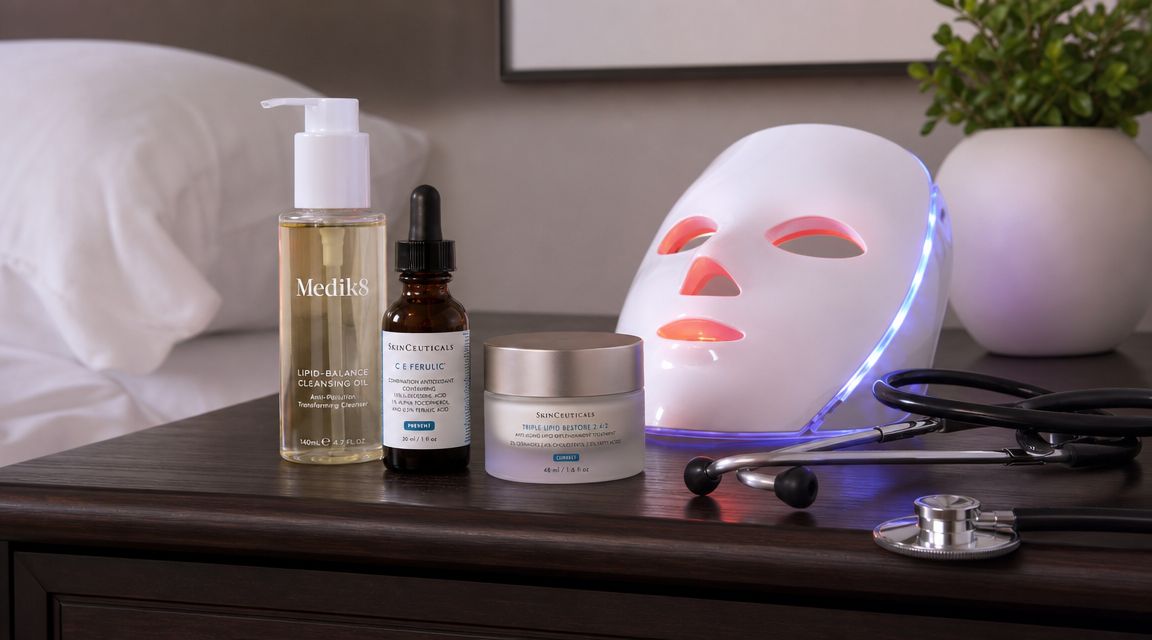
Patients who wear long-wear makeup or heavy sunscreen often do well with a two-step cleanse. An oil-based first cleanse can break down product without aggressive rubbing. Epicutis Oil Cleanser is one example that removes residue well while staying comfortable on skin that already leans dry or reactive. If you wore very little during the day, one gentle cleanse is usually enough.
Technique matters. Use lukewarm water. Massage with your fingertips for about 30 seconds. Stop before the skin feels squeaky.
A practical rule set:
- Choose one cleanse for sensitive skin, light product wear, or nights when your barrier already feels stressed.
- Choose a double cleanse after foundation, water-resistant SPF, or heavier outdoor exposure.
- Reassess your cleanser if skin feels tight right after rinsing. That usually means the formula is too stripping, not that it is doing a better job.
Treat
The treatment step is where simple routines stay effective. It is also where many people create problems.
One active is often enough for a single night. That may be a retinoid for texture and fine lines, niacinamide for redness and barrier support, or a mild exfoliating product used on limited nights. Layering multiple strong actives sounds productive, but in clinic I see the downside often. Stinging, flaking, rebound dryness, and confusion about which product caused the reaction.
This matters even more if professional treatments are part of your plan. Skin that is over-exfoliated at home is less predictable after PRP, microneedling, or injectable appointments. A calmer barrier usually tolerates both home care and in-office care better.
If you want help sorting product roles and sequence, this guide on how to build a skincare routine gives a clear breakdown without pushing unnecessary steps.
Apply treatment to fully dry skin unless the product directions say otherwise. On damp skin, some actives penetrate faster and can trigger more irritation than benefit.
Hydrate
Moisturizer finishes the routine by reducing overnight water loss and making the treatment step more tolerable. That is not cosmetic fluff. It is barrier support.
For dry or mature skin, a richer night cream often works better because it leaves less room for overnight tightness and irritation. SkinCeuticals Triple Lipid Restore is a good example when the goal is replenishment and comfort. Oily skin still needs moisturizer, just in a lighter texture that does not feel occlusive.
This is also the step that helps patients stay consistent with retinoids and other stronger ingredients. If skin is chronically dry, it will not tolerate much for long.
What works and what usually backfires
| Approach | Usually works better when | Common downside |
|---|---|---|
| Simple three-step routine | Skin is sensitive, schedule is busy, or you are trying to stay consistent after Botox or PRP | May need small adjustments for acne, pigment, or aging concerns |
| Double cleanse plus one active | You wear makeup, heavier SPF, or live in a humid or urban environment | Can become drying if the second cleanser is too strong |
| Multiple actives layered nightly | Rarely appropriate without a specific plan and good tolerance | Redness, stinging, flaking, and barrier disruption |
Consistency is easier when the routine feels manageable at the end of a long day. For patients who struggle with follow-through, pairing skin care with a broader wind-down habit often helps. This article on how to craft a self-care plan is useful because it approaches routine-building in a practical way rather than turning it into another perfection project.
Choosing Your Actives and Power-Up Devices
The treatment step is where you can improve results or derail your barrier. The deciding question isn't "What's trending?" It's "What problem am I solving tonight?"
Dermatologist guidance increasingly favors a simpler routine of a gentle cleanse, one treatment, and a moisturizer for many people, with additional steps reserved for specific concerns because over-layering can increase irritation and reduce tolerance to strong ingredients like retinoids, as discussed in the Doctor Rogers nighttime routine guidance.
Retinoids when the goal is texture and aging support
Retinoids remain one of the most useful categories in a skin care night routine because they target multiple concerns at once. I think of them as a strong choice for patients dealing with uneven texture, visible fine lines, post-acne roughness, and dullness.
But the trade-off is real. More product does not equal better results. If retinoids are making your skin sting, peel, or burn, the answer usually isn't to push harder. It's to cut back, improve moisturization, and simplify the rest of the routine.
Good retinoid habits:
- Start with spacing rather than nightly use if you're new or reactive.
- Pair with a plain moisturizer instead of stacking acids on top.
- Reassess irritation early so you don't mistake barrier damage for "purging."
If you're troubleshooting dryness, flaking, or sensitivity from this category, this article on retinol serum side effects lays out the practical signs that tell you when your skin needs less, not more.
Acids when the goal is clarity
Exfoliating acids can help when pores look congested, breakouts are active, or skin feels rough. They are useful tools, but they are not nightly necessities for everyone.
I prefer restraint here. Exfoliating serums only once or twice a week is a sensible framework if you're trying to keep the barrier intact while still getting benefit. If your skin already feels hot, tight, or reactive, skip the acid and moisturize instead.
Your skin can't heal on schedule if you keep re-irritating it.
Supportive ingredients that play well with others
Not every treatment step needs to be aggressive. Some of the most useful nighttime ingredients are the ones that make the whole routine more tolerable.
Consider these categories:
- Niacinamide for barrier support, visible redness, and a more balanced feel.
- Peptides when you want a repair-focused serum without the irritation profile of stronger resurfacing actives.
- Hydrating serums when dehydration is the main issue and you need comfort more than correction.
Where devices fit
For patients who want to add a non-chemical option, LED can fit well into the treatment step because it doesn't ask the skin to tolerate another active ingredient. The Barb N.P. Facial Mask is one example of a device-based option. It's wireless, designed for comfortable wear on the face, and includes 3 lighting settings for different treatment goals, commonly used as red for collagen support, blue for acne-focused care, and a calming or brightening setting depending on the protocol.
I like devices most when they replace product overload, not when they get added on top of an already irritated routine. Cleanse first, use the mask on clean skin, then apply your chosen treatment or go straight to moisturizer if your skin is feeling reactive that night.
Customizing Your Routine for Specific Concerns
A strong skin care night routine has a stable backbone, but the treatment choice should change based on what your skin is doing. That's where personalization matters.

For dry skin, a simple regimen can do a lot. In one study, a once-daily mild cleanser plus twice-daily glycerin-rich moisturizer over 2 weeks led to more than 80% of participants reporting less dryness or pruritus and better texture, with no adverse events, according to this clinical review on dry-skin care.
If you break out easily
Acne-prone skin often does better with fewer variables. Cleanse thoroughly, use one acne-focused active, and keep moisturizer in place even if you're oily. Stripping skin tends to backfire.
Blue LED can be a reasonable non-topical add-on. If you're also using salicylic acid or a retinoid, don't stack every acne strategy into the same night unless your skin has already shown it can tolerate that.
If your skin burns, flushes, or reacts easily
Sensitive skin needs less stimulation and more barrier support. Choose a low-irritation cleanser, avoid frequent exfoliation, and use one calming or hydrating serum if needed. Then moisturize generously.
This is the group that benefits most from simplification. If your routine leaves you shiny, red, and uncomfortable, your skin isn't asking for another active. It's asking for recovery. For a closer look at that approach, this guide on how to repair damaged skin barrier is worth reading.
If your focus is aging support
Aging-focused nighttime care usually responds well to a retinoid-based plan, but only if the barrier can tolerate it. Pairing a retinoid with a nourishing moisturizer is usually more productive than pairing it with additional exfoliants.
Red LED often fits well here because it gives patients another way to support a repair-oriented routine without more acids.
If uneven tone is the concern
Hyperpigmentation routines need patience and consistency. This is one area where people often sabotage themselves by rotating too many brightening products before giving one a fair trial.
I generally prefer a plan built around one pigment-targeted serum and a stable barrier. Medical-grade options such as SkinCeuticals Discoloration Defense can make sense when discoloration is the primary concern, but they still work better when the rest of the routine stays simple.
Don't forget the scalp
The scalp is skin. If you're noticing shedding or thinning, nighttime is often the easiest time to apply a leave-in product consistently. Nutrafol Hair Serum is a reasonable example for patients who want to add scalp care without changing the rest of their evening flow.
Timing Troubleshooting and Professional Integration
A routine can be well chosen on paper and still fail at 10:30 p.m., when you are tired, your face feels dry, and you are tempted to use every product that promises faster results. In practice, timing problems and post-treatment mistakes cause more irritation than a lack of products ever does.

The goal at night is simple. Give treatment products a fair chance to work without creating unnecessary friction, irritation, or confusion.
How long to wait between steps
Long wait times are rarely necessary. Skin does not need a ceremony. It needs products applied in a calm, consistent order with enough spacing that each layer can sit on the skin instead of being pushed around.
A practical sequence looks like this:
- After cleansing, pat until the skin is no longer dripping. Then apply your treatment step.
- After treatment, wait just long enough for the product to spread evenly and stop feeling slippery before applying moisturizer.
- If products pill, use less product, press instead of rubbing, or remove one layer that may be redundant.
I tell patients to stop chasing perfect timing and start watching skin response. If your retinoid stings every night, the issue is often not whether you waited 90 seconds versus 3 minutes. It is usually that the formula is too strong for your current barrier, the skin is still damp, or you are layering too much underneath it.
Common mistakes I see in clinic
The usual problems are straightforward, but they matter.
- Stacking multiple actives in one evening makes it hard to tell what is helping and what is causing irritation.
- Skipping moisturizer after a strong treatment often reduces tolerance and leads to the tight, shiny look of early barrier strain.
- Using exfoliation to fix rough or inflamed skin usually pushes already stressed skin further in the wrong direction.
- Rebuilding the whole routine after one bad night removes the pattern you need to identify the true trigger.
If your skin suddenly burns with products that were previously fine, pull back to cleanser and moisturizer first. That reset gives you useful information. It also protects skin that may already be inflamed.
Adjusting after Botox, fillers, PRP, and in-office care
Professional treatments work best when your home routine supports healing instead of competing with it. Simplifying the routine offers real clinical value.
After Botox or Dysport, keep the evening routine gentle unless your injector gave you different instructions. That is not the night to use an exfoliating pad, try a stronger retinol, or scrub at leftover makeup. After fillers, avoid pressure, aggressive massage, and strong actives over areas that feel tender or swollen. After PRP, microneedling, or any treatment that leaves skin temporarily reactive, stick with a bland cleanser, barrier-supportive hydration, and patience.
Patients often want to "boost" results after an in-office treatment. Usually, the better decision is to reduce variables for a few nights. Calm skin heals more predictably, and predictable healing gives you a clearer view of what the treatment achieved.
If you already tie skin care to another bedtime habit, that can help with consistency. Some patients pair their evening routine with supplements or gut-health habits, and for those sorting out nighttime scheduling, these digestive health probiotic recommendations offer a practical read.
The busy-night version
Some nights need a stripped-down plan. That is not failure. It is good judgment.
| Situation | Keep | Skip |
|---|---|---|
| Late night with makeup on | Cleanse, moisturize | Extra masks, exfoliants |
| Skin feels irritated | Gentle cleanse, plain moisturizer | Retinoids, acids, scrubs |
| Post-procedure evening | Follow aftercare, keep barrier support in place | Experimental products |
Your Routine Is a Ritual Not a Race
The healthiest skin care night routine is rarely the most complicated one. It's the one that respects your skin barrier, matches your actual goals, and still gets done when you're tired.
That means cleansing with purpose, choosing one treatment that earns its place, and finishing with hydration that helps your skin stay comfortable overnight. It also means knowing when to pull back. If you're using retinoids, exfoliating acids, or getting professional treatments like Botox or PRP, simplification isn't settling. It's often the smarter clinical choice.
I want patients to stop thinking of nighttime skin care as a test they can fail. Your routine doesn't need to look impressive on a counter. It needs to work on your face.
Build a ritual your skin can trust. Repetition beats intensity.
When your routine feels calm, your skin usually follows. And if it doesn't, that's when personalized guidance matters. The right adjustments can save you weeks of trial and error, irritation, and wasted product.
If you want a routine that fits your skin, your treatments, and your schedule, explore the curated options at BotoxBarb. You'll find medical-grade skin care, wellness essentials, and in-clinic aesthetic services that can be paired with a simpler, more strategic nighttime plan.