Dermal Filler Eyebrow Lift: A Non-Surgical Guide
You catch it in the mirror before you can name it. Your eyes don't look different exactly, but the upper face seems heavier, the outer brow less defined, and your whole expression a little more tired than you feel. A lot of clients describe it that way. They're not looking for a dramatic change. They want to look more open, more rested, and still like themselves.
That's where a dermal filler eyebrow lift can fit in. This isn't surgery, and it shouldn't be sold like surgery. It's a precise, minimally invasive way to support the brow complex by restoring structure where volume has thinned or shifted. When it's planned well, it can refine the brow tail, improve contour, and create a subtle lifted effect that reads polished rather than obvious.
A Modern Approach to a Youthful Brow
The appeal of this treatment is simple. Many people want brow improvement without incisions, long recovery, or a permanently altered look. They want a softer reset.
A dermal filler eyebrow lift addresses that need by using injectable filler to support the upper face from underneath. The goal isn't to pull tissue upward in the way surgery does. The goal is to build support in the right places so the brow sits in a more flattering position.
Why clients ask for it
Individuals considering this treatment fall into one of a few groups:
- They notice early brow descent and feel the eyes look tired or hooded.
- They want a cleaner arch or brow tail without changing their natural expression.
- They've had neuromodulator treatment before and want more shape than muscle relaxation alone can provide.
- They want a modest refresh with little interruption to work or daily life.
The key word is modest. A filler brow lift can look elegant and effective, but it works within the limits of anatomy. If someone expects a dramatic surgical repositioning, filler is the wrong tool.
A good result doesn't look “done.” It looks like the brow belongs there.
What makes it modern
Older conversations about brow rejuvenation focused heavily on cutting and lifting. Current aesthetic medicine looks at the face more architecturally. Volume loss in the temple and lateral brow can flatten support around the eyes. Replacing that support can improve shape and balance in a way that feels natural.
That's why this treatment works best for people who want refinement, not reinvention. Done well, it can make the upper face look more awake without announcing that anything was injected.
Understanding the Filler Eyebrow Lift
You may look in the mirror and notice that the outer brow sits flatter than it used to, the temple looks a bit hollow, and the eye area reads tired even when you feel well rested. That is the situation where a filler brow treatment can make sense.
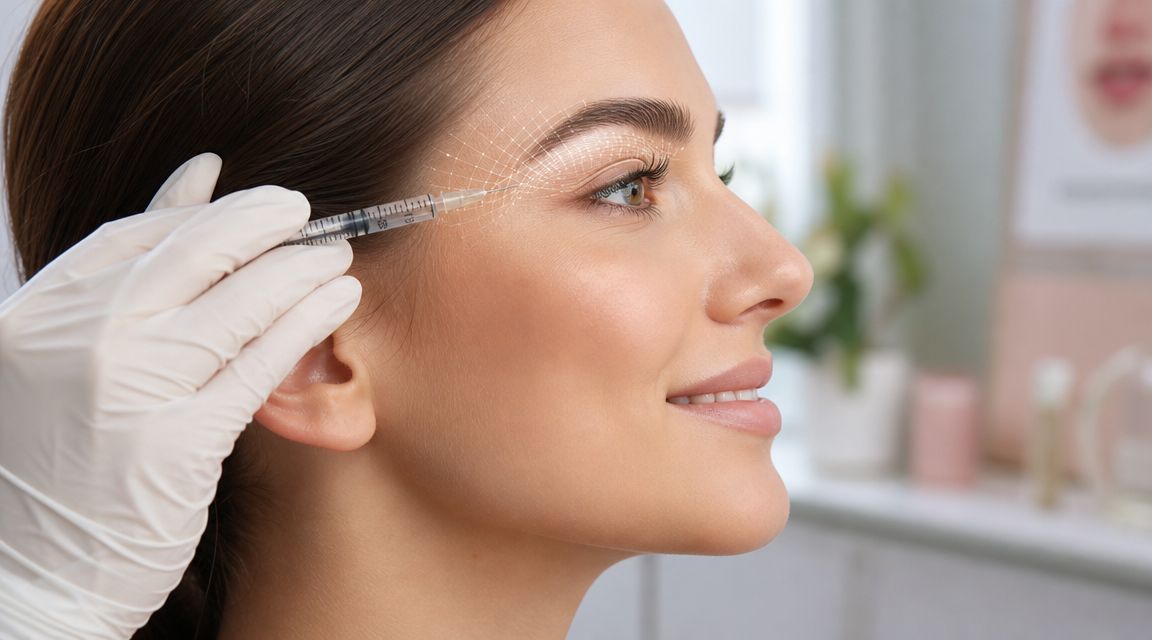
A dermal filler eyebrow lift is a non-surgical brow enhancement that uses filler to reinforce the brow-temple framework under the skin. I describe it as structural support because that is what the treatment does. It adds architectural scaffolding in selected areas so the brow has better support and a cleaner frame.

What it can do well
The best results usually come from improving shape, support, and proportion in the outer brow area. In the right patient, filler can:
- Improve the brow tail
- Add definition to the lateral brow
- Restore contour in the temple-brow transition
- Create a more open look around the eyes
Published clinical discussion on eyebrow contouring with hyaluronic acid filler describes brows as appearing fuller immediately after treatment. The same review describes filler as a useful adjunct when botulinum toxin alone does not create enough improvement in the brow tail.
That matters because this is usually a framing procedure, not a dramatic height procedure. The change often reads as a better-supported upper face rather than an obvious lift.
What it does not do
Filler does not remove skin, tighten lax tissue, or reposition the entire brow the way surgery can. It also does not raise every part of the brow evenly. The outer brow usually responds better than the inner brow, and that difference should be part of the consultation from the start.
In practice, this treatment is strongest when mild descent and volume loss are part of the problem. It is much less satisfying when the main issue is heavier tissue, significant hooding, or a request for a clear surgical-level change.
Strong candidates often include
| Candidate type | Why filler may help |
|---|---|
| Mild to moderate brow descent | Added support can improve brow shape without surgery |
| Hollowing in the temple or lateral brow | Restoring volume can improve the brow frame |
| Clients wanting subtle change | Results usually look refined rather than dramatic |
| Clients comfortable with maintenance | Filler results are temporary |
Reality check: If your goal is a major change in brow height, surgery is usually the more direct option.
Good treatment planning starts with that level of honesty. A well-done filler brow lift improves structure and balance. It does not pretend to be a surgical brow lift, and clients are happiest when the plan matches that reality.
The Science of a Non-Surgical Lift
This treatment works when the injector understands anatomy and uses filler as a structural scaffold. That phrase is more accurate than “just lifting.” The filler is placed where it can support tissue mechanics, its role being structural rather than creating puffiness.
The core technique described in the literature is deep placement along the lateral brow bone, specifically in the pre-periosteal plane, where the product can function like a firm anchor beneath the soft tissue envelope. A narrative review notes that high-G' and high-viscosity hyaluronic acid gels are preferred for this purpose because they resist deformation and spread, helping maintain support with such placement, as explained in this review of filler science and technique.
Why the brow tail responds better
The lateral brow has different support dynamics than the medial brow. When filler is placed strategically along the lateral orbital rim and temple, it can help support the soft tissue around the brow tail and encourage an upward and outward vector.
That same review specifically notes that this technique primarily improves the eyebrow tail with little effect on the medial brow. That's one of the most important expectation-setting points in the entire consultation.
If you want to understand the broader mechanics behind filler behavior in tissue, this guide on how dermal fillers work is a useful companion.
Why temple support matters
A brow doesn't exist in isolation. The temple and lateral upper face are part of the same visual frame. If the temple is hollow, the outer brow can look less supported even before true descent is severe.
A study highlighted by the American Society of Plastic Surgeons reported that injectable fillers can create measurable lifting effects beyond the exact injection site. In that research, central facial injections produced up to 1 millimeter of vertical lift in the forehead area, while lateral facial injections in the temple, midface, and jawline created local and neighboring lifting effects. A combined approach with a superficial temple injection added an additional 17.5% increase in temple lifting and a 100% increase in jawline lifting effect, according to the ASPS press summary of the filler lift study.
That doesn't mean every brow lift requires temple filler. It means the upper face behaves as a connected structure. Sometimes a more natural brow outcome comes from restoring support beside the brow, not only under it.
Technique and safety are inseparable
This area sits near critical vessels and the orbit. The literature describes careful identification of the orbital rim, deep placement, aspiration, and slow bolus injection to reduce the risk of inadvertent orbital injection. Product choice matters. Plane matters. Restraint matters.
A filler eyebrow lift should never be treated as a casual add-on. Small amounts in the right place can help. Poor placement can make the brow look heavy, puffy, or uneven.
Precision beats volume in the brow every time.
Your In-Clinic Eyebrow Lift Journey
A first appointment is usually calmer than people expect. Most of the work happens before the syringe ever touches the skin. Brow position, asymmetry, temple hollowing, eyelid heaviness, and expression patterns all need to be assessed together.

What the visit usually looks like
The procedure is typically a low-downtime, in-clinic treatment that takes about 15 to 30 minutes, may use roughly 1 to 2 syringes total depending on anatomy, and reaches its final contour after initial swelling settles at around two weeks, according to this clinical overview of dermal fillers for a brow lift.
Most visits follow a straightforward sequence:
-
Facial analysis
The provider studies brow height, arch shape, brow tail position, and whether temple hollowing is contributing to the look. -
Marking and planning
Injection points are mapped with attention to bone landmarks and symmetry. -
Comfort measures
Many practices use topical numbing and a gentle pace during treatment. -
Injection and assessment
Small placements are made, then the brow is reassessed from multiple angles before adding more.
What it feels like
Most clients describe pressure more than pain. The brow and temple aren't areas where aggressive overfilling feels good or looks good, so a thoughtful injector usually works in controlled amounts.
That also means you may not walk out looking “finished” in the dramatic sense. Early swelling can blur the final contour for a bit. Patience matters.
If you want a grounded look at expected reactions after filler, this overview of dermal filler side effects helps separate common short-term changes from warning signs that need prompt attention.
Some of the best brow filler results look understated on day one and more polished once the tissue settles.
Comparing Brow Lift Alternatives
Not every brow concern should be treated with filler. The right option depends on whether the issue is muscle pull, volume loss, tissue descent, or a combination of those factors.
Here's the practical side-by-side view.
Brow Lift Options at a Glance
| Treatment | How It Works | Best For | Longevity | Downtime |
|---|---|---|---|---|
| Dermal filler eyebrow lift | Adds structural support under the lateral brow and sometimes temple | Mild brow descent, temple hollowing, brow-tail shaping | Temporary | Minimal |
| Botox brow lift | Relaxes selected muscles that pull the brow downward | Clients whose brow position is strongly influenced by muscle activity | Temporary | Minimal |
| Thread lift | Uses dissolvable threads to create a temporary repositioning effect | Clients wanting more pull than filler but not surgery | Temporary | Usually more recovery than filler |
| Surgical brow lift | Surgically repositions tissue | More advanced descent or clients seeking a more dramatic and durable change | Long-lasting | Longer recovery |
How to decide
A filler brow lift is often the better fit when the brow looks unsupported rather than overpowered by muscle movement. Botox works differently. It changes muscle dynamics. Filler changes structure.
If your main concern is muscle pull at the brow depressors, a neuromodulator plan may be the more logical starting point. This guide on where to inject Botox for eyebrow lift explains that pathway well.
The trade-offs that matter
- Choose filler when you want contour, support, and a subtle brow-tail enhancement.
- Choose Botox when movement patterns are the main driver of the problem.
- Consider threads carefully if you want temporary repositioning but understand that the feel, recovery, and aesthetic can differ from filler.
- Consider surgery when skin excess or heavier descent is beyond what injectable support can realistically improve.
What works best isn't the most aggressive option. It's the one that matches the anatomy causing the concern.
Enhancing Your Results with Smart Aftercare
A common mistake happens after a good brow filler treatment. The area looks improved right away, then a client goes home, presses on it, sleeps hard on one side, or starts checking the symmetry every hour in the mirror. That usually creates more worry than benefit.
Aftercare matters because this treatment is building support in a high-mobility area. The filler acts like structural scaffolding under the brow and through the temple. In the first days, that support needs time to settle into the tissue without extra pressure, heat, or friction.
If you bruise easily, swell easily, or take anything that increases bleeding risk, discuss that before your appointment so your injector can guide you. Good aftercare starts with good planning.
The habits that protect your result
A practical recovery routine usually includes:
- Keep the area low-stress for the first stretch after treatment. Avoid rubbing the brow, pressing on the temple, or wearing anything that pushes on the treated area.
- Pause intense workouts briefly if your injector recommends it, especially if you tend to swell.
- Use uncomplicated skincare around the upper face while the tissue calms down. Strong exfoliants, aggressive devices, and vigorous facial massage can wait.
- Follow your provider's instructions exactly if one side looks a little different early on. Swelling often settles unevenly before the final shape becomes clearer.
The brow can look slightly different during the settling phase than it will once the tissue relaxes and the product integrates. That is normal. I tell clients not to judge the final outcome too early, especially in the first few days.

A useful at-home add-on
For clients who like supportive recovery tools, the Barb N.P. LED Facial Mask can fit into a broader skin-maintenance routine. It's a wireless mask designed for convenience and shaped for comfort on the face. It includes three lighting settings for different goals: red light for recovery-focused routines, blue light for breakout-prone skin, and amber light for rejuvenation support.
LED therapy does not replace careful injection technique, proper product placement, or follow-up with your injector. It works best as a simple add-on within an overall skin plan. For some clients, that means calmer-looking skin and a less reactive upper-face routine while the filler settles.
Treat aftercare like part of the procedure, not an afterthought.
Longevity Risks and Investment
A common scenario in consults is this: the client likes the refreshed brow at first, then starts asking how often it needs to be maintained and whether repeated filler will make the area look heavy. Those are the right questions.
An eyebrow filler lift does not suspend tissue the way surgery does. It adds structural scaffolding in carefully chosen points so the brow sits on better support. That distinction matters because longevity is not just about how long filler remains present. It is also about how long that support still looks clean, balanced, and appropriate for your facial movement.
As noted earlier, published follow-up on eyebrow contouring found that maintenance commonly happened around the one-year mark, with some patients returning sooner and others later. In practice, duration depends on product choice, metabolism, muscle activity, baseline anatomy, and how much support was built in the first place. A petite correction often fades less noticeably. An overfilled brow can last in the wrong way.
Risks to understand clearly
Short-term issues include swelling, bruising, tenderness, and temporary unevenness while the tissue settles. The more meaningful concern in this area is placement. The brow and temple contain important vessels, so injector experience is not a luxury here. It is part of risk control.
There is also a longer-view risk that clients do not always hear enough about. Filler can create puffiness if too much product is layered into a thin, mobile area or if maintenance is done before the previous result is properly assessed. Earlier published follow-up on eyebrow filler reported cases of persistent fullness. I use that as a practical reminder to stay conservative. Good brow work is often about millimeters and restraint.
What determines value
Cost reflects more than the syringe. It reflects the assessment, the injection plan, the anatomy knowledge behind product placement, and the judgment to stop before the brow looks padded instead of supported.
I do not give a generic internet price range because that number can mislead you. Some clients need a very small amount placed strategically at the lateral brow or temple to improve framing. Others are poor filler candidates and will get a better result from neuromodulator, skin tightening, or surgery. The best investment is not the cheapest appointment. It is the treatment plan that matches what filler can realistically do.
If you're considering a dermal filler eyebrow lift and want an honest plan based on your anatomy, book a consultation with BotoxBarb. The goal should be a brow that looks supported, balanced, and believable, with treatment choices that match what filler can do.