Tixel Skin Treatment: A Complete Patient Guide
You're booked, but you're still weighing whether this is the right move. Maybe the eye area is starting to look tired, maybe your texture has changed, or maybe you're done with the kind of laser recovery that turns a “quick” refresh into a week of planning around peeling and social downtime. That's exactly where Tixel skin treatment gets attention, because it sits in a narrow but useful space between aggressive resurfacing and barely-there maintenance.
What matters most is not whether Tixel sounds modern, it's whether it matches the concern in front of you. It's a thermal, contact-based device, not a laser, and that difference changes how it's used, who tends to tolerate it well, and how much recovery you should plan for. If you want a broader skin-health refresher while you think through clinic options, this clean beauty guide from Maximum Health Products is a useful companion read.
Why Patients Are Asking About Tixel
A typical consult starts with someone who has already tried a bit of everything. The under-eye area looks crepey, the skin feels rough, and they want a visible change without the recovery that comes with a more aggressive laser. They are not asking for perfection. They want a treatment that fits real life.
That is where Tixel gets attention. It sits in a practical middle space for patients who want refinement but do not want to plan their week around peeling or extended social downtime. The device also has a growing evidence base, and a 2023 review in the Journal of Aesthetic Nursing notes FDA approval in 2021 and 18 published studies at the time of publication, which helps explain why more clinics are discussing it now.
Practical rule: patients usually ask about Tixel when they want visible refinement without a long recovery period.
The other reason it comes up in consults is simpler. Patients are no longer asking only, “Should I do a laser?” They are asking which tool makes sense for a specific area and concern. That matters, because a fine line around the eye, rough texture on the cheek, and pigment irregularity do not all respond the same way. Tixel gets attention because it can be used as a middle-ground option, with modest downtime, broad skin-type use, and a heat-based mechanism that does not rely on light absorption.
If you are already sorting through skin-care options, the useful question is strategy, not hype. Tixel is often one part of a broader plan, not the whole plan. If you want a broader skin-health refresher while you think through clinic options, this clean beauty guide from Maximum Health Products is a useful companion read.
How Tixel Works
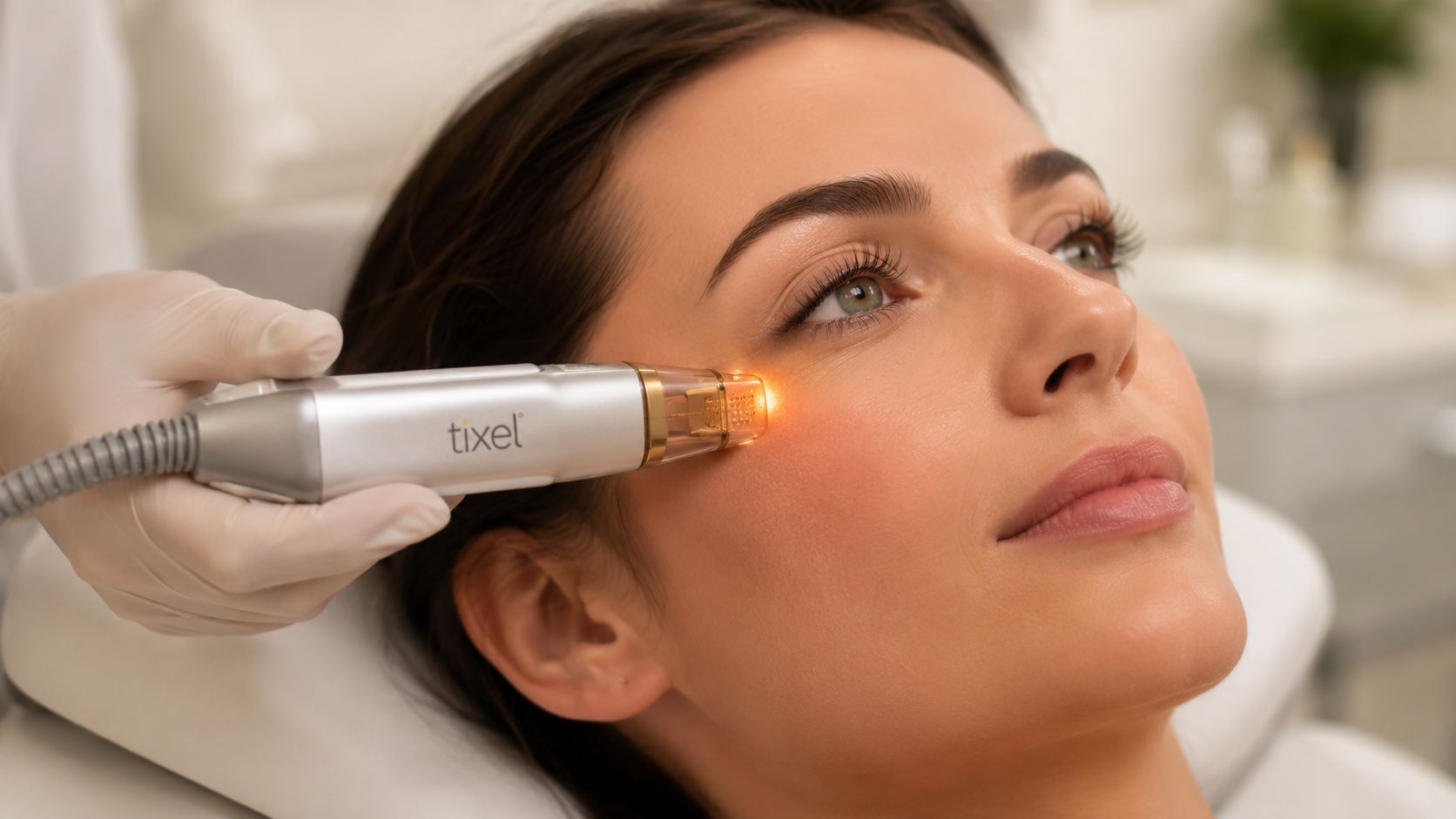
Tixel uses direct contact heat transfer from a hot titanium tip, which is a different mechanism from a laser session.
That difference matters in clinic. A laser delivers optical energy, while Tixel uses fractional thermo-mechanical energy. The handpiece presses a heated metallic tip against the skin to create controlled thermal injury without radiation. The effect depends on tip temperature, contact time, and how the practitioner moves the handpiece, so intensity is chosen intentionally, not treated as a marketing label.

The three common settings
Clinics usually talk about Glow, Intense, and Super Intense as practical intensity levels. The names are easy to remember, but what changes is how much thermal injury is delivered and how much visible recovery follows.
- Glow fits maintenance, subtle brightening, and lighter texture work. It is the setting many patients picture when they want a fresher look with less interruption to daily life.
- Intense sits in the middle for fine lines and more obvious texture irregularity.
- Super Intense is used for deeper wrinkles or more demanding scar work, where stronger treatment comes with more downtime.
If a provider cannot explain why a specific setting matches a specific concern, that is a warning sign.
The goal is controlled injury. Tiny zones of heat trigger a wound-healing response, and that is why the result is not immediate. The skin looks resurfaced because it has been, but the longer-term benefit comes from remodeling underneath. In practical terms, Tixel works like a precision thermal stamp, not a light beam and not a needle-based device.
What a Tixel Session Looks Like
Patients usually want a clear picture of the appointment before they decide whether to book. A typical visit starts with numbing cream, then the practitioner maps the treatment zone and makes passes with the handpiece across the skin. In many clinics, the full session takes about 20 to 45 minutes depending on the area treated, which is one reason it fits more easily into an office-day schedule than many resurfacing procedures.
The experience is usually described as heat, pressure, or a prickly warmth rather than sharp pain. The immediate response is usually mild redness, swelling, and a heat sensation that settles within a few hours, and many patients rate the discomfort in the low range. Patients can generally drive themselves after treatment if they are not heavily sedated, though the skin may look flushed right away.
What happens in the room
The handpiece is moved in passes across the targeted area, and the number of passes depends on the zone and the treatment goal. Under-eye work is handled differently from cheek texture or perioral lines because the skin thickness and tolerance are not the same. A good provider does not sell Tixel as a one-size-fits-all facial.
The setting should match the problem being treated, not the other way around. Glow is usually chosen for lighter texture work and maintenance, Intense is used for more noticeable lines or irregularity, and Super Intense is reserved for deeper correction where stronger treatment also means more downtime.
Right after treatment, the area usually looks red and feels warm. Some patients are surprised by how manageable the visit is, especially if they have done other procedures that left them bracing for days of recovery. Tixel is still a real resurfacing treatment, but it is usually office-based and straightforward to recover from when the plan is matched to the skin in front of you.
For patients comparing it with other scar-focused options, a practical overview of the best laser treatment for acne scars can help clarify when Tixel is the better fit and when a laser may do more.
What Tixel Treats Best and Where It Falls Short
Tixel makes the most sense when the main complaint is mild-to-moderate texture change, especially in the thinner, more delicate zones around the eyes and mouth. Periorbital wrinkles, perioral lines, enlarged pores, sun-related roughness, and some acne-related textural change are the problems it handles best. The improvement is real, but the response is uneven across indications, so expectations need to stay practical.
For wrinkle-focused treatment, the published studies are encouraging without turning Tixel into a miracle device. One prospective perioral study reported 69.6% of subjects with a 2-grade improvement at 3 months and 8.7% with a 3-grade improvement on the wrinkle scale, with no severe adverse events and minimal pain (PubMed 36946689). A comparative periorbital study found average improvement of 1.6 ± 0.6 in the Tixel group versus 1.7 ± 0.8 in the comparator group, with about 80% of subjects back to work and social activities two days after treatment (PubMed 34787919).
Where the ceiling shows up
The limits become obvious fast if a patient wants Tixel to behave like surgery or a deep ablative laser. Deep static wrinkles, severe acne scarring, and meaningful laxity usually need a stronger intervention than a thermal stamp can provide by itself. A clinical review of early studies also found that physician-rated improvement was often only mild-to-moderate, even when patients felt more satisfied, which shows that subjective improvement and objective grading do not always move together (Wiley review).
That difference matters in consults. Tixel is a reasonable choice for a fresher under-eye area, softer perioral lines, and subtle texture refinement. It is a poor first choice for etched creases, advanced acne scarring, or loose tissue that needs real tightening.
For patients weighing scar treatments, a practical starting point is this best laser treatment for acne scars guide, which helps separate the situations where Tixel fits from the ones where a laser is likely the better tool.
Realistic Downtime and Recovery Calendar
Downtime is where Tixel gets oversold online. The early recovery is usually manageable, but it isn't zero. Patient guidance describes redness, swelling, and microcrusting for 3 to 7 days, with avoidance of sun exposure, tanning, and other procedures before and after treatment, plus spacing of 4 to 8 weeks between sessions (Tixel FAQ PDF).
The most useful way to plan is by intensity. Glow often fits same-day or next-day social recovery. Intense and Super Intense are closer to a visible recovery window of roughly 5 to 7 days, especially if you're treating around the eyes or stacking multiple passes.
A practical calendar
- Hours 0 to 4: Expect heat and redness. Cool compresses and a calm schedule help.
- Days 1 to 3: Swelling and microcrusting are more noticeable, and makeup may not sit well.
- Days 4 to 7: Flaking and settling usually become the main issue.
- Weeks 2 to 12: Collagen remodeling keeps working, so the best change is delayed.
Avoid retinoids, strong exfoliants, hot yoga, and direct sun exposure while the skin is healing. This is also the window where at-home support can make sense, especially if a patient wants a structured routine instead of guessing at products.
A comfortable, wireless Barb N.P. LED Facial Mask can be a sensible add-on here because it gives you three lighting settings, a comfortable fit, and hands-free use during the remodeling phase. I like LED as a complement, not a replacement, because it supports the recovery routine without adding friction to it. For post-care pairing, the post-procedure skin care guide is a practical companion.
Tixel Compared to Lasers and Microneedling
A patient sitting in my chair usually wants the same thing, better skin without committing to the longest possible recovery. That is the lane where Tixel fits well. It sits between heavier resurfacing and gentler collagen stimulation, which makes it useful when you want meaningful change but do not want to plan your week around a laser wound.
| Modality | Mechanism | Typical Downtime | Skin-Type Range | Best Fit |
|---|---|---|---|---|
| Tixel | Direct-contact thermal energy | Short visible recovery, often days rather than weeks | Broad, with clinical support across skin types II–V | Eye-area rejuvenation, fine lines, texture, modest resurfacing |
| Fractional CO2 laser | Ablative optical energy | Longer recovery | More selective, higher pigment-risk concerns in some patients | Severe wrinkles, deeper resurfacing, stronger correction |
| Non-ablative fractional laser | Optical energy without full ablation | Moderate downtime | Broad, but still dependent on pigment risk assessment | Texture, early aging, patients wanting laser-based resurfacing |
| Traditional microneedling | Mechanical channels | Usually shorter downtime | Broad | Gradual collagen support, textural maintenance |
| RF microneedling | Needles plus radiofrequency heat | Usually shorter to moderate downtime | Broad | Tightening and texture when the goal is progressive collagen building |
Tixel often earns its place around the eyes because it gives a precise thermal response without putting optical energy on the skin surface. That matters for patients who are worried about pigment issues, or for clinicians who want a more controlled approach than a stronger laser. It also suits people who want visible refinement without signing up for the heavier recovery that comes with ablative resurfacing.
For deeper wrinkles, advanced scarring, or more aggressive resurfacing, fractional CO2 still has the stronger corrective effect. The trade-off is simple, more power usually means more downtime, more aftercare, and more room for irritation. I would not send every patient toward Tixel just because it sounds gentler, and I would not send every patient toward a laser just because it sounds more complete.
Decision rule: choose Tixel when downtime matters and the concern is mild-to-moderate, choose laser when the concern is severe, and choose microneedling or RF when you want gentler collagen-building with less visible recovery.
For patients comparing device-based acne-scar strategies, the internal micro-needling vs Fraxel comparison is a helpful next read.
Cost, Course Length, and Building a Year Around Tixel
The most honest way to think about cost is by course, not by a single visit. Tixel is usually planned as 3 to 5 sessions spaced 3 to 6 weeks apart, with maintenance around every 3 to 4 months. Visible change can keep building for 3 to 6 months after treatment, so the first appointment is only the start of the return on investment.
That course structure matters because Tixel works gradually. If a patient expects one session to carry the full result, the plan is usually mismatched from the start. I would rather be direct about that than sell a quick fix that the skin cannot realistically deliver.
A practical year plan usually combines Tixel with other tools instead of asking it to do everything. Neurotoxin can handle dynamic movement lines, light peels can address surface pigment, and home LED can support the healing window without adding procedural stress. A Journal of Aesthetic Nursing review supports that kind of paced approach, and it fits what I see in clinic. One treatment can improve texture. A broader plan is what usually holds the result.
Planning around the calendar
If you are building around events, think backward. Start the series when you can tolerate several short recovery windows, then leave space for the remodeling phase to do its work. If you need a polished look for a wedding, travel, or a heavy work season, your last higher-intensity session should sit well before that date.
Intensity matters here. A Glow session is easier to fit into a busy stretch, while Intense and Super Intense settings need more breathing room because the skin response is stronger. That is the trade-off patients need to plan for, since downtime is not just about the device name, it is about how hard you set the treatment.
A clinic can help map the timing, but the basic principle is simple. Tixel works best as part of a paced plan, not as a last-minute fix.
Who Is Tixel For
The strongest candidate is usually someone with skin types II to V, mild-to-moderate wrinkles or texture change, and a clear sense of what Tixel can and cannot do. They are comfortable with a few visible days of healing and want meaningful improvement, not a handpiece that promises a lift it cannot deliver. The least suitable patient is the one chasing dramatic tightening, brushing off downtime, or expecting scars and deep creases to vanish.
It is also the wrong choice for active flares, open lesions, or anyone who has not finished planning around recent isotretinoin use. The studies that support Tixel reported a generally tolerable side-effect profile, with no adverse effects in the actinic keratosis study and no severe adverse events in the perioral study.
For patients who want a simple at-home complement, a Barb N.P. LED Facial Mask makes sense because it is wireless, comfortable on the face, and has three lighting settings for different treatment goals. It will not replace the procedure, but it can support the remodeling window in a way that is easy to keep up with.
A CTA for BotoxBarb.