Cheek Filler Migration: Symptoms & Treatment 2026
You're probably here because you saw a video claiming cheek filler can suddenly “slide” down the face, settle in the jawline, or leave someone permanently distorted. That kind of content gets attention because it's dramatic. It doesn't help patients make calm, informed decisions.
In practice, cheek filler migration is a real complication, but it's not the viral horror story people are often shown. It's usually a localized issue, tied much more closely to injector technique, product choice, and placement than to the mere fact that filler was used at all. When patients understand that, the conversation changes from fear to problem-solving.
A lot of facial aesthetics comes down to respecting anatomy and tissue behavior. The same principle applies whether we're talking about injectable treatments or daily skin support. If you're trying to keep your skin hydrated and resilient between treatments, this overview of the benefits of hyaluronic acid serum is a useful companion read because it helps explain why hyaluronic acid remains such a central ingredient in both skincare and filler science.
Understanding Cheek Filler Migration
A patient sits down, opens her phone, and says, “I'm scared my filler is going to travel all over my face.” That concern is common now. Social media has turned a nuanced medical issue into a blanket warning, and patients often come in expecting the worst before they've even had a proper assessment.
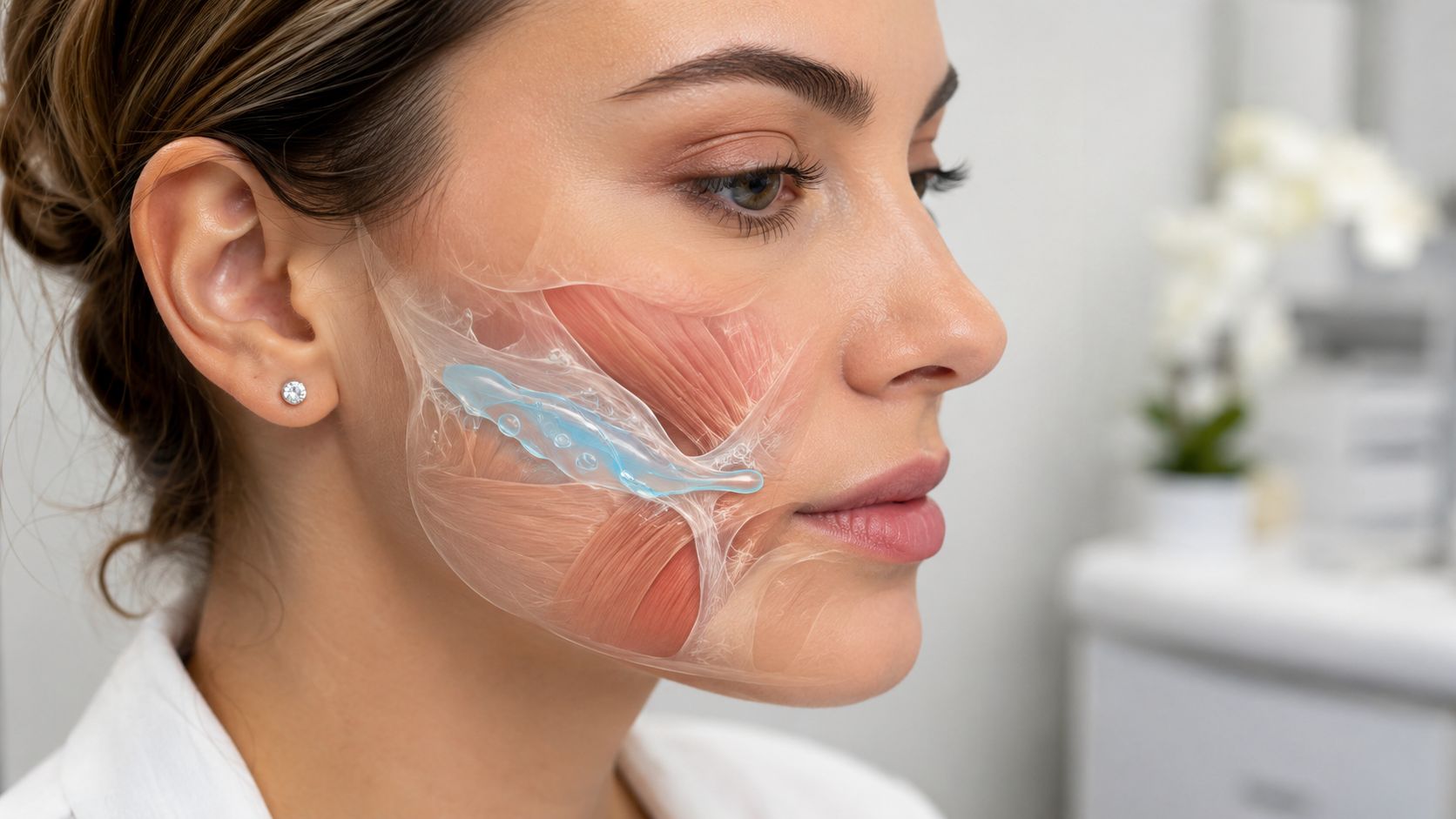
What we mean by cheek filler migration is that filler has shifted from the intended placement area into a nearby space. It doesn't mean the product has become uncontrollable or started roaming through the face. In most real cases, the issue is more specific than that. The contour looks off, fullness sits lower or higher than planned, or the midface starts to look less crisp over time.
What patients usually notice first
The pattern is often subtle at the start. Some people notice a soft mound of volume that seems to sit lower than intended near the nasolabial fold. Others notice puffiness closer to the under-eye area after cheek augmentation. The change usually develops gradually over months, not all at once, according to clinical guidance summarized by APT Injection Training's review of cheek filler migration in practice.
That timeline matters. Immediate swelling after treatment is expected. Migration is a different conversation.
Clinical perspective: A result that looks slightly “off” after the first appointment doesn't automatically mean migration. Early swelling, product integration, and lighting can all change how the cheeks look in the first days and weeks.
Why the topic gets distorted online
Online content often lumps together several completely different issues under one label. Swelling gets called migration. Overfilling gets called migration. Normal asymmetry gets called migration. That's why patients end up more alarmed than informed.
The most useful way to frame this complication is simple. It's uncommon, it's usually local, and it's often preventable with proper technique. If it does happen, there are established ways to assess it and manage it safely. That's a very different message from “filler always moves.”
Filler Migration The Reality vs The Myths
The biggest myth is also the one that scares patients most. People are told cheek filler can drift down into the jowls or travel across the face like it has no anatomical boundaries. That's not how clinicians describe it.
Clinical experts have stated that migration is almost exclusively local, typically moving upward toward the under-eye area rather than descending to the jawline, and that this movement is often a 1 to 3 mm local displacement caused by incorrect injection planes or muscle movement, not a product “traveling” to the chin, as discussed in this expert video explanation on filler migration myths.

What true migration looks like
True migration is better understood as local displacement. The filler moves a short distance into an adjacent tissue space. That can change the contour, blur a transition, or create puffiness where you didn't want it.
This is why anatomy matters so much in cheek work. The midface isn't one empty pocket. It contains distinct fat compartments and structural boundaries. If filler is placed in the wrong plane, or too much volume is placed into tissue that can't comfortably accommodate it, the product may settle next door instead of staying where it lifts best.
What gets mislabeled as migration
A lot of patients show me photos from the first week after treatment and worry they've already had migration. Most of the time, what they're seeing is one of the following:
- Post-treatment swelling that hasn't settled yet
- Bruising that changes facial shadowing
- Overfilling that makes the cheeks look heavy without actual product displacement
- Inflammatory puffiness that has more to do with healing than movement
Those aren't the same problem, and they shouldn't be managed the same way.
The phrase “my filler migrated everywhere” usually describes fear, not anatomy.
If you want a broader look at how this topic gets oversimplified, this article on whether fillers migrate is a helpful starting point. Patients do better when they understand the difference between a dramatic online claim and a localized clinical finding.
The practical takeaway
Filler migration is less dramatic and more manageable than the myths suggest. Cheek filler doesn't usually head for unrelated areas of the face. When migration happens, it tends to stay close to the original treatment zone. That makes diagnosis more precise and correction more straightforward.
Why and How Cheek Fillers Can Shift
Cheek filler doesn't move for no reason. There's physics behind it. Tissue can only accommodate so much volume in a given layer, and if pressure builds in the wrong place, the gel follows the path of least resistance.
That's why overfilling and poor plane selection are such common setup errors. You can think of the cheek like a structural support zone. If you use the wrong material or place it in the wrong layer, you don't get elegant lift. You get instability.

The role of pressure and facial movement
Cheek filler migration is mechanically driven by pressure gradients forcing the gel along paths of least resistance. Guidance also notes that choosing a high G-prime filler is important for the cheeks because it better resists displacement from muscle activity and gravity when positioned within specific tissue layers, as outlined in this discussion of filler migration causes and prevention.
A simple way to understand G-prime is to think of it as the filler's ability to hold shape under stress. In the cheeks, support matters. A softer product that works beautifully in a different area may not be the right tool for building lift over the zygoma.
The wrong plane creates the wrong result
Deep placement is often what gives cheek filler stability and clean structure. If product sits too superficially, it can look puffy, irregular, or mobile. If too much volume is placed in one sitting, tissue pressure rises and the chance of displacement goes up.
Here's what tends to work better in real practice:
- Appropriate product selection for the treatment goal, especially a filler designed for structural support
- Deep, controlled placement in the correct anatomical plane
- Gradual volume building instead of trying to force a dramatic change in one visit
- Respect for facial compartments so the injector supports natural boundaries instead of crossing them
Why injector skill matters most
Patients often ask whether migration means the filler itself “failed.” Usually, that's the wrong question. Product quality matters, but technique determines whether the filler is likely to stay where it belongs.
Practical rule: The best prevention isn't chasing a miracle product. It's pairing the right product with the right depth, the right vector, and the right amount.
That's also why cheek injections aren't beginner work. Midface anatomy rewards precision and exposes shortcuts.
Symptoms of Filler Migration and Key Risk Factors
A common scenario in clinic is this: a patient likes her initial cheek result, then a month later notices puffiness closer to the under-eye or a small area of fullness that does not match where support was supposed to sit. That can feel alarming, especially after seeing dramatic social media posts about filler “moving everywhere.” In practice, true cheek filler migration is usually a localized issue, and reports in the literature describe it as uncommon rather than expected. A review in the Aesthetic Surgery Journal Open Forum discusses delayed and displaced hyaluronic acid filler as a recognized but relatively infrequent complication that requires careful assessment, not panic: Migration of Hyaluronic Acid Fillers.
Normal healing vs a persistent change
Early swelling can mimic a problem. Cheeks often look a little uneven at first, and nearby areas can hold fluid during the first couple of weeks.
What matters is what remains after healing.
| Symptom | Normal Healing (First 1-2 weeks) | Potential Migration Sign (After 4+ weeks) |
|---|---|---|
| Swelling | Fluctuates and gradually improves | Fullness stays in place or becomes more obvious |
| Tenderness | Mild soreness at injection sites | Firmness in a nearby area that was not meant to be volumized |
| Under-eye puffiness | Can happen early, then fades | Ongoing puffiness below the treated cheek after swelling should have resolved |
| Cheek contour | May look temporarily uneven | Volume appears to sit off the cheekbone or lower than intended |
| Symmetry | Minor asymmetry can improve as tissues settle | Asymmetry persists or becomes easier to see over time |
Signs worth evaluating
During an assessment, I look for a pattern, not a single imperfect day in the mirror. Migration is more suspicious when the change is persistent, sits in an adjacent compartment, and does not fit the original treatment plan.
Signs that deserve a professional review include:
- A mound of volume lower than intended, often closer to the nasolabial area than the cheekbone
- Lingering under-eye or upper cheek puffiness weeks after treatment
- Fullness in a nearby area that was not injected for volume
- A gradually distorted contour instead of a contour that softens as swelling resolves
Some patients also describe the area as looking heavy in certain lighting or in photos before they notice it in person. That history can be useful.
Who is at higher risk
The pattern is usually technical. Risk goes up with overfilling, poor product selection, placement in the wrong plane, or treatment by someone without a strong working knowledge of midface anatomy. Repeated “touch-ups” before the first treatment has fully settled can also cloud the picture and create more bulk than the tissue can handle gracefully.
This is why I do not frame migration as proof that filler is bad in itself or that the product somehow failed on its own. In the cheeks, injector judgment matters more than internet myths suggest. The product, depth, volume, and vector all have to match the patient's anatomy.
If a patient is concerned that a contour change may represent displaced hyaluronic acid filler, an in-person exam is the right next step. For patients who want to understand the correction option ahead of time, this page on hyaluronidase treatment for unwanted or misplaced filler explains how reversal is approached in medical practice.
For patients comparing risks across aesthetic and wellness treatments, careful supervision matters in every setting. This guide for medically supervised weight loss shows the same principle clearly. Better screening, better follow-up, and better technique usually lead to better outcomes.
Safe and Effective Treatment Options for Migration
The reassuring part of this conversation is that most concern around migrated hyaluronic acid filler doesn't lead to a dead end. There is a well-established correction tool, and that matters.
The key safety feature is reversibility. Misplaced hyaluronic acid filler can be dissolved with hyaluronidase, an injectable enzyme that breaks down the filler, offering a safety net that permanent, non-biodegradable substances don't provide, as explained in this overview of filler migration treatment with hyaluronidase.

What treatment usually involves
When migration is significant enough to affect contour, the safest approach is often to dissolve first and rebuild later if needed. That process is more controlled than many patients expect.
A typical plan includes:
- Assessment of the contour and confirmation that the issue is migrated HA filler
- Targeted hyaluronidase placement into the affected area
- A waiting period so the tissue can settle and the true baseline becomes visible
- Reassessment, then conservative retreatment only if it still makes sense
The number of treatment sessions depends on the type of filler, how much product is present, and how long it has been in place. Mild cases may sometimes be monitored or managed conservatively, but persistent or obvious migration is not something to chase with more filler on top.
Why “covering it up” often fails
Patients sometimes ask whether a little extra filler can smooth out the problem. In my opinion, that's one of the easiest ways to make a poor contour worse. If filler is already in the wrong place, layering more product over it can blur facial structure even further.
Correction works best when you reset the anatomy first, then rebuild with a better plan.
If you're not familiar with this treatment option, the Hylenex hyaluronidase page gives a useful patient-facing overview of how enzymatic dissolution is used in practice.
How to Prevent Migration and Enhance Your Results
The most effective prevention strategy is simple. Choose an injector who understands facial anatomy, uses appropriate hyaluronic acid fillers, and builds volume conservatively instead of chasing an oversized result in one visit.
That matters more than any trend, hack, or aftercare myth. Clinical guidance links migration risk more strongly to poor placement technique, overfilling, and underqualified injectors than to the procedure itself. Good cheek work is planned, layered, and anatomically disciplined.
Prevention starts before the syringe
Patients often focus on the brand of filler. I care just as much about the treatment plan.
What lowers risk in real life:
- Conservative correction rather than overcorrection
- Deep placement in the appropriate plane
- Use of an FDA-approved hyaluronic acid filler designed for support
- Staged treatment when more volume is needed, instead of forcing the endpoint in one session
There's also technique nuance that patients don't always see. Injection direction matters. Clinical discussion has noted that needle vector affects distribution, and a 45-degree angled vector has shown significantly reduced migration rates in comparative study discussion reported by the same treatment source already cited earlier in this article. That kind of detail is why experience matters.
Aftercare supports the result
Good aftercare won't rescue poor technique, but it does help protect a well-done treatment while tissues settle. If you want a concise set of practical reminders, Ultra Smile DentalSpa's filler care instructions are a helpful reference for the basics patients often forget once they leave the office.
For a fuller overview specific to injectable recovery, this guide on dermal filler aftercare is worth bookmarking before treatment day.

Supporting skin quality after treatment
Skin quality changes how filler sits, reflects light, and ages over time. One supportive tool I like discussing for overall skin recovery and maintenance is an LED Facial Mask, especially for patients who already invest in in-office aesthetic care.
The Barb N.P. Facial Mask stands out as a practical at-home device because it's wireless, comfortable to wear on the face, and offers 3 lighting settings for different treatment goals. Patients often like this format because it feels easy to use consistently. It supports a recovery routine without adding pressure or friction to recently treated areas when used appropriately in the broader healing window.
Your Cheek Filler Questions Answered
A common consult goes like this. A patient points to the outer cheek or temple area and asks whether filler can suddenly "spread" years later after seeing dramatic before-and-after clips online.
Usually, what I evaluate is much less dramatic and much more specific. Cheek filler concerns tend to be localized. They are often related to layering over time, placement depth, facial changes with aging, or volume that no longer matches the rest of the face. That is very different from filler randomly traveling all over the face.
Can migration happen years later
It can show up later, but late changes do not always mean new migration.
In practice, delayed fullness can reflect product that was placed too superficially, product that was repeatedly added to the same area, or natural tissue changes that make older filler more visible. Weight change, skin thinning, and loss of ligament support can all change how the cheeks look from year to year. Patients usually notice this as widening, puffiness, or a shape that feels less crisp than it used to.
That is why the timeline matters. I want to know what was injected, how often, in which areas, and whether the change appeared gradually or after a specific appointment.
Does cheek filler move in predictable patterns
Yes, and that point is reassuring.
Cheek filler follows anatomy. It does not behave like a free-floating liquid looking for somewhere to go. If product shifts, it usually does so within nearby tissue planes or in areas connected by the way the face is structured. For patients, that means an experienced injector can often tell the difference between too much volume, poor placement, swelling, and true migration based on where the fullness sits and how it feels on exam.
That distinction matters because the treatment plan changes. Some patients need time and observation. Some do well with targeted dissolving. Some need no more filler in that region.
If a cheek looks wider or heavier after filler, I start with anatomy, prior injection history, and exam findings. That approach usually gives a clear explanation.
Cheek filler remains a useful treatment in the right patient. Safety depends heavily on assessment, conservative dosing, and precise placement. When migration does happen, it is usually rare, localized, and manageable. In my view, that speaks more to injector technique and planning than to filler being a bad treatment overall.
If you're considering cheek filler, worried about migration, or want help correcting a result that doesn't look right, BotoxBarb offers medical aesthetic care and curated treatment support with the kind of measured, anatomy-first approach patients need. You can explore services, skincare, wellness essentials, and tools like the Barb N.P. Facial Mask in one place.