Best Skin Care Moisturizer Guide: Expert Tips & Types
You're probably here because the moisturizer step has become oddly complicated. One product says “barrier repair,” another says “oil-free hydration,” another promises glow, firmness, calm, and pore refinement in one jar. Then you add injectables, retinoids, sunscreen, maybe LED therapy, and suddenly a basic cream feels like a clinical decision.
That's the right way to think about it.
A well-chosen skin care moisturizer doesn't just make skin feel softer for a few hours. It helps your barrier stay intact, lowers the chance that active products will tip your skin into irritation, and supports the polished, even look people want after spending money on Botox, filler, PRP, peels, and light-based treatments. If your moisturizer is wrong, everything layered around it tends to work harder and feel worse.
Why Your Moisturizer Is the Hardest Working Product in Your Routine
Moisturizer is often underestimated because it seems simple. Cleanser feels active. Retinoids feel active. Vitamin C feels active. Moisturizer gets treated like the boring middle child of the routine.
Clinically, that's backwards.
Moisturizers are one of the most foundational products in routine skin care because they support hydration, barrier repair, and comfort. A peer-reviewed review notes that they increase water content in the stratum corneum, smooth the skin surface, and improve softness, extensibility, and pliability. That same review found the moisturizing effect is usually strongest within 30 minutes to 1 hour after application and typically lasts about 4 hours in many cases, which helps explain why consistent application matters more than occasional use (peer-reviewed review on moisturizers and skin hydration).
If you've invested in in-office treatments, this matters even more. Skin that's tight, flaky, reactive, or stripped doesn't reflect light well. It doesn't tolerate actives well. It often looks rougher than it needs to, even when the treatment itself was done beautifully.
What moisturizer is really doing for you
A good moisturizer supports three things at once:
- Comfort: It reduces that dry, stretched, overworked feeling that often shows up after exfoliants, retinoids, acne treatments, and procedures.
- Function: It helps the outer layer of skin hold water and behave more normally.
- Cosmetic finish: It makes skin look smoother, calmer, and more even under makeup and in natural light.
Moisturizer isn't an optional extra after aesthetic treatments. It's part of how you protect the result.
A patient may tell me, “My Botox looks great, but my skin still looks tired.” Often the issue isn't the injectable. It's dehydration, a disrupted barrier, or the wrong texture sitting on the skin.
What works better than trend shopping
Choose based on barrier need first, not packaging language.
If your skin feels chronically dry, rough, or stingy, you need a formula with more cushion and more staying power. If you prefer richer textures and are exploring traditional balm-style options, this grass-fed vanilla tallow cream is one example of a heavier barrier-support style product that may appeal to people who do well with more occlusive moisture.
That doesn't mean everyone should use a thick cream. It means moisturizer has a job. Your job is to match the product to the skin you have right now, not the skin you wish you had.
The Science of Skin Hydration Explained
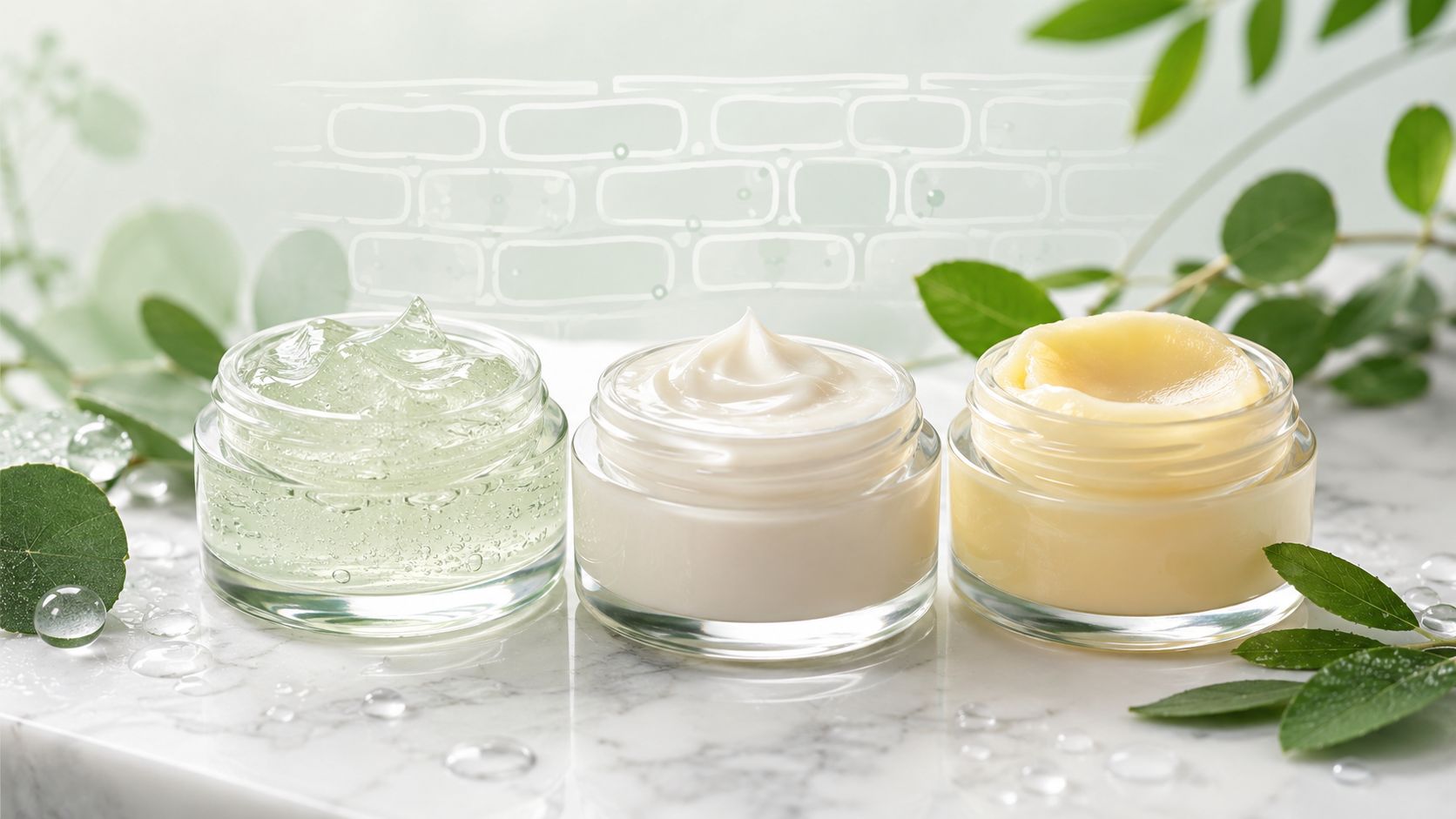
Think of your skin barrier like a brick wall. The skin cells are the bricks. The lipids between them are the mortar. Water needs to stay inside that structure for skin to look smooth and feel comfortable. When the wall is disrupted, water escapes more easily, skin gets reactive, and everything from redness to flaking becomes harder to control.
That's why moisturizer selection shouldn't start with whether a product feels expensive or “clean.” It should start with what part of the wall needs help.

A clinical review in JAMA Dermatology describes three major functional groups in moisturizers. Humectants draw water into the stratum corneum, emollients fill intercellular gaps and improve smoothness, and occlusives slow transepidermal water loss. These mechanisms improve barrier function and reduce water loss, which is why formula choice should match skin phenotype and environment rather than texture alone (clinical review of moisturizer mechanisms and barrier function).
The three parts that matter
Humectants bring water in
Humectants act like moisture magnets. They help pull water into the upper layers of skin. This is useful when skin feels dull, tight, or dehydrated even though it may not be dry.
Common humectant-style ingredients include glycerin and hyaluronic acid. These can make skin feel fresher and look plumper, but humectants alone often aren't enough for a compromised barrier.
Emollients smooth the surface
Emollients make the skin feel softer because they fill in rough spaces between cells. They improve slip, reduce the sandpapery feel of dry patches, and create a more refined finish on the skin.
This is the category that often makes a moisturizer feel elegant instead of just wet.
Occlusives hold the water in
Occlusives reduce water loss by putting a more protective seal over the surface. They're especially useful in cold weather, dry indoor air, after procedures, or anytime the barrier is struggling.
Too much occlusion for the wrong skin type can feel greasy. Too little for dry, inflamed skin can leave a patient wondering why the moisturizer “disappears” in an hour.
Why texture can mislead you
Patients often shop by texture alone. Gel means oily skin. Thick cream means dry skin. That's directionally helpful, but it's incomplete.
A lightweight product can still be well-balanced if it combines water-binding ingredients with enough barrier support. A rich cream can still fail if it seals the skin without giving it enough internal hydration. That's why I prefer people learn the functional categories rather than memorize product marketing.
If you're trying to sort out whether your skin is dry, dehydrated, or both, BotoxBarb's guide on how to treat dehydrated skin is a useful companion read. For a broader ingredient-focused perspective, I also like seeing how brands explain hydration from different angles, such as Matevara's approach to skin hydration.
Practical rule: If your skin feels dry after moisturizing, the formula is often too light. If your skin feels coated but still tight underneath, you may have enough occlusion but not enough true hydration.
How to Choose a Moisturizer for Your Skin Type
The right moisturizer should feel almost uneventful. Your skin stays comfortable, your makeup sits better, your actives sting less, and you stop thinking about your face by noon. The wrong one announces itself all day.
Dermatology guidance recommends lightweight, non-comedogenic moisturizers for oily skin and richer creams for dry skin. Labels such as “oil-free” or “oil control” can be useful technical signals for oily skin because they often indicate lower-residue vehicles that reduce shine without overly occluding pores (practical dermatology guidance on matching moisturizer to skin type).

Dry skin
Dry skin usually needs more than a thin lotion. It loses water easily and often lacks enough lipid support, so the formula has to do two jobs: add hydration and slow further loss.
Look for:
- Richer cream textures that stay present on the skin
- Humectants plus emollients instead of one or the other
- More barrier-focused formulas during winter, travel, or after procedures
People with dry or mature skin often do better when they stop chasing “lightweight” and start asking whether the product lasts through the day. BotoxBarb's article on best moisturizers for dry mature skin gives more targeted guidance if that's your lane.
Oily skin
Oily skin still needs moisture. It just needs it in a vehicle that doesn't sit heavily or leave residue.
A good skin care moisturizer for oily skin often has a gel-cream or fluid texture. It should absorb cleanly, reduce the urge to over-cleanse, and help you tolerate active products without making the face feel slick.
What tends to help:
- Oil-free or oil-control labeling
- Non-comedogenic texture
- Lightweight hydration that doesn't leave a waxy film
What usually fails:
- Heavy balms used all over the face
- Layering multiple rich creams because the skin “felt dry” after harsh cleansing
- Assuming shine means hydration
Combination skin
Combination skin usually needs strategy more than a single perfect product. The T-zone may want less residue, while the cheeks may need more cushion.
A few ways to manage it well:
- Use one balanced lotion overall if your skin isn't extreme in either direction.
- Apply less on oily zones and more on dry zones rather than using the same amount everywhere.
- Change textures seasonally if your face behaves differently in summer and winter.
Sensitive skin
Sensitive skin requires restraint. The goal isn't to use the most advanced formula. It's to use one your skin will tolerate repeatedly.
Sensitive skin does best when the routine gets quieter, not busier.
Prioritize:
- Fragrance-free formulas
- Lower irritant load
- Simple, barrier-supportive textures
- Consistency over experimentation
If a moisturizer burns every time you apply it, don't talk yourself into believing it's “working.”
Acne-prone skin
This group gets the most bad advice. Acne-prone patients are often told to keep everything drying, mattifying, and minimal. Then they start a retinoid or benzoyl peroxide, their barrier becomes irritated, and breakouts coexist with peeling.
The better target is balance.
| Skin type | Texture that usually works | Main goal |
|---|---|---|
| Dry | Cream or balm-cream | Retain water and reduce tightness |
| Oily | Gel or light lotion | Hydrate without heavy residue |
| Combination | Light lotion or zoned application | Balance different areas |
| Sensitive | Fragrance-free cream or lotion | Lower irritancy risk |
| Acne-prone | Non-comedogenic lotion or gel-cream | Support barrier without cloggy feel |
The best moisturizer is the one your skin accepts twice a day without protest.
Decoding Key Ingredients for Clinical Results
Most patients don't need a chemistry lesson. They need to know which ingredients change how skin behaves and which ones are mostly marketing decoration. When I evaluate a moisturizer, I'm looking at whether the formula helps with barrier strength, water handling, irritation control, and cosmetic finish.
That's also why ingredient labels matter more after aesthetic treatments. Once skin has been challenged by retinoids, exfoliants, acne care, or procedures, the difference between a supportive formula and a flashy one becomes obvious fast.

Ceramides
Ceramides matter because they're closely tied to barrier integrity. When skin is dry, sensitive, over-exfoliated, or post-procedure, ceramide-focused moisturizers often make more sense than formulas built mainly around surface feel.
Think of ceramides as part of the structural support system. They're especially useful when skin feels fragile, reactive, or unable to hold onto hydration.
Choose ceramides when:
- your face stings after washing
- retinoids are making you flaky
- cold weather leaves your cheeks rough
- you're trying to calm down post-treatment dryness
Hyaluronic acid
Hyaluronic acid is popular for good reason, but it's often misunderstood. It's a hydration-support ingredient, not a complete moisturizer by itself.
It can help the skin look smoother and feel more comfortable, especially in lighter textures and layered routines. But if the rest of the formula doesn't provide enough emollient or occlusive support, some people describe the result as “plump for an hour, then dry again.”
That doesn't make it ineffective. It just means context matters.
Niacinamide
Niacinamide is one of the most versatile ingredients to see in a moisturizer because it can fit into oily, sensitive, acne-prone, and aging-focused routines. In practice, I like it for patients who want a moisturizer to do more than soften.
It often makes sense when you're trying to support a routine that includes:
- Retinoids
- Pigment management products
- Post-breakout skin care
- Redness-prone skin
A moisturizer with niacinamide can be a smart bridge product. It hydrates while helping the rest of the routine feel more tolerable.
Peptides
Peptides are useful when someone wants a moisturizer to support firmness-focused goals, especially in a routine built around injectables and collagen-supportive care. They won't replace procedures, but they can complement them.
I tend to think of peptide moisturizers as maintenance products. They fit best when skin is already reasonably balanced and you're trying to support texture and aging concerns without increasing irritation.
Clinical lens: If your skin barrier is struggling, choose repair first and specialty actives second. A peptide cream won't outperform a barrier-supportive cream on irritated skin.
Glycerin and similar workhorse hydrators
Glycerin doesn't always get the glamour of newer ingredients, but it's one of the most dependable signs that a formula is built to hydrate effectively. Some of the best moisturizers are not the most exciting on the front label. They're the ones with a practical ingredient architecture that performs consistently.
Body-care brands sometimes offer useful perspective too. Looking at Fillaree's approach to body care can be a reminder that texture, tolerance, and daily usability matter just as much as trend ingredients.
SPF in a morning moisturizer
A daytime moisturizer has one job that a night cream does not. It needs to fit under sunscreen or include sun protection in a way you'll wear. If your skin care moisturizer pills under SPF, feels greasy, or stings around the eyes, your routine usually falls apart by week two.
Morning questions to ask:
- Does it layer well under sunscreen?
- Does it keep makeup from separating?
- Does it leave skin comfortable, not shiny or tight?
For anti-aging, pigment control, and protecting treatment results, your moisturizer needs to cooperate with sun protection. If it doesn't, it's not doing enough practical work.
Advanced Layering to Maximize Your Results
A moisturizer becomes more valuable as your routine gets more advanced. If you use vitamin C, retinoids, growth factor products, exfoliating pads, acne medication, or undergo in-office treatments, moisturizer stops being a finishing touch and becomes the product that keeps the whole plan sustainable.
That's especially true for patients trying to preserve a smooth, polished result after injectables or energy-based treatments. Well-hydrated skin looks better. It reflects light more evenly, tolerates actives more gracefully, and tends to recover with less drama.

Layering with active skin care
If you're using treatment products, order matters. In general, thinner products go first, moisturizer follows, and sunscreen finishes the morning routine.
A simple pattern works well for many people:
- Morning: cleanse, antioxidant serum, moisturizer, sunscreen
- Night: cleanse, treatment serum or retinoid, moisturizer
For people with easily irritated skin, moisturizer can also act as a buffer. That may mean applying a light layer before a retinoid, or using moisturizer immediately after to reduce the chance of peeling and sting. If you're still sorting out how these two categories differ, BotoxBarb's explanation of the difference between serum and moisturizer is worth reading.
Post-treatment support
After aesthetic procedures, I usually want skin care to get simpler, not more ambitious. Skin often benefits from calm, bland, barrier-focused hydration rather than aggressive exfoliation or too many “corrective” steps.
Products in the medical-grade category that emphasize lipid support or barrier repair are often useful here. Epicutis Lipid Serum is one example people often consider when the goal is to soothe and support stressed skin after treatment. SkinCeuticals Triple Lipid Restore 2:4:2 is another product many patients recognize for a richer barrier-focused approach.
The key is matching the texture to the moment. Right after a procedure or during visible dryness, richer support may be appropriate. Once the skin is stable, you can move back to your regular texture.
Using LED therapy with hydration
LED can fit well into a routine built around recovery and maintenance, especially when skin is being asked to do a lot. The practical advantage is not that LED replaces moisturizer. It's that calmer, better-supported skin usually handles light-based care more comfortably.
One option in this category is the Barb N.P. LED Facial Mask, which is a wireless mask designed for at-home use with a comfortable face fit and 3 lighting settings for different treatment goals. In a real routine, that kind of device is easiest to use when you keep the surrounding skin care simple.
A practical sequence looks like this:
- Start with clean skin
- Apply a hydrating serum if your skin tolerates it well
- Use the LED mask
- Finish with moisturizer to seal in comfort
Redness-prone or treatment-dry skin often does better with this restrained approach than with a long stack of exfoliants and actives around the session.
After procedures and LED sessions, the goal is support. Skin usually rewards calm routines more than crowded ones.
Common Moisturizer Mistakes and How to Fix Them
The biggest moisturizer mistakes aren't usually dramatic. They're small habits repeated every day. Patients often think the product failed when the underlying problem is timing, texture mismatch, or expecting a moisturizer to do a treatment product's job.
A common concern is acne. A peer-reviewed review notes that moisturizers are an important adjunct in inflammatory skin diseases because they suppress water loss and restore barrier function, which matters when acne treatments such as retinoids cause dryness and peeling. In acne-prone skin, the better choice is often a moisturizer with a balanced mix of humectants and emollients and a low fragrance or allergen load rather than the richest cream on the shelf (peer-reviewed review on moisturizers in inflammatory skin disease and acne-related barrier support).
Five mistakes I see all the time
- Applying it to completely dry skin: Slightly damp skin usually gives a moisturizer a better start. You don't need dripping-wet skin, just not bone dry.
- Using the wrong weight: Heavy cream on oily skin can feel suffocating. A watery gel on severely dry skin may vanish too quickly.
- Using too much product: More product doesn't always mean more hydration. It often means pilling, congestion, or a greasy finish.
- Ignoring the neck and chest: These areas often show dryness and treatment neglect quickly.
- Skipping moisturizer because you're oily: Oil and hydration are not the same thing. Oily skin can still have a disrupted barrier.
Better corrections
If your moisturizer pills, reduce the amount and simplify what's underneath it.
If you're shiny by midmorning, choose a lighter vehicle rather than abandoning moisturizer altogether.
If your face feels tight despite moisturizing, step up the richness or add a more barrier-supportive night formula.
Oily and acne-prone skin still needs moisture. It just needs the right kind of moisture.
Nighttime is another place people get lazy with choices. A daytime moisturizer designed mainly to sit under sunscreen isn't always the one that gives enough recovery support overnight. Your skin at night often needs comfort and barrier help, not just a light daytime finish.
Building Your Professional Moisturizer Plan
The right moisturizer is not a luxury extra. It's part of the treatment plan for healthy-looking skin, better tolerance of active products, and better maintenance of aesthetic results.
That's also why moisturizers remain such a central category in skin care. Fortune Business Insights estimates the global moisturizer market was valued at USD 11.47 billion in 2025 and projects it will reach USD 19.01 billion by 2034. The same source notes that face creams and moisturizers accounted for 41.9% of total skincare market revenue in 2025, which underscores how central they are in daily routines (Fortune Business Insights moisturizer market outlook).
A simple decision framework
Use these three filters:
- Skin type: dry, oily, combination, sensitive, or acne-prone
- Barrier status: normal, irritated, post-treatment, over-exfoliated
- Routine role: daytime layering, nighttime repair, or treatment recovery
If you want one practical product example, SkinCeuticals Triple Lipid Restore 2:4:2 is a reasonable option for people who need a richer barrier-repair moisturizer, especially in mature or treatment-dry skin. It won't be right for every face, but it fits the patient who needs comfort, lipids, and a more substantial finish.
The goal isn't to own more moisturizers. It's to own the right one for the season your skin is in.
If you want help choosing a skin care moisturizer that fits your skin type, treatment history, and daily routine, browse the curated options at BotoxBarb or use the site to book a personalized consultation. A focused routine usually performs better than a crowded one, especially when every product has a clear job.